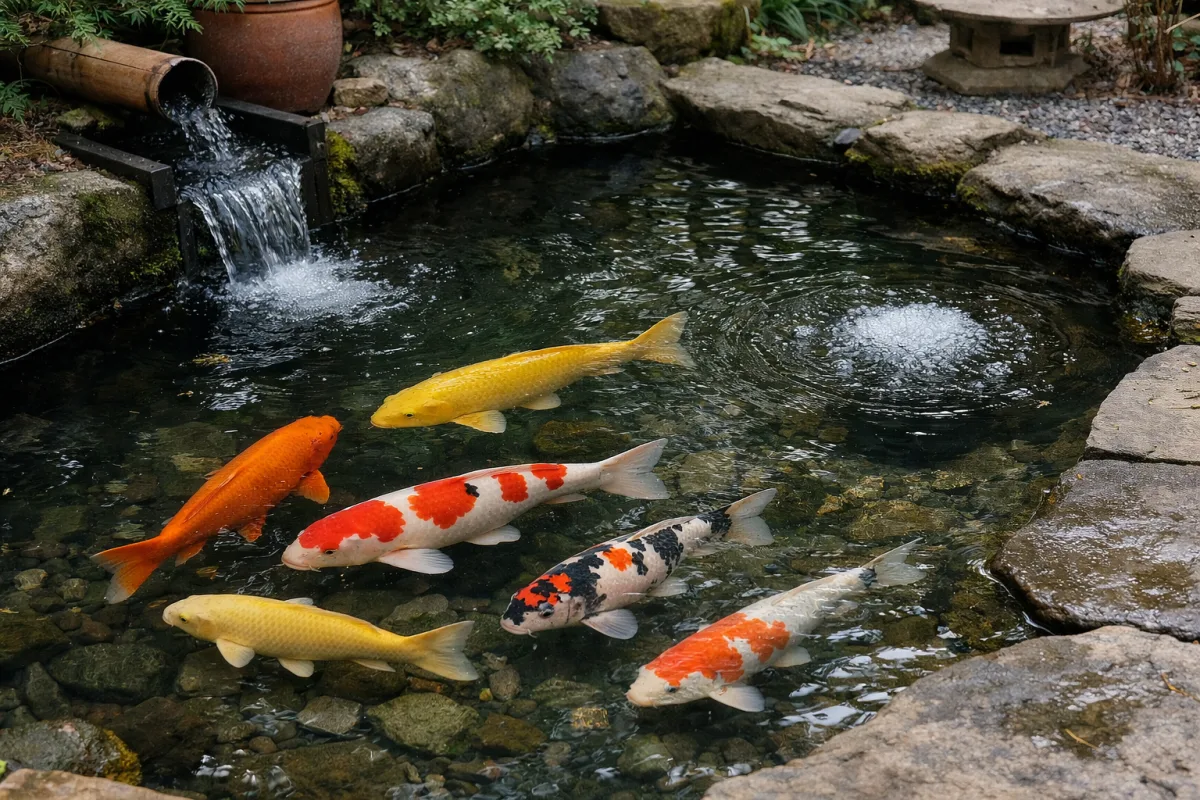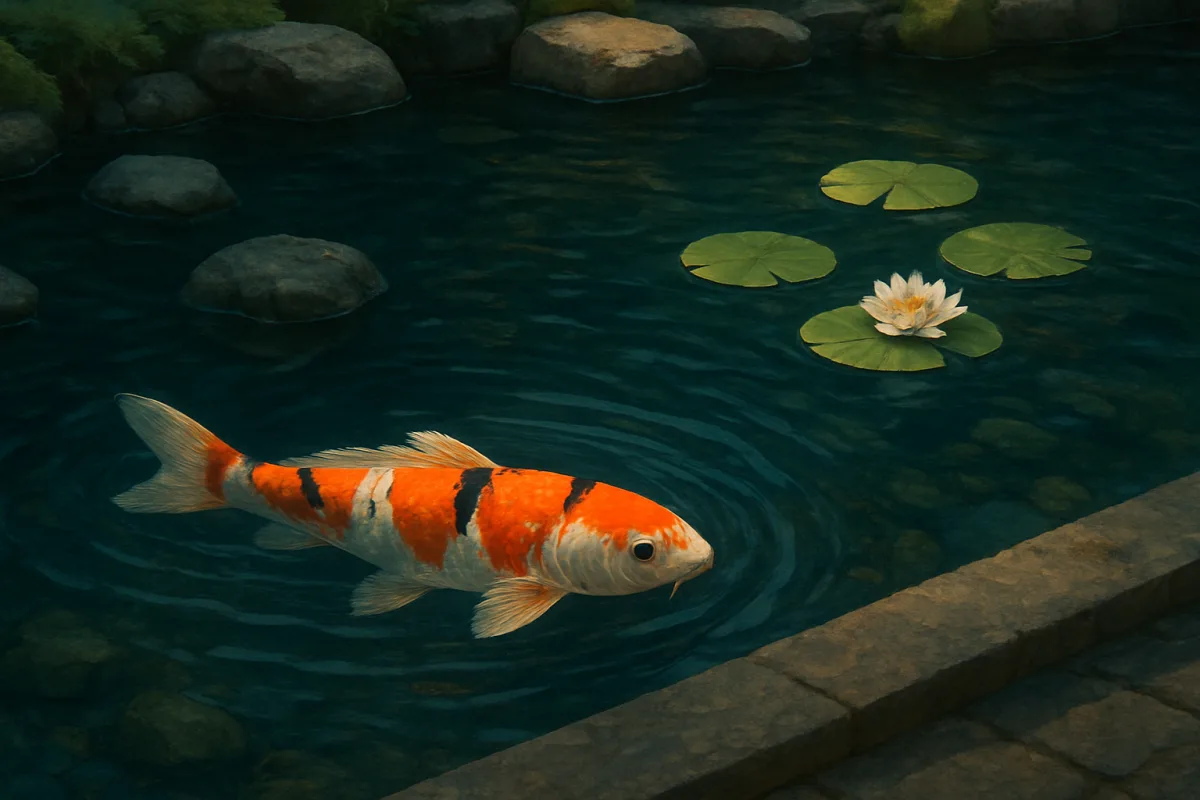
| 📌 | Definition: the koi carp, or nishikigoi, is an ornamental carp selected for its colors, morphology, and longevity in outdoor ponds. |
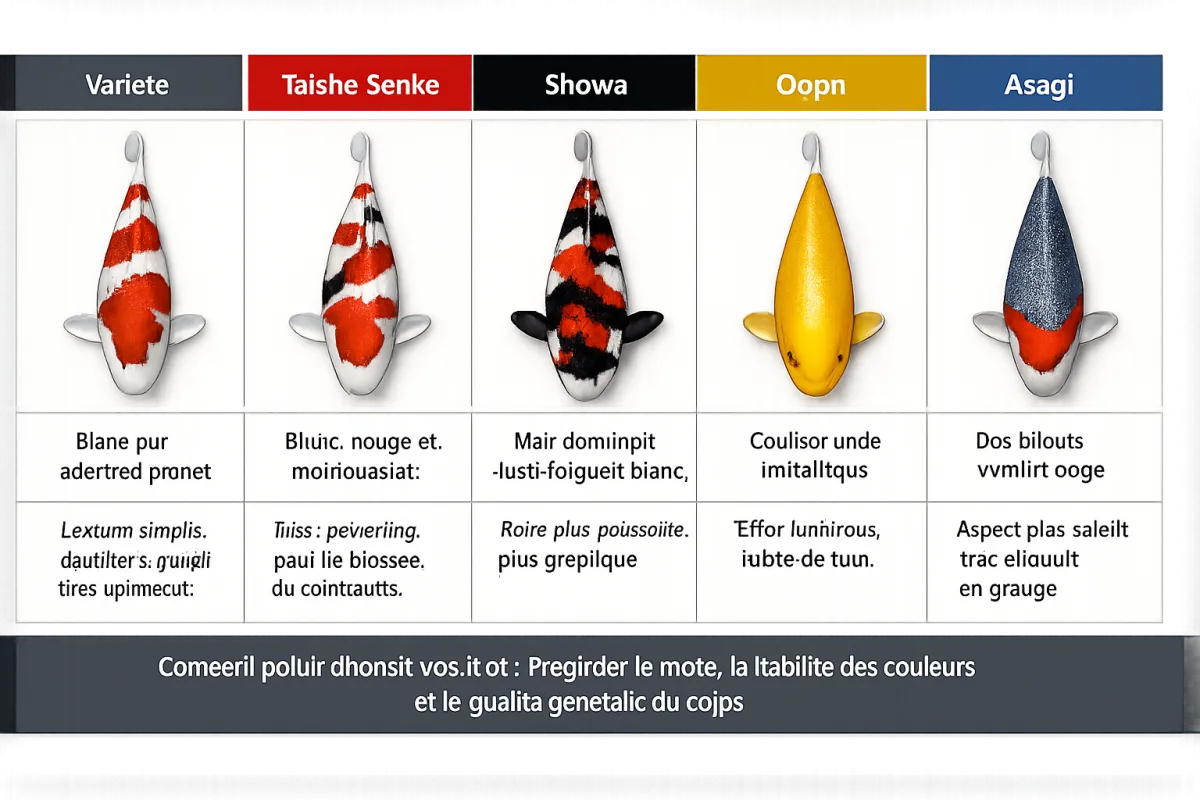
| 🎨 | Varieties: Kohaku, Sanke, Showa, Ogon, or Asagi do not have the same pattern nor the same selection interest. |
| 📏 | Adult size: depending on space, water quality, and food, a koi often reaches 60 to 80 cm, sometimes more. |
| 🏗️ | Koi pond: depth, biological filtration, and oxygenation make the difference between a stable pond and problematic water. |
| 🥣 | Feeding: the ration must follow the water temperature, activity level, and biological load of the pond. |
| 💶 | Budget: the purchase of the fish matters, but the real cost mainly comes from the pond, filtration, electricity, and annual maintenance. |
Koi carp: complete guide to choosing, installing, and maintaining an exceptional fish
The koi carp is an ornamental pond fish raised for its color, condition, and ability to live long. It is not a decorative animal to place in just any body of water. Its care requires space, serious filtration, monitored water, and regular attention. It is precisely this environment that allows the koi to reveal its potential.
What is a koi carp?
The koi carp, also called nishikigoi, is a common carp selected over time for its aesthetics. It is judged not only by its color but also by the quality of its skin, the sharpness of its patterns, body symmetry, and overall appearance. A good koi must remain lively, balanced, and robust.
Its Japanese origin has shaped a true culture of selection. In aquatic gardens, it has taken a special place because it combines visual presence, calm behavior, and longevity. Unlike an aquarium fish, it lives outdoors, grows large, and expresses itself in a substantial volume of water. It is an ornamental fish designed for the scale of the pond, not the bowl.
What are the main varieties of koi carp?
Koi varieties are mainly distinguished by their pattern. Some are very codified, others more spectacular, but not all age with the same elegance. To choose, you must look at the pattern, color clarity, and overall body quality, not just the immediate effect in a photo. A beautiful koi must remain beautiful as it grows.
| Variety | Main characteristic | Interest for the pond |
| Kohaku | Pure white with clear red | Simple reading, very appreciated visual balance |
| Taisho Sanke | White, red, and discreet black | Highly sought after for the finesse of contrast |
| Showa | Dominant black with red and white | Stronger, more graphic pattern |
| Ogon | Solid metallic color | Luminous effect, visible from afar |
| Asagi | Bluish back, red belly | More subtle aspect, very elegant in groups |
- Kohaku: ideal if you are looking for a readable, sober, and very classic koi.
- Sanke: good compromise between white structure and marked contrast.
- Showa: more expressive, but the distribution of black must remain balanced.
- Ogon: very visible in a deep pond, especially in grazing light.
- Asagi: interesting to compose a varied group without visual overload.
How to choose a koi carp without making a mistake?
The right choice is not made on color alone. You must cross-check current size, expected growth, seller quality, pond volume, and the fish’s health status. A lively koi, regular in its swimming and well maintained, is better than a spectacular subject already weakened by transport or poor water.
First observe the body coherence: straight back, intact fins, non-swollen belly, clear eyes, smooth swimming. Then look at the behavior within the group. A koi too isolated, rubbing the walls, or remaining apathetic sends a signal. In this area, blind corrections are avoided. You look at the context, then decide.
- Size: choose a size compatible with the pond, not just with your budget.
- Origin: favor a seller able to explain koi breeding, age, and lineage.
- Silhouette: look for a regular shape, not a koi that is too thin or too bulky for its age.
- Skin and scales: the surface must be clear, without injury or suspicious film.
- Behavior: calm breathing, stable swimming, normal reaction to human presence.
What size does a koi carp reach?
An adult koi carp often exceeds 60 cm when the pond is well managed. Under good conditions, some reach 80 cm, sometimes more. The size of a koi carp mainly depends on the water volume, filtration quality, feeding, and temperature. Genetic potential matters, but the environment determines the outcome.
Longevity follows the same logic. A koi can live 20 to 30 years without particular difficulty if the environment is stable. The best-maintained specimens often exceed 40 years, and some old lineages have surpassed 60 years. Lifespan is therefore not a marketing argument but an indicator of seriousness in maintenance.
What kind of pond is needed for koi carps?
A koi pond must first offer volume, depth, and well-circulated water. For a small group, think in thousands of liters, not just a simple ornamental pond. Depth limits thermal fluctuations and better protects the fish. Filtration supports the entire system’s stability.
In practice, aiming for between 1,500 and 2,000 liters per adult koi is a cautious baseline, with more if you want to keep a safety margin. A shallow pond heats up quickly, cools down quickly, and poorly tolerates overloads. Below 1.20 m, the system becomes more fragile, especially in contrasting climates.
Filtration and oxygenation
Pond filtration must combine a mechanical part, which traps particles, and a biological part, which stabilizes the water. This is the core of maintenance. Without well-established nitrifying bacteria, ammonia rises, then nitrites, then stress. Oxygenation is not a bonus: it conditions filter efficiency and fish respiration.
A good starting rule is to circulate the pond volume at least once per hour, and more if fish density increases. Serious pond filtration manufacturers emphasize the winning trio: flow rate, oxygen, and pre-filtration. If one of the three is missing, the system fails sooner or later.
Layout and safety
- Depth: a deeper zone reduces thermal stress.
- Partial shade: useful to limit summer overheating and algae.
- Safe banks: avoid collapse zones where koi can get injured.
- Protection: nets, grids, or tension lines limit predators.
- Technical access: leave an easy space to clean pump, filter, and skimmer.
How to feed a koi carp?
Koi carp feeding must follow the water temperature. In mild and warm seasons, the fish digests better and tolerates richer inputs. When the water cools, its metabolism slows down. Overfeeding, or feeding with a poorly chosen food, means unnecessarily loading the pond and tiring the filtration.
A quality koi food aims for a balance between protein, energy, and digestibility. In spring and summer, a protein rate around 30 to 40% often suits growth and activity resumption. Conversely, a food with wheat germ or lighter becomes relevant when the water cools down.
The real trap is overfeeding. Leftovers end up as organic load, thus nitrates, thus algae and extra maintenance. It is better to give little, observe the ingestion speed, then adjust. A koi should eat eagerly without leaving pellets lying at the bottom.
How to maintain the water and prevent diseases?
Koi carp maintenance relies on a simple but regular routine. Test the water, observe the fish, clean technical elements without breaking the biological balance, then correct only what needs to be corrected. Stability is better than brutal interventions, especially in a young or overloaded pond.
| Parameter | Practical guideline | Why monitor it |
| pH | Stable, ideally around 7 to 8 | Sudden changes stress the fish |
| GH | Medium to moderately high depending on the area | Influences mineral balance and overall stability |
| KH | Buffered enough to maintain pH | Protects against pH drops |
| Ammonia | Undetectable | Extremely toxic for koi |
| Nitrites | Undetectable | Sign of a struggling filter or overload |
| Nitrates | As low as possible, controlled by water changes | Indicator of accumulated biological load |
To prevent diseases, quarantine remains the best defense. A new fish should ideally spend several weeks apart, with observation, normal feeding, and monitoring for signs of parasitosis or infection. Veterinarians specialized in exotic or aquatic animals recommend this caution because a healthy pond can be weakened by a single uncontrolled newcomer.
Warning signs are quite clear: fish rubbing itself, rapid breathing, jerky swimming, loss of appetite, clamped fins, wounds, white spots, or isolated behavior. As soon as doubt persists, avoid piling on random treatments. First identify the cause: water, parasite, injury, or transport stress.
How much does a koi carp cost?
The price of a koi carp varies greatly depending on age, size, variety, breeder, Japanese origin or not, pattern quality, and growth potential. A small hobby-quality koi can be inexpensive, while a selected specimen with a solid lineage and very clear pattern quickly becomes costly. The fish is only part of the budget.
| Item | Approximate range | Comment |
| Beginner koi carp | €20 to €80 | Young fish, decent appearance, simple selection |
| Selected koi | €80 to €300 | Clearer pattern, better morphology, better tracked origin |
| Quality Japanese koi | €300 to €1,500 and up | Influence of breeder, lineage, and potential |
| Pond + filtration | €1,500 to several thousand euros | The real major expense of the project |
| Annual budget | €300 to €1,000 for a small setup, more for a large installation | Electricity, food, tests, maintenance, consumables |
To buy wisely, you also need to look at the seller. A good professional describes the origin, shows breeding conditions, specifies age or size, and agrees to discuss quarantine. They don’t just push a color. They also explain how the fish was kept, because a well-bred but poorly maintained koi often arrives already weakened.
Where and how to buy a koi carp?
A serious purchase starts with observation. The koi must swim actively, breathe without apparent effort, and have intact fins. Scales should be regular, eyes clear, and belly firm. If the fish seems tired, isolated, or too nervous, it’s better to wait. The seller must be able to answer simply about age, recent treatment, and origin.
- Choose a transparent seller regarding the origin and care given to the fish.
- Ask for the actual size, not just a commercial estimate.
- Check the tank water: a healthy fish does not compensate for poor maintenance.
- Prepare the arrival with slow acclimation and a stabilized pond.
- Avoid impulsive buying if filtration or pond volume are not ready.
Mistakes to avoid when starting with a koi carp
The most costly mistakes are almost always the same. The pond is undersized, overfeeding occurs, too many fish are added too quickly, then corrections are made with products instead of addressing the cause. A koi tolerates consistency much better than constant tinkering. The pond must be thought of as a system, not as a decoration.
- buying a koi before stabilizing the pond
- neglecting biological filtration in favor of a simple mechanical filter
- mixing too many fish without calculating the biological load
- overfeeding when the water is cold
- introducing a new fish without quarantine
- treating a symptom without checking the water
FAQ about koi carp
How many koi carp can be kept in a pond?
The answer depends on the volume, depth, filtration, and local temperature. To be cautious, it is better to start with few fish and keep a margin. The number is never fixed: a highly filtered pond can accommodate more than a shallow decorative pond.
Can a koi carp live with other fish?
Yes, but cohabitation must be thoughtful. The koi is not a predator, but it is large, powerful, and greedy. Tiny companions, overly lively species, or those that poorly tolerate the same water parameters should be avoided. Group stability takes precedence over diversity at all costs.
Is koi carp difficult to maintain?
It is not difficult if the system is well designed. It becomes demanding when the pond is undersized or the filtration is too light. In practice, maintenance mainly relies on regularity: feeding appropriately, testing the water, monitoring the fish, and cleaning without disrupting the balance.
Should koi be brought indoors in winter?
No, not if the pond is deep enough and the water remains stable. However, feeding should be reduced, stirring the bottom avoided, and oxygenation preserved. In cold regions, depth and quality of water circulation become decisive to get through the season without stress.
How long does a koi carp live?
In a good pond, a koi often lives several decades. Twenty to thirty years is already common. With clean water, consistent feeding, and good filtration, longevity can be much higher. Lifespan almost always reflects the quality of care.
Key takeaways
Choosing a koi carp is not about buying a color. It is about building a stable living environment: water volume, depth, pond filtration, oxygenation, adjusted feeding, and health monitoring. If the pond is ready, the koi becomes a true long-term ornamental fish. If the environment is lacking, even the most beautiful specimen quickly loses its value.