

The animal behaviorist intervenes when the relationship with a dog or cat becomes difficult to read: repeated barking, destruction, soiling, tensions at home, fear during walks, agitation upon return from absences. Their role is not to “train” on an assembly line, but to understand what is happening behind the behavior. They observe the animal, the living environment, the household habits, and how each person reacts. This overall assessment helps to propose realistic solutions, without mechanical recipes or overly easy promises.

What this professional really does
A behaviorist first looks for the cause of a problem, not just its visible manifestation. A dog that jumps on visitors may lack reference points, have learned that this sequence brings attention, or be overwhelmed by excitement. A cat that urinates outside its litter box may express stress, discomfort in its space, poorly managed cohabitation, or physical discomfort. The work therefore consists of linking the facts together, then proposing concrete adjustments.
This approach is based on observation, history, and household coherence. The professional is interested in schedules, outings, rest, stimulations, moments of tension, human reactions, and recent changes. A move, a birth, an adoption, the arrival of a second animal, or a longer absence than usual can sometimes be enough to destabilize an animal that was previously stable.
Another useful point: the behaviorist does not replace the veterinarian. As soon as a change is sudden, aggression appears without the usual signal, a cat suddenly becomes unclean, or a dog seems unusually irritable, a health check remains the first reflex. Behavioral problems can be related to pain, illness, or a metabolic problem, and the clinical examination is precisely to rule out this possibility before working on the environment and learning.
Situations in which to consult
People often think to consult when fatigue is already established. In fact, early intervention avoids many tensions. The most frequent requests concern barking, destruction, fear of being alone, conflicts between animals, reactions on leash, or soiling. For cats, the reasons often revolve around elimination outside the box, avoidance, territorial tensions, and unusual vocalizations.
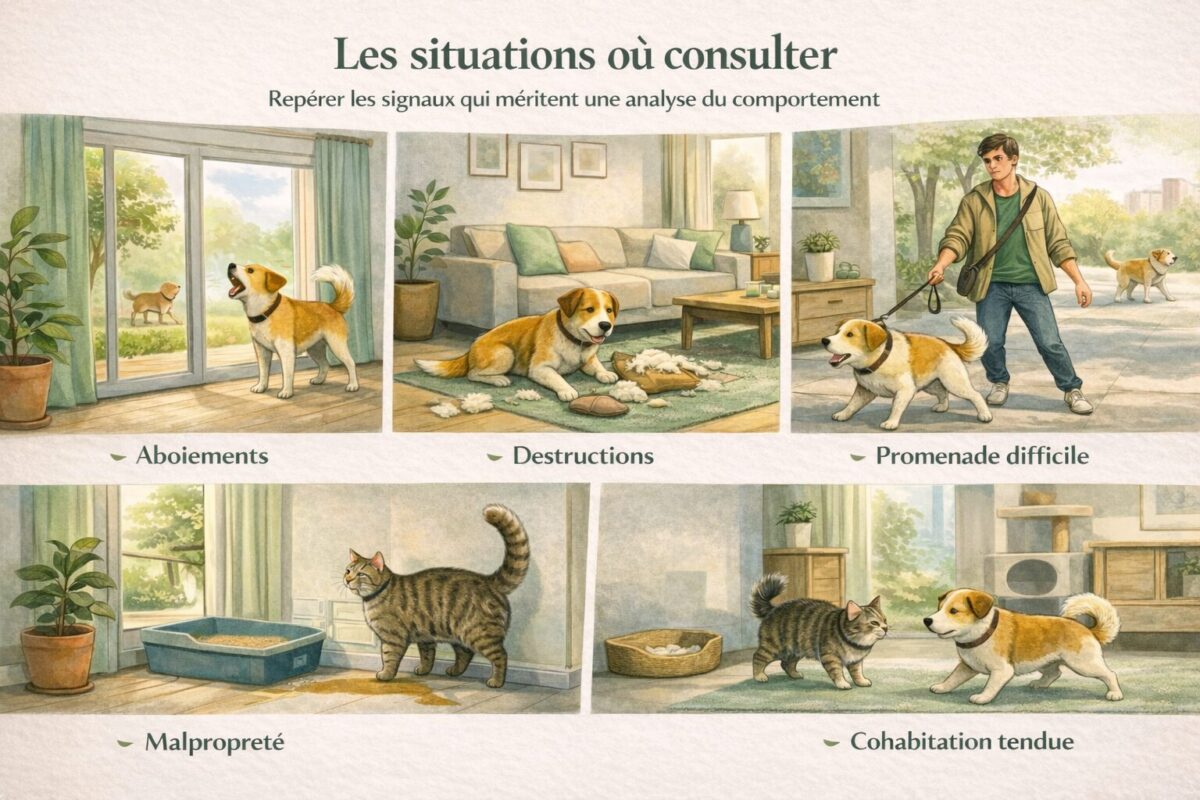
- Repeated destruction: it can reveal boredom, frustration, stress, or poor management of absences.
- Aggressiveness or growling: it is important to distinguish fear, resource guarding, pain, and learned behavior.
- Dirtiness: context, cleanliness of the place, stress, and medical issues must be considered together.
- Complicated walks: pulling, reactivity, and hypervigilance require a careful reading of triggers.
- Tense cohabitation: dog-cat or dog-dog, managing space often changes the situation.
Consulting preventively also makes sense. Before the arrival of a puppy, kitten, baby, or before a long period of absence, having some well-established guidelines saves precious time. The behaviorist then helps to set up a clear framework rather than to fix an already degraded situation.

How the support process works
The first session usually begins with a detailed interview. The professional asks what is happening, since when, how often, under what circumstances, and with what consequences. They look for triggers, unintentional reinforcements, moments of calm, and daily inconsistencies. Two animals who “do the same” do not necessarily need the same response.
Next comes the analysis phase. It focuses on the living space, quality of rest, interactions, physical exercise, mental engagement, signal reading, and how the family intervenes. The action plan is built from there: reorganizing certain routines, lightening overly charged situations, better anticipating tension build-ups, making rules clearer, and balancing demands.
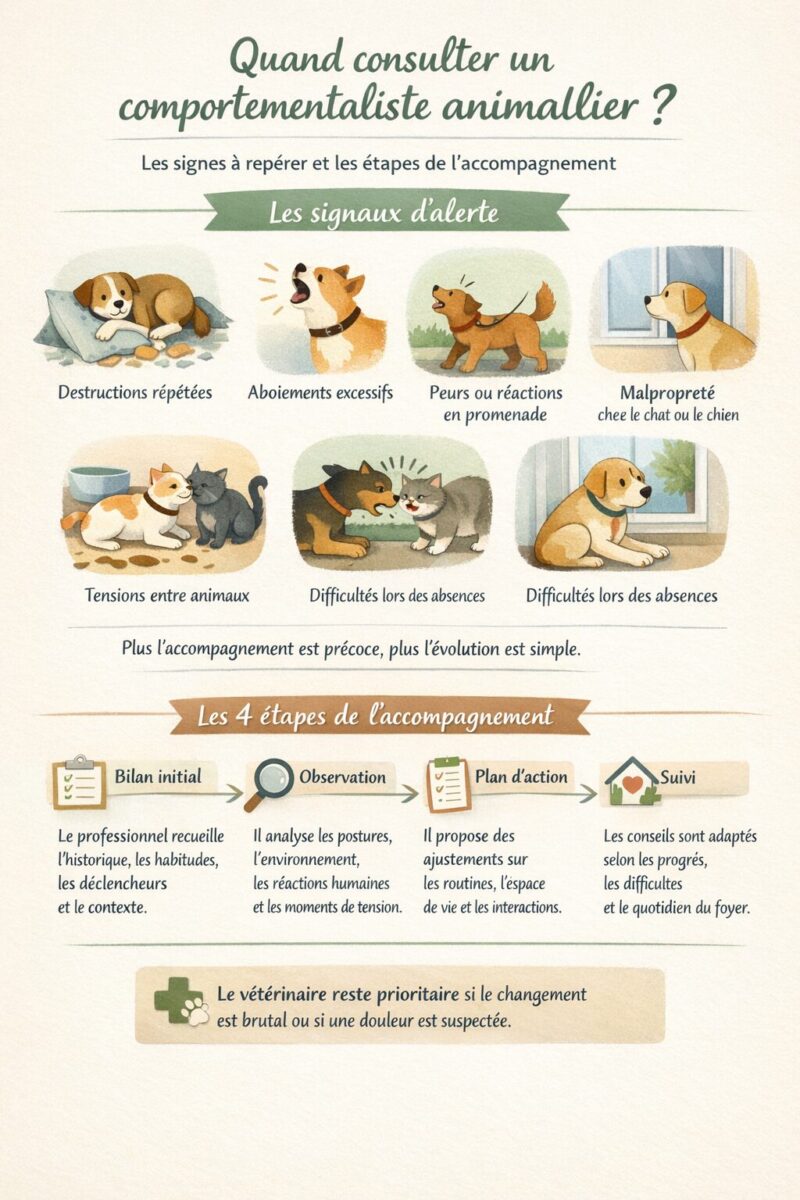
| Step | What is observed | Objective |
|---|---|---|
| Initial assessment | History, habits, triggers | Understand the real context |
| Observation | Postures, distance, human reactions | Identify the mechanisms of the disorder |
| Action plan | Routines, space, interactions | Reduce tension and clarify landmarks |
| Follow-up | Progress, relapses, adjustments | Stabilize progress |
Good support remains progressive. It does not promise a “before/after” in a few days. It aims rather for lasting improvement, compatible with the household’s lifestyle. It is this coherence that lasts over time.
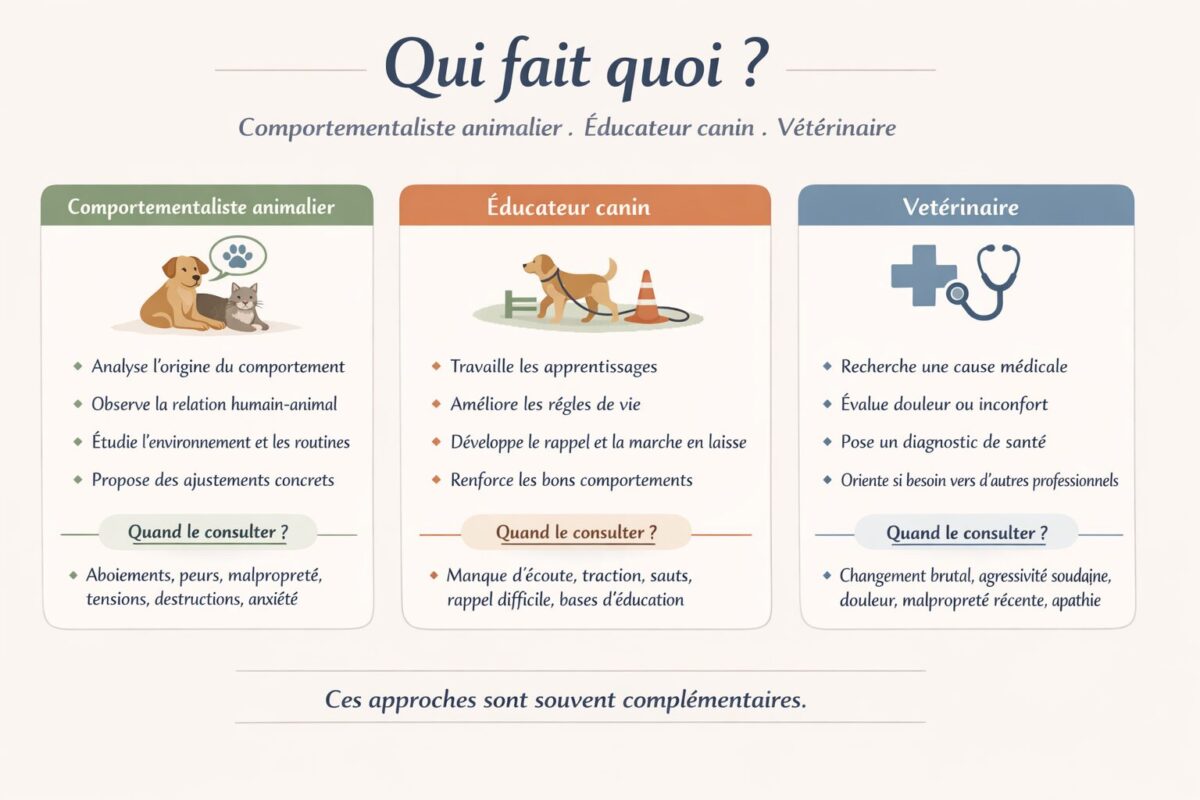
Behaviorist or dog trainer?
The two professions overlap, without doing exactly the same thing. The trainer mainly works on learning: leash walking, recall, self-control, life rules, motivation management. The behaviorist, on the other hand, focuses more on the why of the behavior, the human-animal relationship, and the role of the environment in the problem. In many cases, the two approaches complement each other.
An adolescent dog lacking structure sometimes mainly needs training. An adopted animal that panics during separations or reacts to every noise requires a broader understanding, with work on emotions, landmarks, and daily predictability. The right professional also knows how to refer when the need exceeds their field of intervention.
Criteria for making the right choice
First guideline: the method must be understandable. A serious professional explains what they observe, what they want to modify, and why they propose a particular adjustment. They ask many questions before giving answers, do not dramatize the situation, and do not sell a one-size-fits-all technique.
- Targeted experience: dog, cat, or cohabitation, field experience counts.
- Clear approach: you must understand the logic of the proposed plan.
- Possible follow-up: adjustments between sessions often make the difference.
- Network work: referral to the veterinarian should be natural if needed.
- Realistic goals: lasting improvement is better than a spectacular promise.
To better understand the scope of intervention, many owners take the time to look at the profession of animal behaviorist before comparing approaches, services, and the level of support offered.
Beware of overly rigid statements. When a practitioner refuses to consider a medical angle, ignores the family context, or claims to resolve serious situations alone in one session, it’s better to move on.
What good support really changes
The most visible benefit is not always what you think. Yes, the goal is to reduce problematic behaviors. However, the real change often happens elsewhere: better reading of signals, calmer reactions, better-structured routines, less escalation of tensions. The animal gains predictability, the household gains serenity.
For dogs, this can involve a more understandable walk, better-prepared separations, reduced excitement upon returns, or greater comfort with visitors. For cats, progress often takes the form of more regular litter box use, a more relaxed presence in the living space, or less conflictual cohabitation.

FAQ about the animal behaviorist
When should you consult?
As soon as a behavior sets in, intensifies, or clearly disrupts daily life. Waiting several months often makes the situation harder to rebalance.
Can a behaviorist intervene for a cat?
Yes. Inappropriate elimination, scratching, tensions between cats, avoidance, or vocalizations are common reasons for consultation.
Is one session enough?
Sometimes, for a simple or well-identified problem. As soon as the issue is old, emotional, or linked to multiple factors, follow-up provides better results.
Should you see the veterinarian first?
Yes, if the change is sudden, if the animal seems in pain, if it becomes aggressive for no apparent reason, or if a cat suddenly changes its litter habits.
Does the behaviorist work at home?
Often yes, because many problems depend on the environment, routines, and real interactions within the household.
Can you consult preventively?
Yes, and it is often very useful before an adoption, a move, the arrival of a child, or a new cohabitation between animals.