| 📌 | Definition: a educational farm is a farm that welcomes the public to explain livestock, crops, food, and the cycle of life. |
| 👨👩👧👦 | Audience: families, schools, leisure centers, groups, birthdays, and specialized audiences depending on the farms. |
| 🐐 | Activities: feeding animals, nature workshops, gardening, discovering farm products, and guided tours. |
| ⏱️ | Duration: usually expect 1.5 to 3 hours for a simple visit, longer with workshops, snacks, or group hosting. |
| 💶 | Budget: the price of an educational farm varies according to the package, age, group, and options; booking is often recommended. |
| ✅ | Good practice: check the recommended age, weather, accessibility, allergies, and hygiene instructions before leaving. |
Educational Farm: The Complete Guide to Understand, Choose, and Succeed in Your Visit
An educational farm is a farm that welcomes visitors to introduce them to animals, crops, daily tasks, and the role of agriculture. It combines production, activities, and education, with a simple logic: learning by observing, handling, and asking questions. Last updated: April 2026.
This type of place meets a very concrete need: to see animals up close, understand where food comes from, take a farm outing with children, or organize a meaningful school farm trip. The interest is not only recreational. A good visit provides benchmarks on livestock, crops, seasonality, hygiene, and safety rules around animals.
- observe farm animals and learn about their needs;
- participate in children’s nature workshops around the vegetable garden, compost, or sowing;
- discover the transformation of products such as milk, eggs, honey, or bread;
- understand the work of a farm throughout the seasons;
- enjoy a short family outing or a longer program for a group.
| Audience | Common Activities | Average Duration | Prices | Booking |
|---|---|---|---|---|
| Families | Free visit, animals, small workshops, snack | 1.5 to 3 hours | Often per visit, sometimes family package | Recommended on weekends |
| Schools | Guided tour, thematic workshops, mediation | 2 hours to half a day | Group / school rate | Often mandatory |
| Groups | Custom activities, birthday, discovery | Variable depending on the program | Quote or dedicated package | Yes, almost always |
What is an educational farm?
The simplest answer is the right one: it is a farm that does not just produce, it explains. It has real agricultural activity, but also structured mediation for the public. The educational farm stages the professional gestures without oversimplifying them. It shows animal care, crop cycles, the role of the soil, water management, harvests, and daily constraints.
It is not a farm “turned into” a leisure park. That is precisely what gives it value. The pedagogy starts from reality: a herd has needs, a vegetable garden follows a season, a hen does not lay according to the schedule of an activity. This coherence makes the visit more accurate, more concrete, and more memorable.
What is the difference between an educational farm and a traditional farm?
A traditional farm primarily produces. An educational farm produces and welcomes. The difference is not only the presence of visitors but the organization of space, the time devoted to explanation, safety, and the ability to adapt the message to the audience. In an educational farm, the activity is part of the project; in a traditional farm, it may exist but is not central.
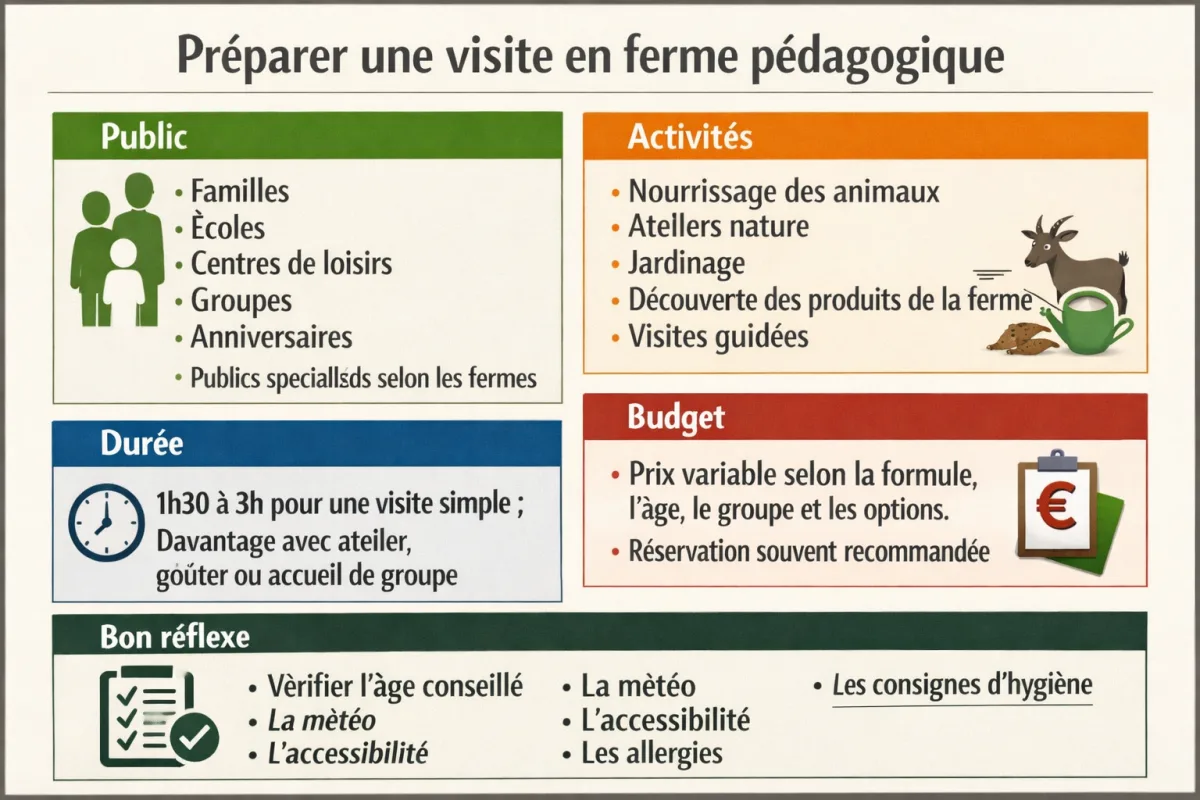
In practice, this changes everything for the visitor. You don’t just “see animals.” You get insights into the animals’ diet, care, reproduction cycles, product processing, food origins, and often, the role of short supply chains. Networks like the National Sheepfold, agricultural chambers, or certain local labels emphasize this aspect of transmission.
Why visit an educational farm?
Because it brings together what many separate outings do not: concreteness, rhythm, and meaning. For a family, it’s a farm outing with children that calms, occupies, and educates without screens. For a school, it’s a lively learning tool. For a group, it’s a shared experience that naturally fosters exchanges around living things.
The benefits are very concrete: sensory awakening, vocabulary, attention, motor skills, following instructions, understanding the life cycle. For the youngest, the approach works because it involves observation and action. For older children, it helps connect concepts learned in class to an easily understandable reality.
For families
Families often look for an activity that is simple to organize but rich in content. The discovery farm meets this need well. The child sees, listens, sometimes touches, compares species, and understands why a goat does not eat like a rabbit. The parent appreciates a calm setting, clear rules, and a visit that does not depend solely on the weather, provided the spaces are well designed.
For schools and leisure centers
The educational farm is particularly useful for a school farm outing because it provides a concrete basis for learning about food, the environment, seasons, and agricultural professions. Good school reception includes an adapted pace, precise instructions, short workshops, and an explicit educational objective from the time of booking.
What activities can be found in an educational farm?
Educational farm activities vary depending on the size of the facility, the presence of animals, the season, and the level of supervision. However, the most common remain fairly stable: feeding, brushing, observation, sowing, simple care, harvesting, product making, or discovering the animals’ living habits. The important point is not the number of workshops, but their coherence.
- Meeting and caring for animals: feeding, brushing, observing, learning the needs of each species.
- Nature workshops: sowing, gardening, composting, plant recognition, seasonal cycles.
- Product discovery: milk, eggs, honey, bread, wool, cheese, depending on the productions present.
- Animal mediation: supervised approach with rules of distance, calm, and hygiene.
- Themed visits: food, biodiversity, short supply chains, farm professions.
In a good educational animal farm, contact is never left to chance. You don’t touch everything, you don’t feed without instructions, and you don’t approach an animal as if entering a playground. This safety requirement does not detract from friendliness. On the contrary, it ensures that the exchange remains calm for both visitors and animals.
How to choose the right educational farm?
The right choice first depends on your objective: family outing, occasional discovery, school reception, or themed group. The best farm is not necessarily the most famous. It is the one that matches the visitors’ age, available time, travel distance, budget, and desired level of supervision.
For a search for an educational farm near me, start with tourist offices, agricultural networks, community websites, and specialized directories. Then check photos, workshop descriptions, presence of animals, frequency of activities, and reception conditions. Reviews are useful, but they do not replace direct communication with the farm.
| Criterion | What to check | Why it’s decisive |
|---|---|---|
| Recommended age | Reception of toddlers, school-age children or teenagers | The content must remain understandable and well-paced |
| Accessibility | Parking, strollers, wheelchairs, pathways | Avoids unpleasant surprises on site |
| Safety | Barriers, instructions, hygiene, supervision | Protects visitors and animals |
| Reservation | Mandatory or not, time slots, group capacity | Determines the feasibility of the trip |
| Activities | Workshops, guided tour, snack, actual duration | Measures the value of the outing |
When comparing several farms, also look at the emphasis placed on education. Some are very focused on public reception, others closer to a working farm occasionally open to visitors. In the second case, the visit can be more authentic but less staged. There is no superior model. There is a good fit for your needs.
Is it necessary to book in advance?
The answer is generally yes, especially for group outings, during holidays or weekends. A reservation allows the farm to adjust the number of animals presented, the equipment, the facilitators, and the reception time. It also allows families to be informed of weather constraints, equipment, or minimum age requirements.
Booking early also avoids a false start. Some facilities only accept small groups at specific times. Others reserve certain workshops for birth periods, harvest, or processing. This anticipation is even more important if a child has allergies, if the group comes with a stroller, or if someone needs adapted access.
Preparing your visit to an educational farm
A good visit is prepared without excess, but seriously. You should plan shoes that can handle dirt, season-appropriate clothing, water, sometimes a change of clothes for the youngest, and a windbreaker if the activity takes place outdoors. The goal is not to be perfectly equipped. It is to prevent logistics from overshadowing discovery.
On site, three rules matter more than others: respect the instructions, keep calm behavior, and ask before entering an animal area. Children remember this framework very well when it is explained simply. Do not run after the animals, do not give anything without permission, wash your hands after workshops, and follow the team’s pace.
The best time to visit depends on your objective. In spring, you often enjoy births, sowing, and milder weather. In summer, you have to manage heat and shade. In autumn, some places offer harvests and seasonal workshops. In winter, the setting can be quieter, with fewer outdoor workshops but more exchanges about daily care.
How to organize a school trip to an educational farm?
A school farm trip works well when the teacher has defined a clear objective before calling the facility. It may involve discovering animals, working on living vocabulary, understanding crop cycles, or observing animal feeding. The clearer the objective, the more the farm can build a useful visit, with the right workshops and the right pace.
On the educational team side, permissions, allergies, supervision, and transportation must be anticipated. On the farm side, the actual reception capacity, availability of facilitators, and safety level on the routes must be checked. A well-thought-out visit does not try to do everything. It favors a few solid learnings, well explained and well experienced.
What are the prices and services offered?
The price of an educational farm varies according to the region, duration, type of visit, and included services. A simple entry obviously does not have the same cost as a half-day with workshops, snack, and guided animation. For a school group or a birthday, pricing is often by quote or package. Comparison should therefore be made with equal content, not just the displayed price.
Among the useful services, you will often find a picnic area, a sheltered space, a snack, a local products shop, workshops by appointment, and sometimes birthday packages. Some places also work with local authorities, leisure centers, or associations. These are good indicators of reliability, provided that public reception does not take precedence over animal welfare.
Before paying, always check three points: the actual opening hours, cancellation conditions, and any additional fees. Prices, activities, and access rules can change depending on the season, weather, or group size. A simple phone call often helps avoid an unpleasant surprise.
FAQ about the educational farm
From what age can one visit an educational farm?
One can often visit an educational farm from 2 or 3 years old, but it depends on the place and the proposed pace. For very young children, short workshops, low noise, and secure spaces are necessary. Some farms prefer to welcome children from 4 or 5 years old to better utilize the visit.
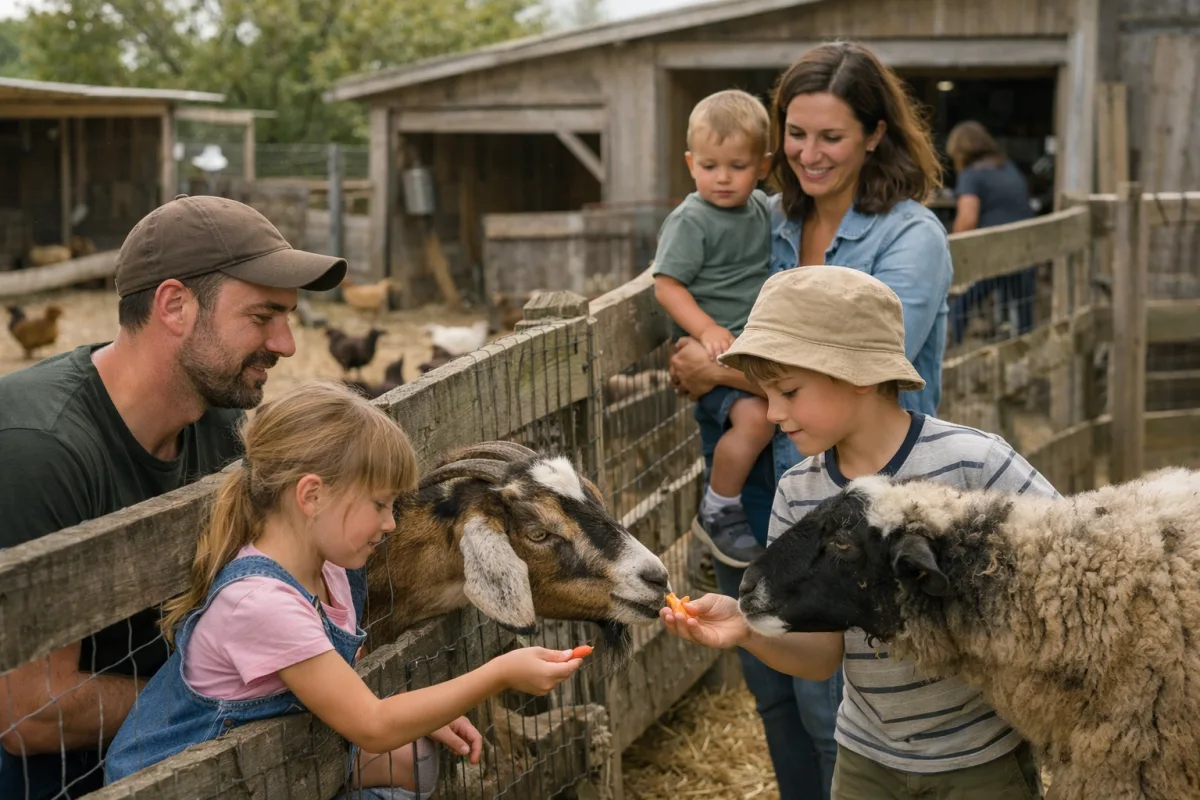
Can you touch or feed the animals?
Yes, but only if the farm allows it and according to specific rules. Feeding and direct contact are among the most appreciated educational farm activities, but they are supervised for hygiene, safety, and animal welfare reasons. You never feed without instructions.
How long does a visit last?
The duration often varies from 1.5 to 3 hours for a family visit and can last up to half a day for a school group. Packages with workshops, snacks, or thematic activities naturally take more time. It is better to check the actual duration, not just the displayed time slot.
Is an educational farm suitable for a school outing?
Yes, provided the educational objective is clarified and logistics are prepared with the institution. It is a very relevant outing to work on living things, food, seasons, biodiversity, and respect for instructions. The interest is maximized when the farm adapts its mediation to the class level.
What is the difference between an educational farm and a discovery farm?
The two concepts are close. A discovery farm often emphasizes visiting and observing, while an educational farm clearly focuses more on learning, workshops, and transmission. In practice, many places combine both approaches.
Is it necessary to book in advance?
Most often, yes. Booking is strongly recommended as soon as it involves a group, a weekend, or a holiday period. It allows you to secure your educational farm visit, avoid a temporary closure, and obtain the correct instructions before leaving.
How to find an educational farm near me?
The most effective way is to search locally through tourist offices, agricultural chambers, specialized networks, and local authority websites. The terms educational farm near me, educational farm visit, or educational farm also help refine the search according to your city or department.