
| 📌 | Definition: the human cat age is an estimate of feline aging, not an exact day-to-day equivalence. |
| 🧮 | Simple rule: 1 cat year ≈ 15 human years, 2 years ≈ 24 years, then add about 4 human years per year. |
| 📊 | Useful reference: a cat age chart remains more reliable than a single formula to read the major life stages. |
| 🐾 | Life stages: kitten, young adult, adult, mature, senior. Each stage changes actual needs. |
| 🩺 | Health: diet, activity, lifestyle, and veterinary follow-up modify the equivalence. |
| ⚖️ | Key point: a cat’s biological age can differ from its chronological age. |
Human cat age: the simple guide to convert its age and better understand its needs
To convert the human cat age, first remember this: 1 cat year corresponds on average to 15 human years, 2 years to 24 years, then each additional year adds about 4 human years. The 7-year rule is too simplistic. It does not take into account the very rapid growth of the first two years, nor the differences related to health and lifestyle.
The right approach is therefore not to look for a perfect “translation,” but to place your cat within a life stage. A kitten is not managed like a settled adult, and a senior cat does not have the same priorities as a young, healthy feline. This is where the conversion chart becomes really useful.
- Kitten: growth, energy, learning.
- Adult: weight stability, muscle maintenance, prevention.
- Mature: vigilance on teeth, weight, and subtle wear.
- Senior: more regular check-ups, comfort, early screening.
How to calculate human cat age without making a mistake?
The simplest method is to remember a two-step logic: the cat’s first year counts a lot, the second already leads it toward adulthood, then aging slows down. After 2 years, a stable calculation base can be used, while keeping in mind that it is only an estimate. This is the most reliable way to make a quick and useful cat age calculation.
In other words, how to calculate cat age is not just a mechanical multiplication. A 1-year-old cat is not like a 7-year-old child: it already has a formed body, consolidated reflexes, and very advanced behavioral maturity. The conversion must therefore read biology, not copy humans.
Cat age to human age conversion chart
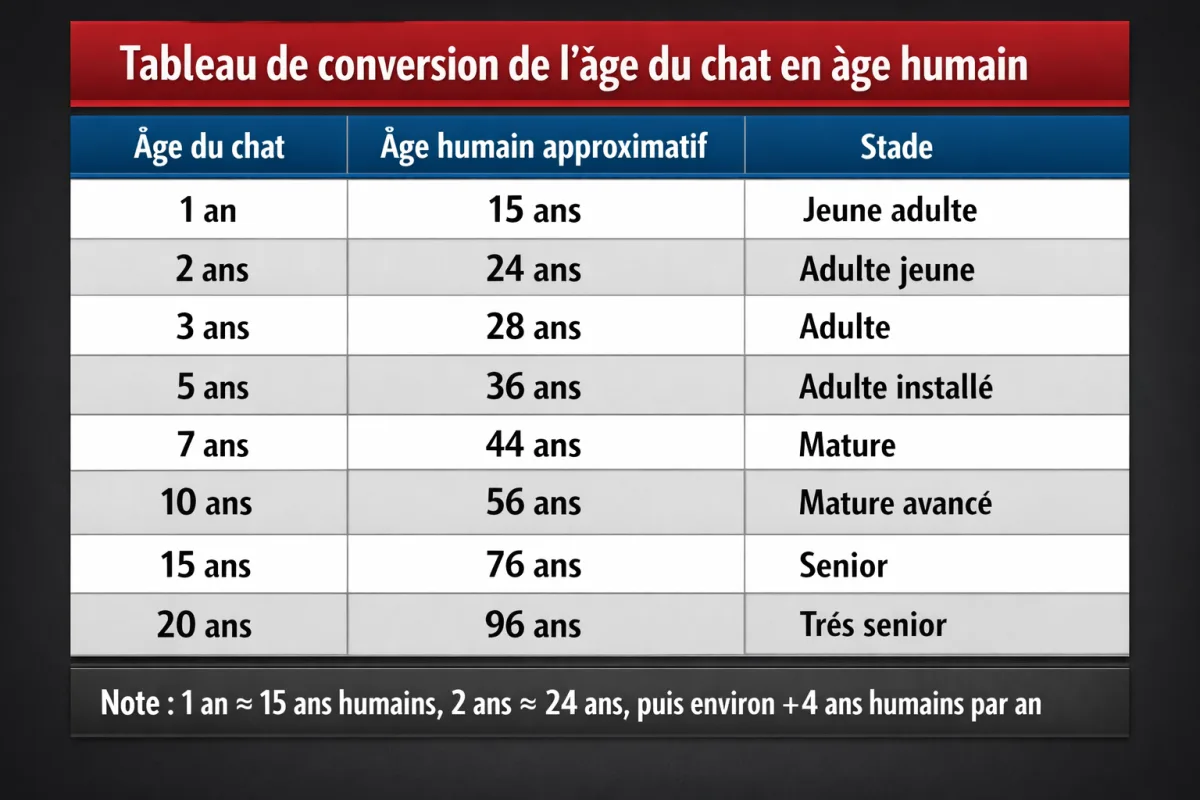
The cat age chart below provides clear references for the most useful ages. It does not replace a veterinary exam, but it helps to immediately place your animal and understand the expression cat age in human years.
| Cat’s age | Approximate human age | Stage | Practical reading |
| 1 year | 15 years | Young adult | The cat has already passed the “baby” stage and enters a true phase of maturity. |
| 2 years | 24 years | Young adult | Growth is almost complete; behavior stabilizes. |
| 3 years | 28 years | Adult | The pace becomes steady, with few visible changes if health is good. |
| 5 years | 36 years | Established adult | The cat is in its prime, but weight and teeth already deserve attention. |
| 7 years | 44 years | Mature | More serious monitoring of comfort, tartar, and mobility begins. |
| 10 years | 56 years | Advanced mature | The senior cat age is not yet systematic, but monitoring becomes more important. |
| 15 years | 76 years | Senior | Check-ups must be more frequent, especially for kidneys, teeth, and joints. |
| 20 years | 96 years | Very senior | We speak of a great feline age, with a strong need for comfort and surveillance. |
Kitten: 0 to 1 year
The kitten grows at a high speed. In a few months, it learns to play, climb, hunt, orient itself, and manage its interactions. If you look for the human equivalent, a 6-month-old kitten is already much more advanced than a human infant: the comparison should remain symbolic, not literal.
Young adult: 1 to 3 years
Between 1 and 3 years, the cat changes register. It retains the energy of a young animal, but is no longer in full development phase. This is where the expression cat human age takes its full meaning: at 2 years, your companion already corresponds to a young adult of about 24 human years.
Mature: 7 to 10 years
Around 7 to 10 years, the cat often remains active, but begins to manage its effort differently. The coat may lose some density, recovery after play becomes less explosive, and tartar settles more easily. A 10-year-old cat age does not necessarily announce fragility, but it requires better observation of signals.
Senior: 11 years and older
The transition to senior is not a sudden shift. In practice, many veterinarians classify the cat as senior around 11 to 12 years, then very old after 15 years. At this stage, the priority becomes comfort, pain prevention, weight control, and early detection of silent diseases.
What factors cause variation in cat-to-human age equivalence?
Two cats of the same chronological age can age differently. Lifestyle, sterilization, diet, access to the outdoors, heredity, and health status modify the real pace. Benchmarks remain useful, but they never replace observing the cat itself.
Veterinary sources such as International Cat Care, the Cornell Feline Health Center, or the MSD Veterinary Manual emphasize the same point: we are talking about an estimate of maturity, not an absolute measurement.
- Indoor cat: often less exposed to trauma, fights, and infections, so aging sometimes appears slower.
- Outdoor cat: more risks of injuries, parasites, stress, and wear, which can accelerate certain markers.
- Breed and morphology: some lines are more prone to heart, kidney, respiratory, or joint problems.
- Body condition: a cat that is too thin, too round, or in pain does not have the same biological age as a balanced cat.
How to estimate a cat’s age when you don’t know it?
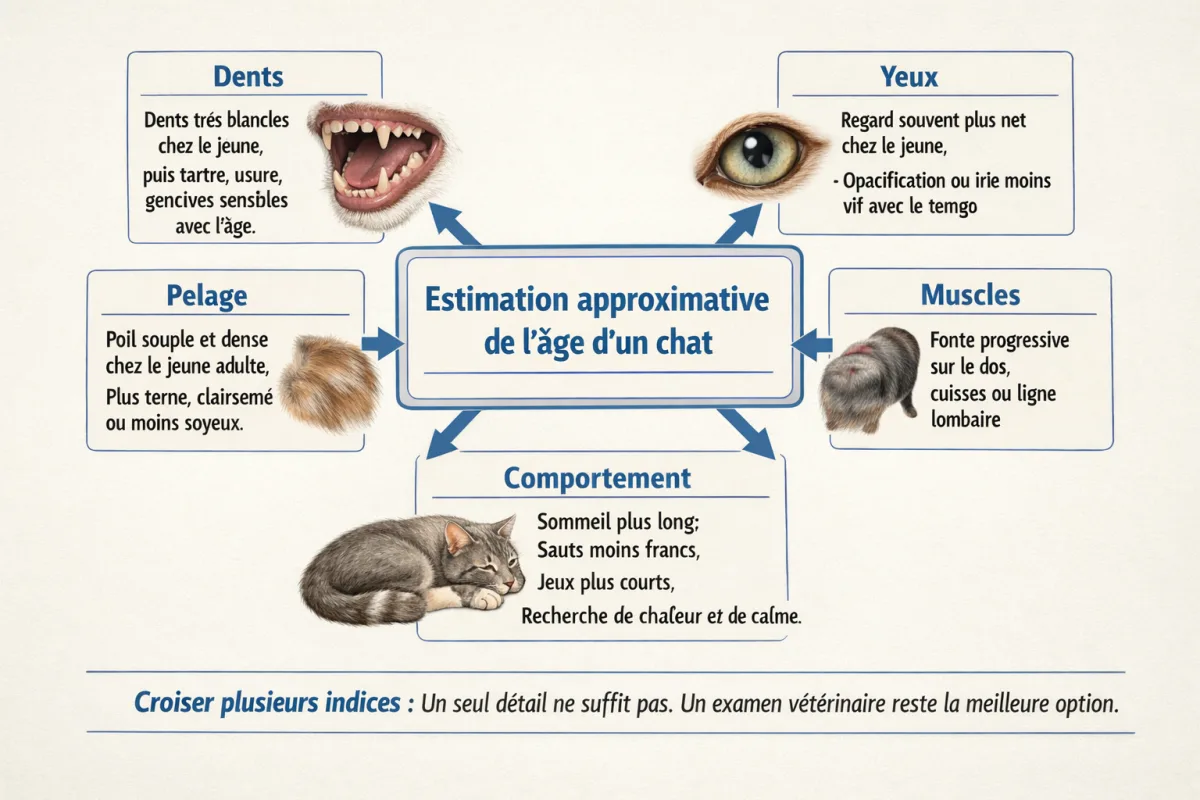
For an adopted or stray cat, you cannot “calculate” its exact age. You combine several clues: teeth, eyes, coat, musculature, mobility, and behavior. This method does not give a birth date, but it allows distinguishing a young adult from a senior with a fairly good practical margin.
The trap is wanting to judge based on a single detail. A cat can have tartar without being old, or conversely appear clean and already be mature. So you need to measure several signals before deciding.
- Teeth: very white teeth in the young, then tartar, wear, more sensitive gums with age.
- Eyes: often clearer gaze in the young, sometimes slight clouding or less vivid iris over time.
- Coat: soft and dense fur in many young adults, then sometimes duller, thinner, or less silky.
- Muscles: progressive wasting on the back, thighs, or lumbar line in some seniors.
- Behavior: longer sleep, less agile jumps, shorter play sessions, seeking warmth and calm.
What should be adapted according to the cat’s age?
The conversion to human age mainly serves to adjust care. A kitten does not have the same needs as an adult, and a senior does not have the same priorities as a mature cat. The older the cat gets, the more you need to monitor its weight, teeth, hydration, and mobility methodically.
| Stage | Priority | Monitoring reference |
| Kitten | Growth, energy, learning | Appropriate meals, short and frequent play, up-to-date vaccinations |
| Adult | Stable weight, activity, prevention | Annual check-up, oral hygiene, overweight monitoring |
| Mature | Subtle wear, teeth, mobility | More attentive assessments, observation of behavior changes |
| Senior | Comfort, hydration, screening | More regular veterinary check-ups, adaptation of diet and environment |
In practice, a kitten needs a high energy intake and stable routines. An adult should mainly maintain a correct weight and good activity level. A mature cat begins to require more prevention, while a senior benefits from more frequent monitoring, especially if the senior cat age is already visible in its mobility or appetite.
FAQ on cat human age
What human age is a 5-year-old cat?
A 5-year-old cat corresponds on average to 36 human years. It is still in a solid adult phase, but no longer a very young animal. It is a good time to check weight, teeth, and activity level.
From what age is a cat considered senior?
The practical threshold often used is 11 years. Some cats show signs of aging earlier, others later. The most useful criterion remains the general condition, not just the number on paper.
Does a neutered cat live longer?
Neutering can reduce certain risks related to escapes, fights, and infections, especially in outdoor cats. It does not guarantee maximum longevity, but it often helps secure the life path. The rest depends on monitoring, weight, and lifestyle.
Can the age of an adopted cat be estimated?
Yes, but only approximately. You combine teeth, coat, musculature, and behavior. For a more serious assessment, a veterinary exam remains the best option, especially if the cat already shows signs of pain or fatigue.
Is the 7-year rule true?
No, it is too crude. It ignores the very rapid growth of the first two years, then the slowing of the pace afterward. The right reflex is to read the cat’s life stages, not to apply an automatic multiplication.
Key Points About Human Cat Age
The most practical equivalence is simple: 1 year ≈ 15 human years, 2 years ≈ 24, then +4 human years per year approximately. But the most important thing remains reading the context: indoor or outdoor, weight, teeth, mobility, and veterinary follow-up. It is this combination that allows understanding the real needs of the cat, not an isolated number.