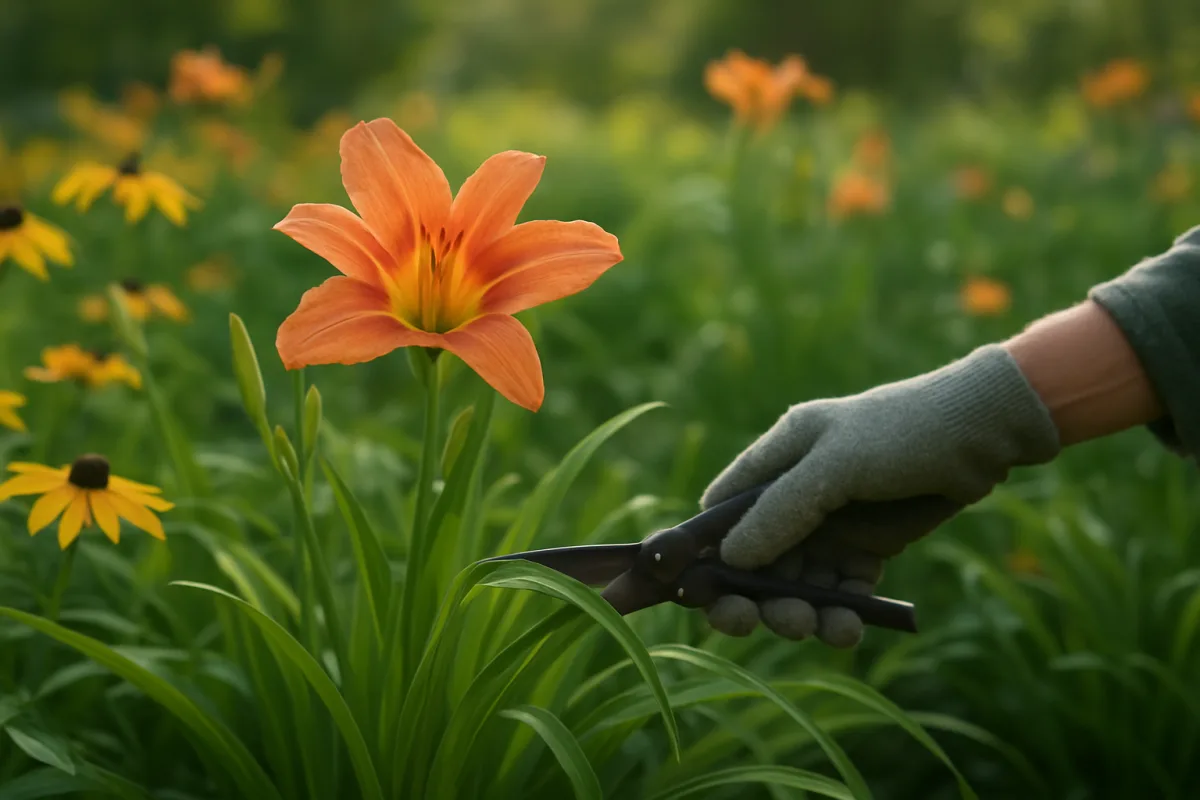
| 🌼 | Definition: the daylily is a robust rhizomatous perennial, also called a one-day lily, known for its ephemeral but very numerous flowers. |
| ☀️ | Ideal exposure: full sun or bright partial shade, with well-drained soil to support flowering. |
| 🪴 | Planting: in open ground or in a large pot, in spring or early autumn, spacing clumps well. |
| 💧 | Key care: regular watering the first year, mulching, removing faded flowers, and moderate fertilization. |
| ✂️ | Enhanced flowering: dividing clumps every 3 to 5 years revives vigor and improves regrowth. |
| 🌺 | Garden asset: a hardy summer perennial, reliable in beds, borders, or pots, with very varied cultivars. |
Daylily Care: The Complete Guide to Planting and Reblooming
The daylily is a flexible and hardy summer perennial, appreciated for its abundant flowering and its ability to return each year without excessive demands. Daylily care mainly relies on three simple levers: good planting, well-drained soil, and regular actions at the right time. Properly managed, it blooms for a long time and thickens without becoming invasive.

If you are looking for a reliable plant, it is especially important to distinguish noise from the real problem: a daylily that blooms little is not necessarily sick. It often signals a lack of light, a clump that is too tight, excess nitrogen, or simply a need for division. The right reflex is to observe the context before correcting.
What is a daylily?
The daylily, of the genus Hemerocallis, is a rhizomatous perennial with strap-like foliage. It is also called a one-day lily because each flower opens for a short duration, often just one day. This brevity is not a flaw: the plant multiplies flower stalks and renews its buds over a long period.
Daylily or true lily: the useful difference in the garden
Confusion is common, but it is quickly resolved. The lily belongs to the genus Lilium and grows from a bulb, with leaves borne on the stem. The daylily forms a dense clump, evergreen or semi-evergreen depending on the cultivars, and has narrow leaves emerging from the base. This detail matters for planting, dividing, and care.
Why choose the daylily for the garden?
Because it combines three rare qualities: generous flowering, solid hardiness, and true versatility of use. The daylily establishes well in beds, borders, slopes, or large pots. It tolerates contrasting summers well, returns faithfully, and mainly requires consistent soil and water management.
- It withstands cold winters without heavy protection.
- It adapts to most gardens if the drainage is adequate.
- It offers cultivars of varying heights, colors, and flowering periods.
- It is suitable for minimally equipped gardens, provided it is planted correctly.
What are the ideal growing conditions?
The right location does most of the work. A daylily placed in the sun, in fertile but well-drained soil, produces more buds and maintains a neat clump. It tolerates bright partial shade, but flowering then becomes less abundant. The soil must remain loose, never compacted or waterlogged.
Exposure
Full sun daylilies give the best blooms in most regions. In very hot climates, slight shade in the late afternoon limits water stress. On the other hand, dense partial shade elongates the foliage, reduces the number of flower stalks, and weakens reblooming.
Soil
Fertile, slightly cool, and well-drained soil remains the foundation. In heavy soil, the structure must be lightened with mature compost, some coarse sand, or fine gravel depending on the context. The goal is not to impoverish, but to avoid stagnant water around the fleshy roots.
Climate and hardiness
The hardy daylily tolerates cold very well, but it reacts poorly to prolonged winter moisture if the ground is suffocated. In dry areas, it survives well, but flowering then depends more clearly on summer watering and mulching.
How to plant a daylily without missing the establishment?
Establishment depends less on a spectacular gesture than on precise planting. Place the clump in loosened soil, with the crown at ground level, without burying it too deeply. Water generously at planting, then maintain regular moisture during the first weeks. This is the best foundation for effective daylily care.
| Period | Action | Goal |
| Spring | Plant after severe frosts | Allow the clump to establish before summer |
| Early autumn | Plant in still warm soil | Encourage rooting before winter |
| After planting | Water deeply | Eliminate air pockets around the roots |
| First season | Mulch and monitor moisture | Support establishment without excess water |
Steps for planting in open ground
- Dig a wide hole, about twice the width of the root ball.
- Loosen the bottom and incorporate a handful of mature compost if the soil is poor.
- Place the root ball without burying the crown; roots should be spread out, not bunched.
- Backfill, lightly firm, then water abundantly.
- Maintain a spacing of 40 to 60 cm depending on the vigor of the variety.
Pot planting
Daylilies in pots work very well if the container is wide, deep, and perforated. Use a draining mix enriched with organic matter, then water more regularly than in open ground. The weak point of the pot is not the plant, but how quickly the substrate dries out or compacts.
How to care for the daylily throughout the seasons?
Daylily care follows a simple rhythm. In spring, you get the clump going again. In summer, you support flowering without excess. In autumn, you prepare dormancy and division if necessary. In winter, you especially avoid stagnant water. The plant requires consistency, not heavy monitoring.
In spring
Clean the clump by removing dry leaves, damaged stems, and accumulated debris. Apply a thin layer of mature compost or a low-nitrogen fertilizer. The idea is to support growth without forcing foliage at the expense of flowers.
In summer
Water deeply during dry periods, preferably once well rather than often superficially. The daylily prefers watering that penetrates the soil. Also watch for water stress: leaves folding, aborted buds, or shorter flowering. This is often where the quality of the summer is decided.
In Autumn
When the flowering declines, you can cut back the flower stalks and remove the very marked leaves. In mild climates, let the foliage complete its cycle naturally. In heavy soil, a light mulch protects the crown while preventing crusting. Autumn is also the right time for dividing overly dense clumps.
In Winter
The daylily enters dormancy. Intervene almost not at all, except to correct excess water or improve drainage. In soils very exposed to frost, mulching helps stabilize the crown. There is no need to cover the plant heavily: it fears suffocation more than dry cold.
How to get more flowers on a daylily?
To increase flowering, you must first find the right balance between light, space, and nutrients. A well-established clump in the sun, not too crowded and moderately fed, produces more flower stalks. Daylily flowering responds poorly to excesses; it prefers regularity.
- Provide at least half a day of direct sunlight.
- Maintain deep watering during dry spells.
- Apply compost, but avoid fertilizers that are too nitrogen-rich.
- Cut faded flowers to concentrate energy on new buds.
- Divide older clumps that flower less.
In practice, the quality of flowering also depends on the cultivar. Some varieties are very remontant, others focus their effort on a brief but spectacular summer wave. Therefore, you must compare daylily varieties according to the desired effect, and not expect the same response from all plants.
Why is the daylily not flowering?
Most often, the absence of flowers comes from a simple imbalance: too much shade, too much nitrogen, lack of water in summer, or an aging clump. A daylily that grows well but flowers little sends a clear signal. The context must be tested before talking about disease or permanent weakness.

| Symptom | Probable Cause | Useful Correction |
| Many leaves, few flowers | Too dense shade or overly rich fertilizer | Move, thin out, or reduce nitrogen |
| Buds drying out | Water stress | Water more deeply and mulch |
| Clump weakening | Lack of space, aging | Divide and replant vigorous offsets |
| Short flowering | Non-remontant variety or strong heat | Choose a suitable cultivar and monitor water |
Pests and Diseases to Watch For
Slugs, snails, and sometimes aphids can bother young shoots or buds. In overly wet soil, leaf spots and some rots develop faster. Prevention remains simple: air around the clump, proper drainage, watering at the base, and cleaning affected leaves.
How to divide and multiply a daylily clump?
Division of clumps is done every 3 to 5 years on average, as soon as the center weakens or flowering decreases. It is the most reliable method to regenerate an aging plant. Division is not done for the sake of it, but because the clump shows a real need for reorganization.
- Dig up the clump with a well-sharpened spade, keeping as many roots as possible.
- Gently shake off the soil to identify the most vigorous areas.
- Separate into clean offsets, each with at least a fan of leaves and healthy roots.
- Replant without delay in prepared soil and water immediately.
- Cut damaged leaves to limit dehydration.
After division, recovery is often quick if water is not lacking. The classic mistake is to let the offsets dry in the sun for an hour too long. Here again, the method matters more than firmness: a clean cut, quick replanting, and thorough watering give much better results than a rough intervention.
Which varieties of daylilies to choose?
The right choice depends on the available space, the style of the flower bed, and the desired flowering duration. Compact varieties are suitable for small spaces and pots. Repeat bloomers are interesting for those who want a long-lasting presence. Large cultivars provide a more spectacular effect at the back of the bed. Color alone is not enough: height, reblooming, and vigor are just as important.
- For small gardens: compact cultivars, contained habit, clear flowering.
- For a long season: repeat-blooming varieties, capable of producing new buds.
- For graphic flower beds: yellow, orange, red, or bicolor blooms.
- For cool areas: robust subjects, very hardy and little sensitive to temperature fluctuations.
With which plants to associate daylilies?
Daylilies go well with perennials that have the same needs: sun, well-drained soil, and reasonable maintenance. In a flower bed, they work particularly well with grasses, echinaceas, rudbeckias, or garden irises. The idea is not to accumulate colors, but to create flowering rhythms and complementary volumes.
Quick maintenance calendar for daylilies
This calendar summarizes the key actions to remember without overloading the routine. It allows you to keep a simple, clear, and effective framework, whether you grow the plant in the ground or in a pot. The goal is always the same: support flowering without blind corrections.
| Season | Main action | Objective |
| Spring | Clean the clump, lightly enrich, restart watering | Prepare for growth surge |
| Summer | Water at the base, cut faded flowers, monitor dryness | Extend daylily flowering |
| Autumn | Divide if needed, remove dry stalks, mulch | Renovate the clump before dormancy |
| Winter | Check drainage, limit excess water | Protect the crown without suffocating it |
FAQ about daylilies
Is the daylily a perennial?
Yes. It is a rhizomatous perennial that returns every year and gradually forms denser and denser clumps. Well established, it can last many years without frequent replanting.

When to cut faded flowers?
The best is to remove them as they fade throughout the flowering period. This avoids a neglected appearance and concentrates the plant’s energy on the next buds. Dry stalks can be cut later.
Can daylilies be grown in pots?
Yes, provided you choose a wide, deep, and well-drained pot. The substrate must remain draining, and watering more regular than in the ground. Compact or medium varieties are the most suitable.
Is the daylily toxic?
Yes, it can be for cats, which are particularly sensitive to it. If you have pets, place the plant in an inaccessible area or favor protected flower beds.
How long does a daylily clump live?
A clump can live very long if it is divided and regenerated from time to time. Without intervention, it often remains beautiful for several years, but flowering eventually decreases when the center becomes too dense.
Why is it called “day lily”?
Because an individual flower usually lasts only one day. This does not mean the plant flowers little: buds follow one another on the flower stalks and maintain flowering for several weeks depending on the cultivars.
Should it be fertilized often?
No. Light fertilization is enough. Too much nitrogen favors leaves at the expense of flowers. It is better to apply a moderate amount of compost in spring and, if needed, a balanced fertilizer at a low dose.