| Key Points | Details to Remember |
|---|---|
| 🐕 Origin | Balearic Islands, remnant of Mediterranean greyhounds |
| ☀️ Particularity | Short coat that allows heat to circulate in the sun |
| 🏃 Skills | Hare hunter renowned for its speed and agility |
| ❤️ Temperament | Affectionate with family, independent when hunting |
| 🩺 Care | Daily exercise, minimal brushing, regular check-ups |
| 🏠 Habitat | Large space or frequent outings, need for freedom |
| 🐾 Health | Robust, sensitive to cold and exposed ears |

At first glance, the Ibizan Hound impresses with its slender silhouette, erect ears, and bright, almost solar gaze. This ancient breed, sometimes called the Ibicenco greyhound, embodies the subtle balance between elegance and rusticity: it has crossed centuries on the Balearic Islands before becoming a full-fledged companion in Europe and across the Atlantic. Let’s explore in depth its history, physical characteristics, temperament, and the essential care to make this Spanish greyhound shine in your home.
Origin and History of the Breed
From the Balearics to Worldwide Recognition
One might think it is a recent guest, but the Ibizan Hound is among the oldest lineages of Mediterranean greyhounds. The murals of ancient Crete or Egyptian sculptures already show dogs with a similar appearance, suggesting a spread through the Mediterranean basin. When the Phoenicians and Romans sailed to the Balearics, these greyhounds accompanied them, taming hares, rabbits, and other small game.
Evolution and Standardization
In Spain, until the 19th century, the Ibizan greyhound came in two varieties: smooth coat and wire coat. British and French breeders in the 1900s gradually codified the standard, favoring the smooth coat variety. With the recognition of the first breed club in 1935, its elegant profile and hunting performance won admiration. Today, recognized by the FCI and major cynological clubs, the Ibizan Hound maintains this reputation as a tireless hunter and an atypical companion.
Physical Characteristics

Size, Proportions, and Appearance
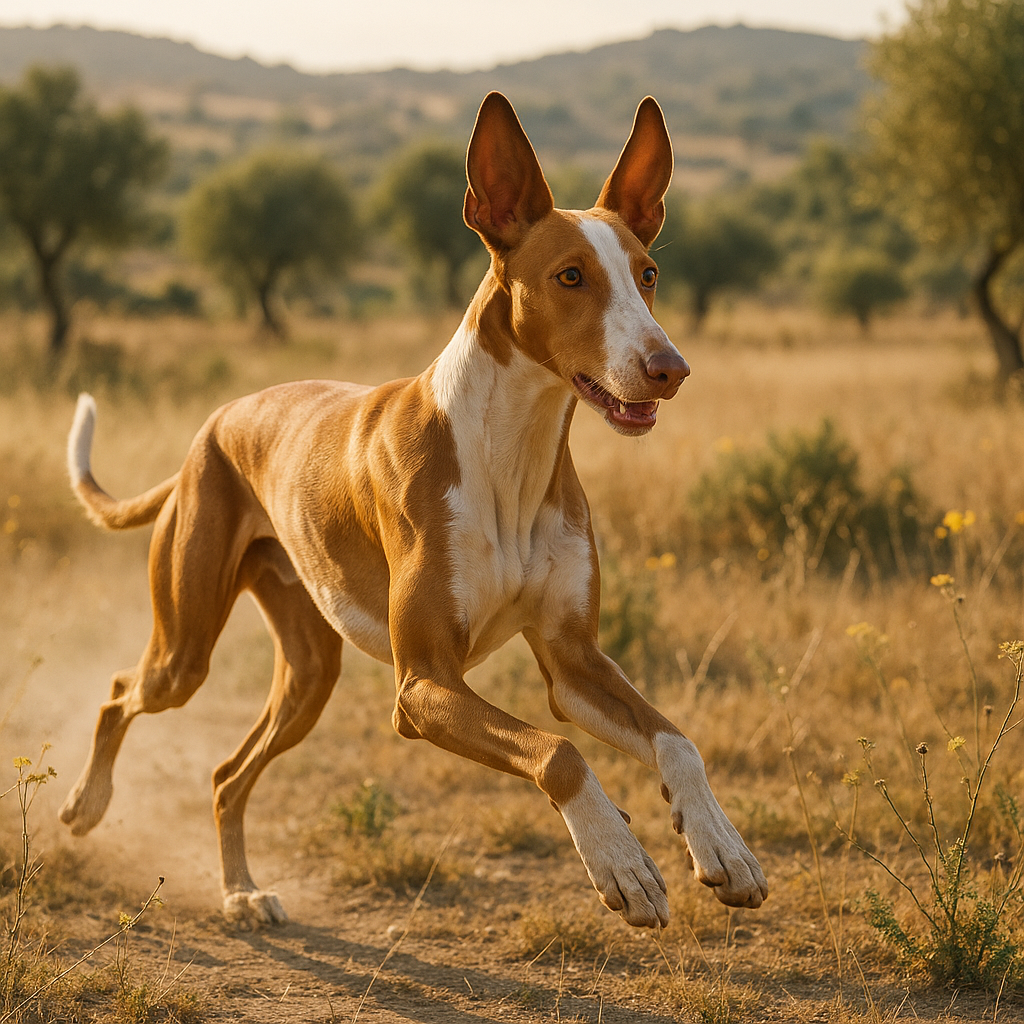
Between 53 and 64 cm at the withers for an average weight of 20 to 27 kg, the Ibizan Hound evokes both lightness and controlled power. Its slender body rests on sturdy limbs, endowed with a lean bone structure. This aerodynamic profile allows it to easily reach 40 km/h in pursuit. Movements are fluid, almost choreographed, reflecting a toned musculature without unnecessary heaviness. One can always sense under the skin a muscular density designed for intense leaps and sprints.
Coat, Color, and Emblematic Ears
The short, close, and glossy coat offers minimal protection against the cold but optimal cooling in the sun. The most frequent colors range from light fawn to brick red, often spotted with white. The ears, wide at the base and pointed at the top, contribute not only to the expressive look but also improve auditory perception. This asset is crucial during the hunt, where identifying the game’s run at approach remains a primal reflex.
Temperament and Behavior
An Independent and Thoughtful Greyhound
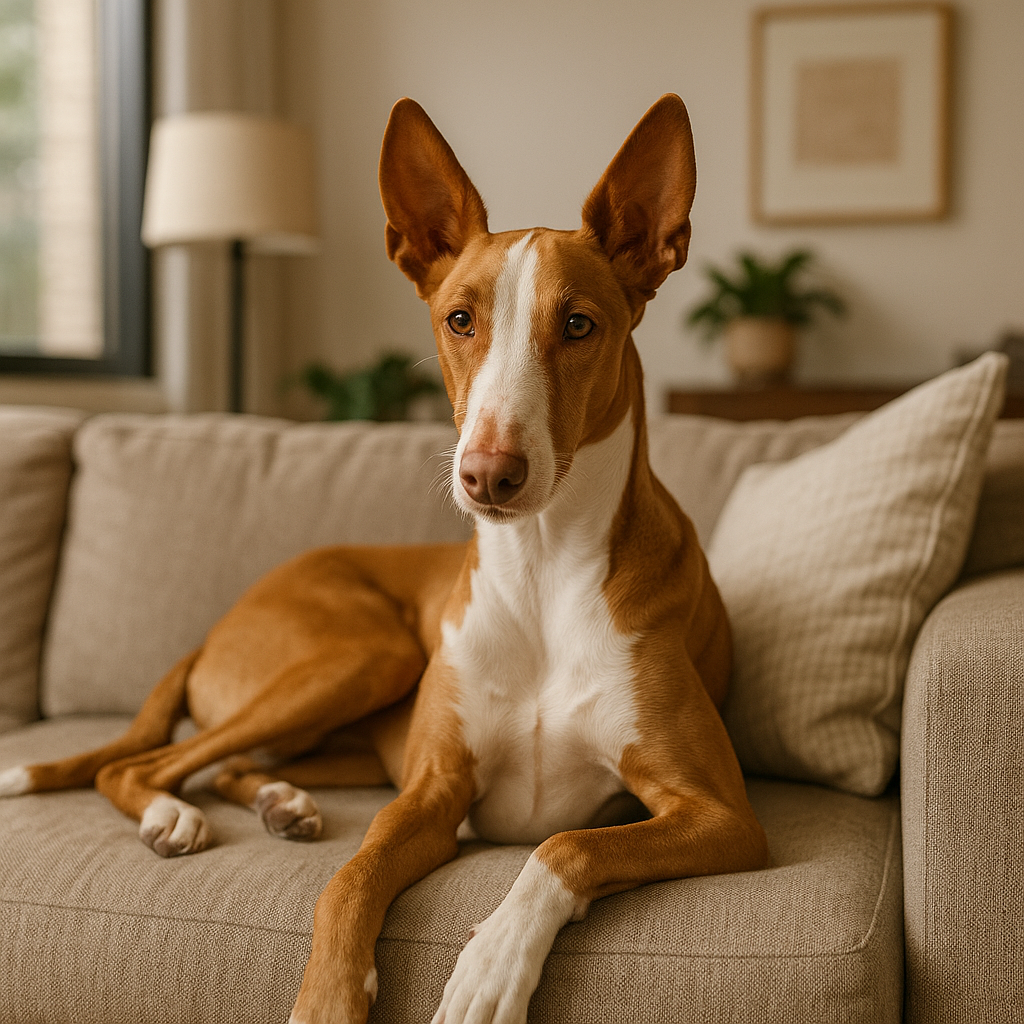
The Ibizan Hound stands out for a measured curiosity: it only barks when a stimulus requires it, but responds promptly to basic commands, especially if the bond of trust is established early. Unlike other greyhounds, less inclined to obedience, it shows a form of cooperation, provided that learning is based on motivation rather than coercion. Its character reveals a hint of stoicism, a don’t-care attitude towards gratuitous flattery.
Relations with Family and Sociability
In a domestic setting, it is gentle, almost shy with strangers, but without aggression. It becomes particularly attached to a human referent, who becomes its anchor point. Awake, respectful children who are quick to play are its preferred partners. With other dogs, early socialization is essential: it tolerates its peers well, especially if exercise allows it to drain its energy. On the other hand, cohabitation with small rodents or birds will require vigilance, as its hunting instinct remains intact.
Health and Specific Care
- Daily exercise: minimum 1 hour of running or intensive play to maintain its mental balance.
- Adapted nutrition: protein-rich ration, adjusted according to activity, to maintain muscle mass.
- Protection against cold: coat recommended in winter, especially for prolonged walks.
- Coat maintenance: weekly brushing is sufficient; sometimes, a grooming glove enhances shine.
- Ear care: regular cleaning to prevent ear infections, as the wide shape catches more dust.
Common Conditions and Prevention
Overall robust, the Ibizan Hound nevertheless presents a typical joint sensitivity seen in greyhounds: hip dysplasia and potential sprains during intense efforts. Radiographic assessments before 2 years old are a means of screening. Furthermore, vigilance regarding hereditary eye problems, such as progressive retinal atrophy, is justified. An annual visit to a canine ophthalmologist can therefore prove wise.
| Aspect Monitored | Warning Signs |
|---|---|
| Hips | Limping, difficulty getting up |
| Eyes | Abnormal reflection, frequent blinking |
| Weight | Sudden loss or gain |
| Ears | Redness, unusual odor |
Choosing and Welcoming an Ibizan Hound
Adopting via a Breeder or a Shelter
For a responsible approach, favor a recognized breeder, capable of providing health certificates of the parents and explaining the lineages. In a shelter, some Ibizans arrive following abandonment; they are already socialized but may require an adaptation phase. In both cases, visit the living environment of the puppies or adults: an open space, stimulation, and a minimum of human contact are reassuring indicators.
Home Arrangement
Essential: a dedicated resting area, away from drafts. A smooth floor is not ideal; prefer a rug or an orthopedic cushion to preserve the joints. A fenced garden or regular access to a dog park allows satisfying its need for speed and exploits. For apartment living, compensate with several outdoor running sessions and integrate intelligence games to avoid boredom and separation anxiety.
FAQ
- What is the life expectancy of an Ibizan Hound?
12 to 14 years on average, with regular veterinary care and an active lifestyle. - How much exercise does this greyhound need each day?
At least 1 hour to 1 hour 30 minutes of running or intense play, plus some relaxation time. - Does the coat require maintenance), too much?
No, weekly brushing and ear cleaning are generally sufficient. - Does it get along with other animals?
Yes, if socialization is early, but be careful with small rodents and birds. - Can it tolerate the cold?
Rather vulnerable when temperatures drop: a coat and short walks are recommended.