✨In brief: What you really need to remember about the Malinois
- 🧠Character: An active dog, intelligent, loyal and sometimes explosive – it absolutely needs an active and stimulating life.
- 👨👩👧👦For whom: Perfect for athletes, trainers, involved families… to be avoided for beginners or sedentary people.
- ⚖️Category: Not categorized in France, the Malinois is not considered dangerous by law.
- 📏Size: Male: 60–66 cm, 28–34 kg. Female: 56–62 cm, 20–25 kg.
Life expectancy: 10–14 years. - 💪Particularities: Strong health, short coat easy to maintain, but beware of hip dysplasia.
- 🐶Puppy: Requires early and rigorous training, intensive socialization from the first weeks.
- 💶Price: 800–1,500 € at purchase, annual budget of 1,300–1,500 €.
- 🔍Key differences: More nervous, more “square” and athletic than the German Shepherd.

Origins and history of the Belgian Malinois Shepherd
The Malinois is an icon of Belgian cynology. Its history dates back to the late 19th century, in the Malines region, where it was selected for its robustness and protective instinct. It is the most rustic of the four varieties of Belgian shepherds (with the Tervueren, the Groenendael, and the Laekenois), officially recognized in 1909.
“The Belgian Malinois Shepherd is the Swiss army knife of working dogs. From the fields of rural Belgium to elite brigades worldwide, it has established itself wherever intelligence and courage are sought.”
– Professional breeder, Walloon Brabant
Today, it is omnipresent in the police, gendarmerie, army, but it also increasingly attracts sporty families or those passionate about canine sports.

Morphology, standard and colors of the Malinois
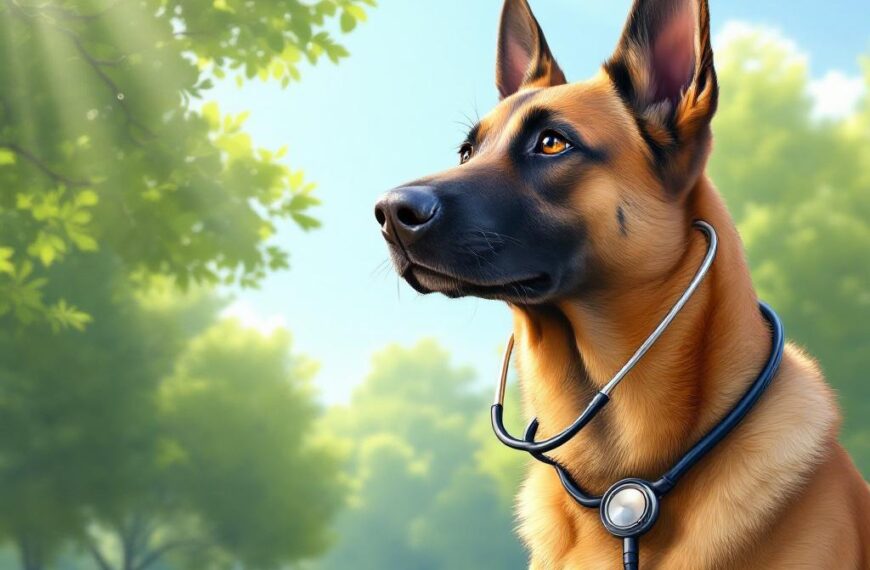
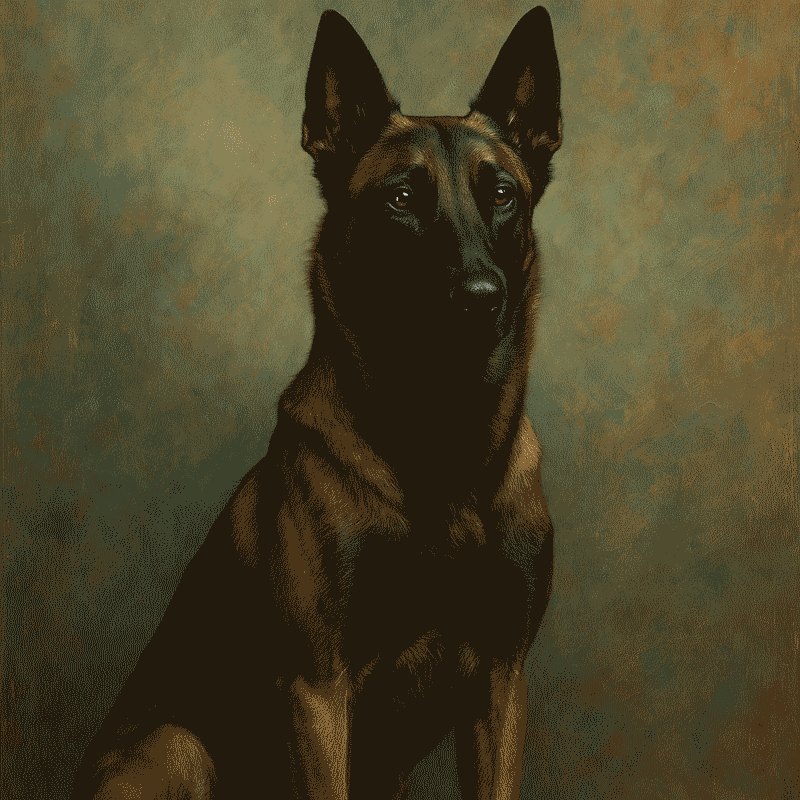
Impossible to confuse an adult Malinois: athletic silhouette, prominent muscles, sharp gaze, proud and dynamic bearing. It is known for its “square” line, with a body length equal to the height at the withers. Its head, long and dry, is topped with triangular ears, always erect.
The Malinois coat is short and dense, fawn with black overlay, with a black mask covering the muzzle, sometimes the ears. The hairs appear longer on the tail and around the neck. If you hear about “black” or “long-haired” Malinois, beware: these are lines not officially recognized.
| Sex | Height at withers | Adult weight | Coat |
|---|---|---|---|
| Male | 60–66 cm | 28–34 kg | Fawn with black overlay, black mask |
| Female | 56–62 cm | 20–25 kg | Fawn with black overlay, black mask |
- Body: straight back, strong loins, well-developed chest.
- Tail: hanging at rest, darker at the tip.
- Eyes: dark brown, expressive, almond-shaped.
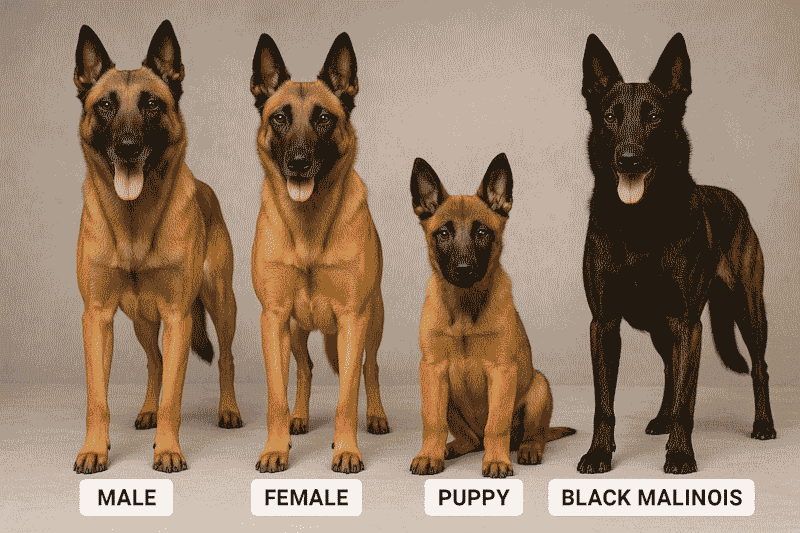
“A well-built Malinois is the perfect balance between power and elegance. Its morphology reflects its temperament: ready to leap, always alert.”
– Judge of the Central Canine Society
Character, behavior and intelligence of the Malinois
This is THE breed synonymous with energy and intelligence. The Malinois is never satisfied with little: it needs to work, learn, play, be challenged. Its protective instinct is very strong – it will naturally defend family and home without hesitation.
It can be the best companion for a committed family, capable of channeling its energy through education, games, and canine sports. It also knows how to be affectionate, sometimes clingy, but it does not like solitude or inactivity.
- Very playful, sometimes barky (but never without reason)
- Incredible learning ability, a “hard worker” at heart
- Can become destructive or hyperactive if poorly stimulated
- Strong protective instinct, but accepts children/animals if well socialized
- Natural reserve towards strangers (never fearful)
“A happy Malinois is a dog that goes out, runs, thinks and shares everything with its owner.”
– Dog trainer, Alsace

The Malinois puppy and the female: specifics, adoption, education
A Malinois puppy is a bundle of energy and curiosity. Training must begin from the first weeks. From 8 weeks old, you need to work on cleanliness, socialization with humans/animals, bite inhibition, the basics of obedience… Strictness is essential: a poorly trained puppy can become difficult to manage as an adult.
- Short but varied learning sessions: he gets bored quickly, he loves challenges!
- No violent games, no early stimulation of guarding instinct: it will come naturally later.
- Expose the puppy to all kinds of noises, places, people, animals.
The female Malinois is often a bit more sensitive and refined than the male, but just as sporty and hardworking.
“The key with the Malinois is consistency: the slightest flaw in training is remembered for life. But that’s also what makes this dog so intelligent and endearing.”
– Canine behaviorist, Lyon
For adoption, favor serious breeders, avoid fearful or “too calm” puppies. Don’t hesitate to ask to see the parents and their health certificates (dysplasia, eyes…).

Health, diseases and life expectancy
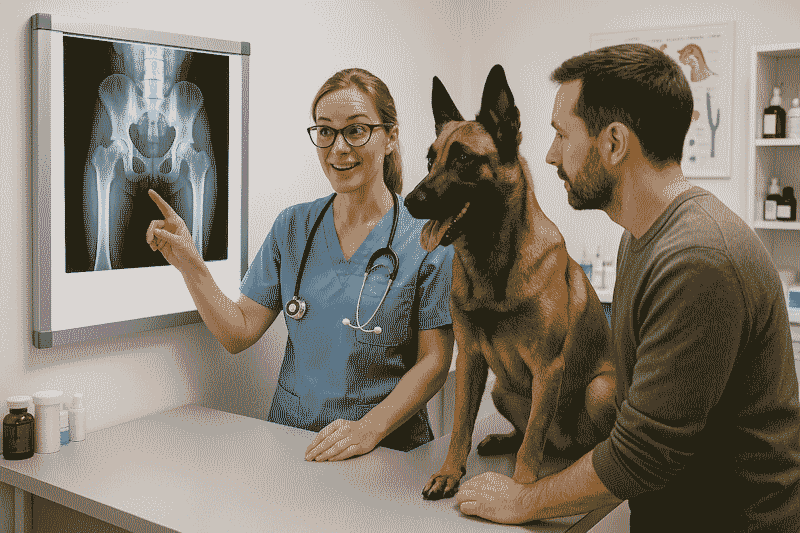
The Malinois is a robust, rustic breed, often very resilient. Its average lifespan is 12 years, but many live longer. However, like any medium to large-sized dog, it is not without vulnerabilities.
- Hip and elbow dysplasia: be sure to check the parents’ tests before buying a puppy.
- Eye problems (progressive retinal atrophy, cataract…)
- Sensitivity to anesthesia (be careful during veterinary operations)
- Sometimes: epilepsy, hypothyroidism, tumors
- Not hypoallergenic
“A well-fed, well-muscled Malinois, regularly checked by the vet, has every chance of living long and in great shape.”
– Dr. Lefèvre, veterinarian in Toulouse
An animal health insurance is recommended to cover unforeseen events (especially for active dogs).
Malinois Nutrition: Puppy, Adult, Senior
This dog is an athlete: it needs champion-level nutrition. Favor “premium” kibble, rich in protein and adapted to its age and activity level. A Malinois puppy must eat often, but in small amounts to avoid digestive overload.
- Active adult: kibble for active dogs, with a ration adapted to exercise.
- Senior: lower-calorie diet to limit overweight, weight monitoring essential.
- Meal splitting: two meals per day, never exercise immediately after eating (risk of stomach torsion).
- Fresh water at all times!
“The secret to a Malinois always in shape is the quality of proteins… and the regularity of meals!”
– Animal nutrition advisor

Care, Grooming and Hygiene
Good news: the Malinois is easy to maintain. Its short coat requires weekly brushing, even daily during the shedding seasons of spring and autumn. No need to bathe it frequently, unless it is really dirty.
- Regularly clean its ears, eyes, teeth (watch out for tartar).
- Trim nails if necessary (risk of cracking otherwise).
- Check for parasites especially after walks.
“A well-brushed Malinois means a shiny coat… and much less hair on your couch!”
– Grooming salon, Strasbourg

Activities and Sports: The Tireless Malinois
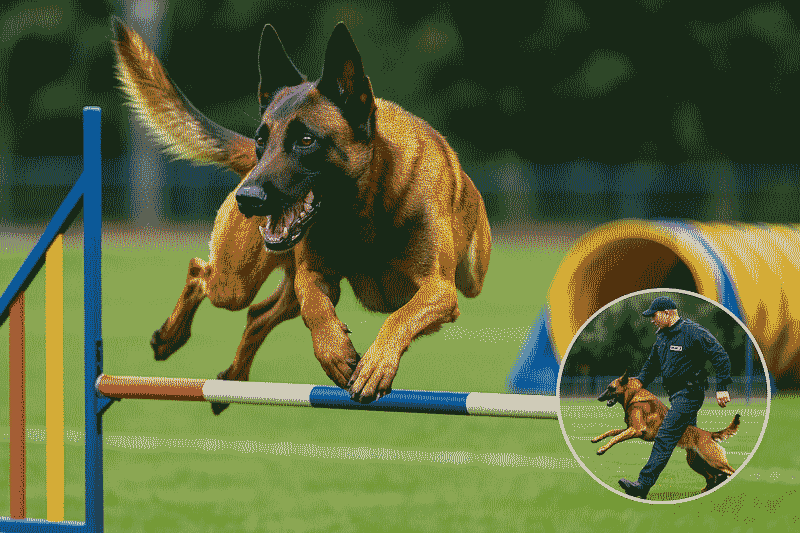
It is one of the most versatile dogs in the canine world. The Malinois excels in agility, obedience, ring, tracking, canicross, search and rescue, police intervention, etc. It needs to expend AT LEAST two hours a day: a garden is not enough, it needs to run, think, feel useful.
- Puppy: favor a variety of games and gentleness, no prolonged effort before 1 year old.
- Adult: favor contact and obedience sports, regular and varied outings.
- Ideal for: sporty owners, active families, professional dog handlers.
“Diesel, a Malinois female from RAID, left a mark on the collective memory during the Bataclan assault in 2015. A symbol of the breed’s courage and versatility.”
– National press
Price, adoption, annual budget
The price of a Malinois puppy ranges between €800 and €1,500 depending on the lineage and the breeder’s reputation. An annual budget of €1,300 to €1,500 should be anticipated (food, health, accessories, insurance…).
| Item | Estimated annual cost |
|---|---|
| Food | €600–800 |
| Veterinary | €200–400 |
| Insurance | €250–400 |
| Accessories | €200–300 |
| Total | €1,300–1,500 |
It is possible to adopt from shelters, specialized associations, or breeders. In all cases, ask for health tests and meet the puppy’s parents if possible.
“The Malinois is attracting more and more adopters, but beware: it’s an investment of time and energy, not just money!”
– SPA Volunteer

Malinois and legislation: category, dangerousness
The Belgian Malinois Shepherd is not a categorized dog (neither category 1 nor category 2) under French law. Therefore, it does not require a mandatory muzzle, except in cases of local decree or problematic behavior.
Its “dangerous” reputation is unfounded: a well-trained Malinois is never aggressive without reason. The danger most often comes from a lack of stimulation or education, never from the breed itself.
“The law is clear: the Malinois is NOT a naturally dangerous dog. Its power simply requires responsible owners.”
– Animal law expert
Malinois or German Shepherd? The real differences
The Malinois and the German Shepherd are two related breeds, but very different in attitude and temperament. The former is more square, livelier, more nervous; the latter more composed, more tolerant of typical family life.
| Criterion | Malinois | German Shepherd |
|---|---|---|
| Morphology | Lean, square, muscular | More massive, sloped back |
| Coat | Short, dense | Medium to long |
| Character | Lively, nervous, intense | Calm, protective |
| Health | Hardy | More prone to dysplasia |
| Work aptitude | Police, dog sports | Family, versatile |
“If you like challenges, choose a Malinois. If you prefer stability, the German Shepherd remains a safe bet.”
– Dog trainer
Complete FAQ on the Malinois
- What is the size of an adult Malinois?
- A male measures between 60 and 66 cm at the withers, a female between 56 and 62 cm.
- Can a Malinois live in an apartment?
- Yes, provided its physical and mental activity needs are met daily.
- Is the Malinois dangerous or categorized?
- No, it is not categorized as “dangerous” in France.
- Does the Malinois come in black or long coat?
- The official standard only recognizes the short fawn coat with black overlay and black mask.
- What are the differences with the German Shepherd?
- Morphology (more square and lean), character (more lively), health (less prone to dysplasia), coat (short vs long).
- What budget should be planned?
- About €1,300 to €1,500 per year, purchase between €800 and €1,500 from a reputable breeder.
- Is the Malinois hypoallergenic?
- No.
- Where to adopt a Malinois puppy?
- From a recognized breeder or through specialized shelters.
- Is the Malinois easy to train?
- No, it requires experience, rigor, and a lot of availability.
- How many puppies in a Malinois litter?
- Usually between 6 and 10 puppies.
Sources & References
- FCI Standard
- Central Canine Society
- Woopets, Wikipedia, Purina
- Interviews with breeders & veterinarians