

| Key Points | Details to Remember |
|---|---|
| 🐕 Definition | Powerful guard dog, originating from South Africa. |
| 🌍 Origin | Crossbreed of Mastiffs imported by Dutch settlers. |
| ❤️ Character | Loyal, protective and surprisingly gentle with the family. |
| 📏 Size & Weight | 55–70 cm at the withers, 50–80 kg depending on sex. |
| ⚕ Health | Robust but sensitive to dysplasias and certain imbalances. |
| 🏡 Daily Life | Needs space, exercise, and consistent training. |

It is enough to meet the gaze of a Boerboel to sense its strength, without forgetting its innate gentleness. Highly valued in South Africa for its vigilance, this dog commands respect wherever it goes, while weaving bonds of surprising tenderness with its own. In this article, we dive into the world of this fascinating breed: from its colonial origins to the demands of its daily life, including the secrets of its character.
History and Origins of the Boerboel
In the 17th century, Dutch settlers brought with them sturdy working dogs, ancestors of European Mastiffs. In South Africa, these mastiffs crossed with local lineages, giving birth to the Boerboel, literally “farm dog” in Afrikaans. Farmers sought a companion capable of protecting fruit and vegetable plantations, guarding livestock, and defending property against predators. Over generations, selection was based on health, courage, and emotional stability. Today, the Boerboel remains an emblem of South African heritage, recognized for its balance between power and calm temperament.
Physical Characteristics

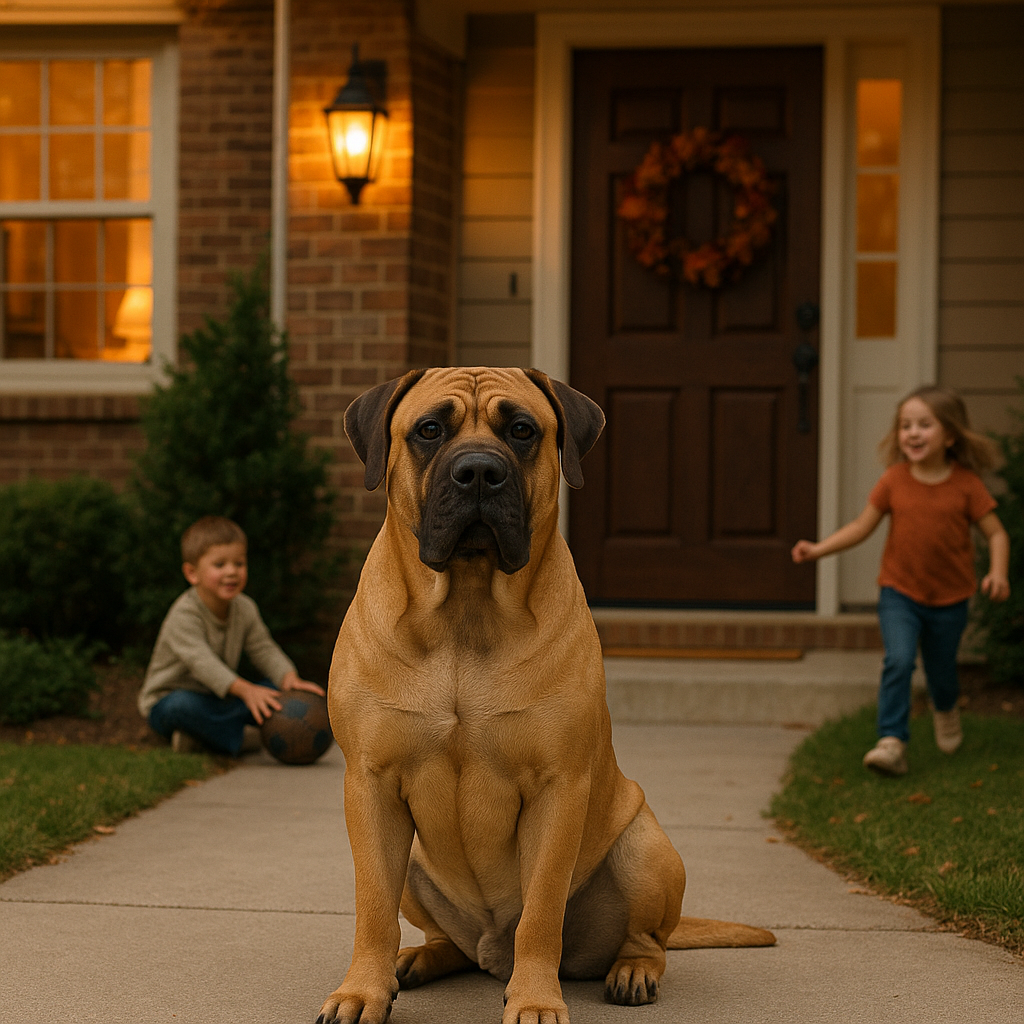
Its build impresses: a broad skull, powerful jaws, a muscular and stocky body. The head shows subtle wrinkles above the eyes, contributing to a serious and protective look. Colors range from brindle to fawn and masked black. Although massive, its bone structure remains harmonious, avoiding excess heaviness. Males often reach 70 cm at the withers, weighing 60–80 kg, while females are slightly slimmer and lighter. The gait is fluid, almost elegant, when the dog moves freely.
Temperament and Behavior
A Determined Guardian
The Boerboel is not an improvised guard dog: its protective instincts are expressed with calm and clarity. Faced with a threatening situation, it quickly assesses before intervening. Unlike more lively or nervous breeds, it avoids excessive reactions, preferring physical demonstration only when strictly necessary. At home, it becomes a silent barrier, always attentive to comings and goings. Its deep bark can be enough to deter an intruder.
An Unexpected Gentleness
One might think such a size equates to roughness, but in fact, the Boerboel reveals itself to be very tender with children and family members. It loves closeness, appreciates petting, and often shows patience with the youngest. Some owners report that it deliberately lies down at the height of little ones to share a moment of complicity. This duality between strength and gentleness creates a unique, almost fusion-like bond.

Education and Socialization
Training a Boerboel requires consistency and a caring approach. It is not about domination, but rather establishing a relationship based on trust. The first weeks at home are crucial: gradual introduction to different environments, meeting other dogs, and getting used to household noises. Basic obedience exercises – sit, lie down, heel – lay the foundation for a balanced dog. With a firm but fair owner, the Boerboel will willingly respond to commands and enjoy carrying them out.
Health and Life Expectancy
Common Diseases
Like many large breeds, the Boerboel can be prone to hip and elbow dysplasia. A rigorous selection of breeding stock, with radiographic examinations, significantly reduces these risks. There are also some cases of mast cell tumors, relatively common tumors in large dogs. Regular veterinary check-ups allow early intervention and adjustment of diet or supplements to preserve joint health.
Preventive Care
Simple maintenance is generally sufficient: bi-weekly brushing to limit dead hair, regular checks of ears and paw pads. Exercise sessions should be adapted to his age: limit jumping and high-speed running until growth is complete, around 18 months. In adulthood, plan daily walks of at least one hour, complemented by puzzle games to stimulate his intelligence.
Daily Life with a Boerboel
Diet and Ideal Weight
The diet must be of good quality, rich in protein and balanced in essential fatty acids. Prefer a premium food adapted to large breeds, or a homemade ration under veterinary supervision. Portions vary according to activity: between 400 and 800 g of kibble per day, divided into two meals, help maintain an optimal weight without overloading the joints.
Exercise and Mental Stimulation
A fenced garden is highly recommended. The Boerboel loves to run, dig, patrol. Without suitable space, he may spin around or adopt destructive behavior. Tracking games, obedience-rhythm courses, or supervised bite work are excellent ways to channel his energy. His intelligence also requires canine puzzles to avoid boredom.
Summary: The Essence of the Boerboel
The Boerboel combines power and kindness, offering unwavering protection to its family while showing unexpected tenderness. A demanding breed, it requires an adapted environment, consistent training, and constant commitment. In return, you gain a loyal, courageous companion with unwavering fidelity.
FAQ
- What size does an adult Boerboel reach? On average 55–70 cm at the withers and 50–80 kg, depending on sex.
- Is it suitable for apartment living? No, it requires a large enclosed outdoor space and frequent outings.
- At what age should training begin? From 8 weeks, with short and positive sessions to reinforce socialization.
- What is the life expectancy? Between 9 and 12 years, provided regular veterinary care and a balanced diet.
- Is the Boerboel good with children? Yes, it is a patient and protective companion, provided early socialization.



