
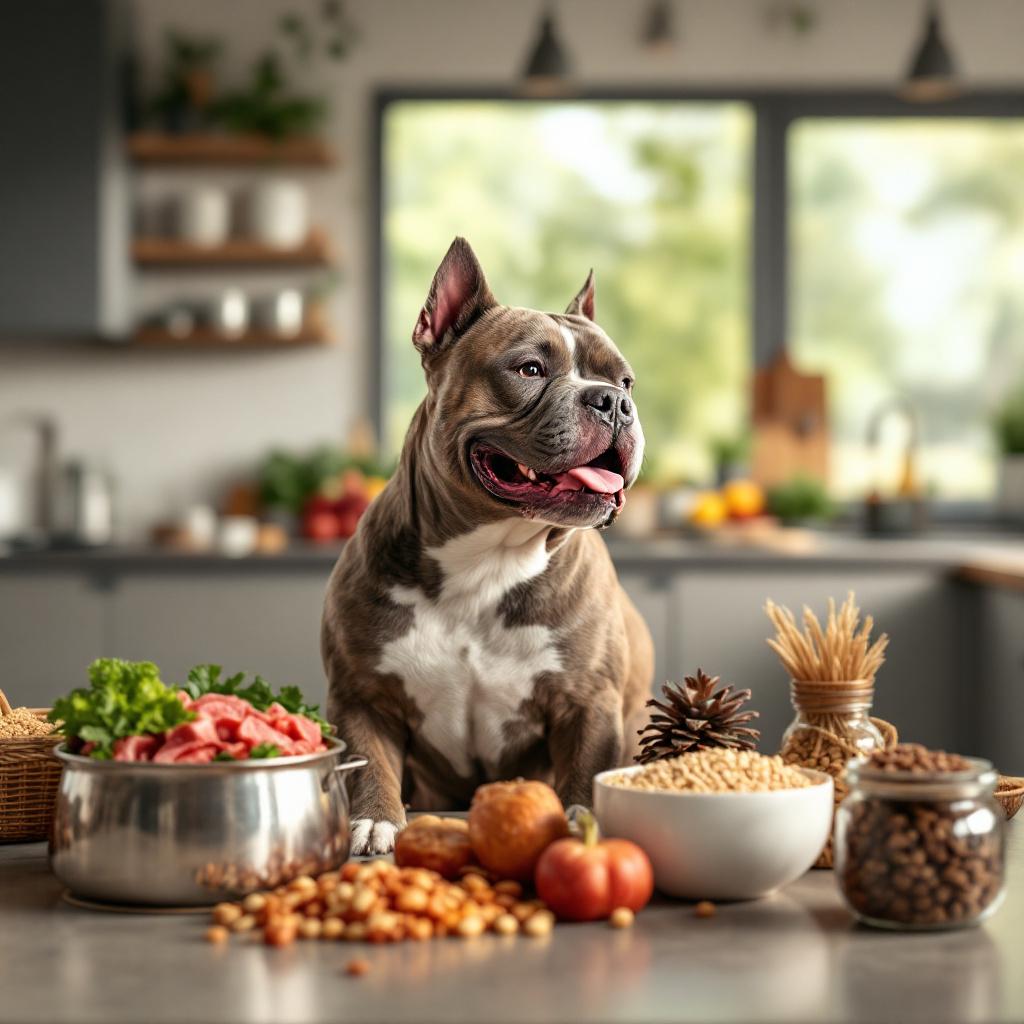

During its growth, an American Bully XXL displays an impressive appetite and a thirst for muscular development that leave little room for improvisation. Its massive bone frame, exceptional size, and athletic silhouette demand a finely tuned nutritional balance. Rather than giving in to the temptation to multiply kibble ranges, it is better to deeply understand your companion’s specific needs to avoid deficiencies, digestive disorders, or excessive weight gain. This article decodes each macronutrient, compares industrial food and homemade recipes, and offers a meal plan capable of supporting harmonious and sustainable growth.
The particularities of American Bully XXL growth
The Bully XXL is not just a mastiff: it is an athlete in the making, whose joints, muscles, and skeleton evolve at a sustained pace. Between 2 and 18 months, its metabolism burns calories at a high tempo, which translates into a caloric need higher than that of a standard-sized dog.
On the muscular level, a peak in protein synthesis is often observed around 6 to 12 months, a period during which protein intake allows maximizing muscle gain without stressing the kidneys. As for the skeleton, it continues to densify until 24 months, requiring careful monitoring of calcium and phosphorus intake to avoid bone fragility.
This accelerated pace also justifies paying attention to the temperament of this breed and its integration into family life, because an underfed or poorly nourished Bully often compensates with restlessness or anxiety.
Anatomy and bone development
The skeleton of the American Bully XXL features thick bones, especially in the legs and pelvis. To support this structure, a calcium/phosphorus ratio of about 1.2:1 must be provided, without tipping into an excess that could harm the absorption of these minerals. Needs can reach 1.2 g of calcium per 1 kg of body weight per day in young subjects.
Energy and muscle building
With a high energy expenditure, the Bully XXL requires a caloric intake of 1,700 to 2,500 kcal per day depending on its activity level and size. Generally, 25% of calories come from lipids to support connective tissues and 30% to 35% from high-quality proteins to nourish muscle mass.
Essential nutritional needs

The key to successful growth lies in the distribution of macronutrients and the selection of sources. Here, proteins, lipids, and carbohydrates each play a precise role, never encroaching on one another.
Proteins and muscle development
A daily intake of 3 g of protein per kg of live weight is recommended between 2 and 12 months. Animal proteins (poultry, beef, fish) are favored for their complete amino acid profile. By-products and poorly digestible meals are avoided as they do not contribute to muscle fiber construction and can overload the digestive system.
Lipids: the dense caloric source
Lipids provide the most concentrated energy and facilitate the absorption of fat-soluble vitamins (A, D, E, K). A ratio of 5 g of lipids per kg of body weight is suitable to support daily effort and maintain the thick coat of the Bully. Fish oils rich in omega-3 also help calm joint inflammation.
Carbohydrates and Energy Regulation
Contrary to popular belief, carbohydrates are not the enemy of the active dog. They provide quick energy and contribute to intestinal health when sourced from foods like sweet potato or brown rice. However, it is important to limit cereals with a high glycemic index (corn, wheat) to avoid unwanted insulin spikes.
Choosing Between Commercial Food and Homemade Recipes
The “ready-made” option appeals for its convenience but requires careful selection. Conversely, DIY (Do It Yourself) offers complete control, provided one is rigorous about dosages and supplements.
Premium Kibble and Pâtés
Look for ranges specially formulated for large breed puppies, which feature a crude protein content above 30% and an adapted mineral complex. Beware of misleading labels: prefer clear mentions about the origin of meats and precise proportions.
- Advantage: ready-to-use dosage, guaranteed balance.
- Disadvantage: high price, lack of flexibility if variation is needed.
Homemade Recipes and Supplements
A daily menu can combine 50% lean meat, 30% cooked and pureed vegetables, 20% complex carbohydrates, with added supplements of fish oil and powdered oyster shells for calcium. A supply of natural probiotics (yogurt, kefir) promotes a healthy gut flora.
| Element | Daily Quantity |
|---|---|
| Lean meat | 10–15 g per kg of weight |
| Vegetables | 5 g per kg, cooked |
| Carbohydrates | 3–5 g per kg (rice, sweet potato) |
| Fish oil | 1 teaspoon |
| Oyster shells | 1 tablespoon |
The Crucial Role of Micronutrients
Beyond macronutrients, vitamins and minerals guide bone strength, resistance to infections, and the overall vitality of your Bully puppy.
Minerals for a Strong Skeleton
Calcium and phosphorus, working together, form a solid foundation. Trace elements—zinc, copper, magnesium—regulate collagen formation and muscle contraction. A deficiency may manifest as limping or nighttime cramps.
Vitamins and Immunity
Vitamins A and D facilitate bone mineralization, while vitamin E acts as an antioxidant, limiting oxidative stress induced by exercise. Vitamin C, although not essential in dogs, can support healing during intense activity phases.
Meal Frequency and Adjustments
An XXL Bully puppy requires a higher meal frequency than adults to stabilize its metabolism and avoid glycemic spikes:
- 2 to 4 months: 4 meals/day.
- 5 to 8 months: 3 meals/day.
- 9 to 18 months: 2 meals/day.
Beyond this schedule, always observe the silhouette (waistline, flank shape) and the dog’s energy to adjust portions.
Adaptation According to Activity
A sporty XXL Bully, engaged in agility or tracking, may see its caloric ration increase by 10% to 20%. Conversely, a dog on prolonged rest for medical reasons deserves a similar decrease to avoid weight gain.
Common Pitfalls and How to Avoid Them
Even with the best intentions, several traps await the informed owner:
Unintentional Caloric Overload
“I just added a small slice of cheese…” quickly becomes 200 unexpected kcal.
Treats and table scraps accumulate: rather multiply healthy chew toys to channel your Bully’s appetite.
Protein Imbalance
Certain plant-based supplements give a false impression of supplementation while lacking essential amino acids. Never substitute meat with plant proteins without rebalancing the amino acid profile.
Whatever the diet choice, regular monitoring of weight, lean mass, and physical condition in consultation with your veterinarian or a canine nutritionist ensures robust and harmonious growth for your American Bully XXL.