| Key Points | Details to Remember |
|---|---|
| 🐾 Origin | Transformation from fighting dogs to playful companion |
| 🏋️ Morphology | Body muscular and characteristic egg-shaped head |
| 🤣 Character | Spirit playful and innate sense of humor |
| 🏃 Needs | Daily activities to channel energy |
| 🩺 Health | Monitoring of sensitive ears and skin |
| ❤️ Adoption | Strong bond with dynamic families |
With its stocky silhouette, almost oval head, and lively gaze, the Bull Terrier immediately captures attention. It is not a discreet dog, but rather an awakener of emotions: surprise, laughter, sometimes a bit of exasperation – especially when it plays the stuntman at home. More than an extraordinary physique, this British molossus hides a tender heart and a mischievous temperament that could be described as “egg on legs.” Let’s dive together into the quirky world of this uncommon companion.
Origin and History of the Bull Terrier
When mentioning the ancestor of the Bull Terrier, we go back to early 19th century England, where the most virile canine sports developed. The goal was to create a dog both powerful and enduring, capable of standing up to the bull during the famous fights: the pit bull. Over time, passionate breeders wanted to soften these warrior canines by crossing them with more graceful dogs, such as the Greyhound and possibly the Dalmatian.
The result was unexpected: the head took on such a distinctive arched shape that it was compared to an overturned egg, while the body remained robust. From the 1860s, the Bull Terrier left the ring world to be noticed in dog shows. But it was especially the many period photographs, immortalizing this curved muzzle and small almond-shaped eyes, that cemented its status as a curiosity. Today, it is no longer a fighting athlete but retains this aura of exuberance inherited from its ancestors.
Physical Characteristics
Silhouette and Bone Structure
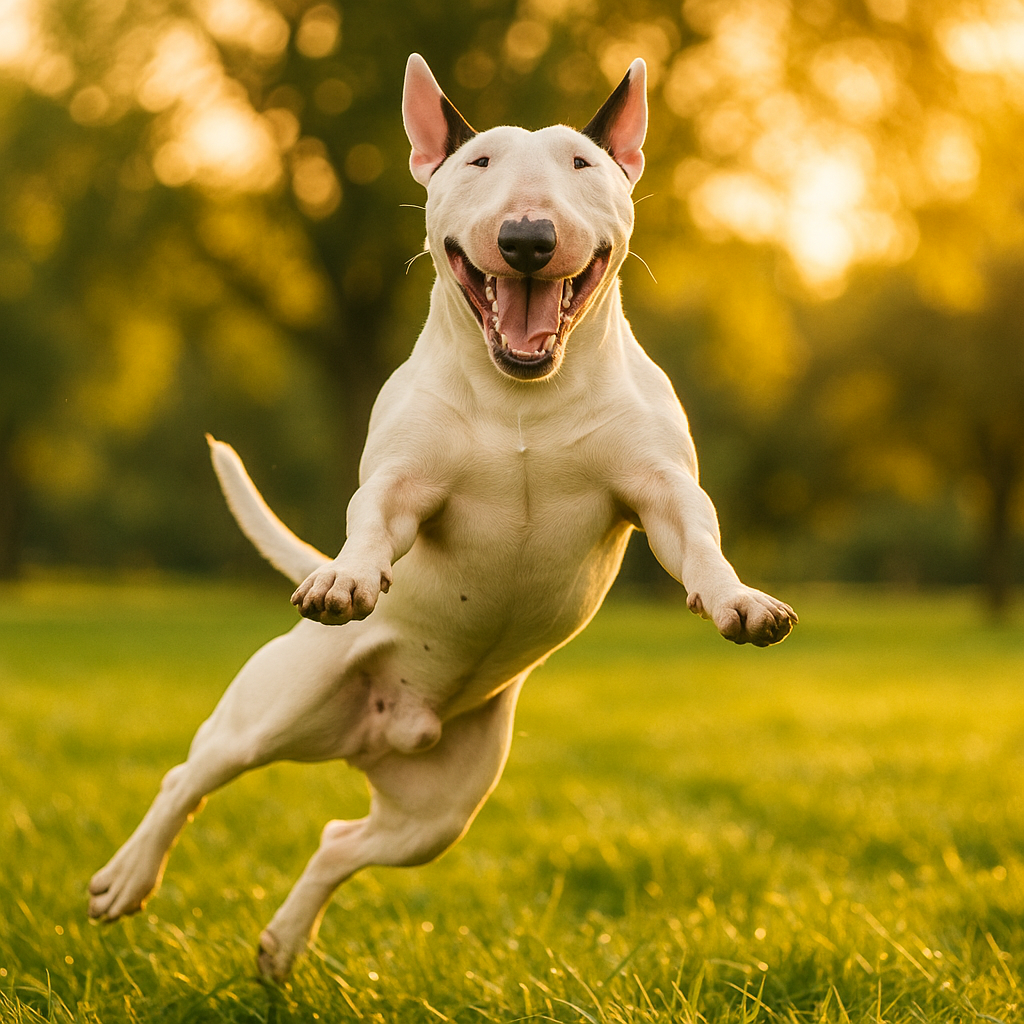
The Bull Terrier displays a dense, almost sculptural musculature that does not deceive. Medium-sized – generally between 35 and 55 cm at the withers – it gives an impression of contained power. The legs are straight, the loins short and solid; everything contributes to giving the image of a sprinter ready to leap. Its coat, smooth and short, requires little maintenance but highlights its clear curves.

Head and Expression
The head, the true signature of the breed, captures all attention. The junction of the skull and muzzle forms a smooth curve, without any apparent break. The eyes, triangular and close-set, express an almost human curiosity. Sometimes, one detects a mischief tinged with naivety, as if wondering: “What shall we accomplish today?” The ears, small and upright, give it an always alert look.
Personality and Innate Humor
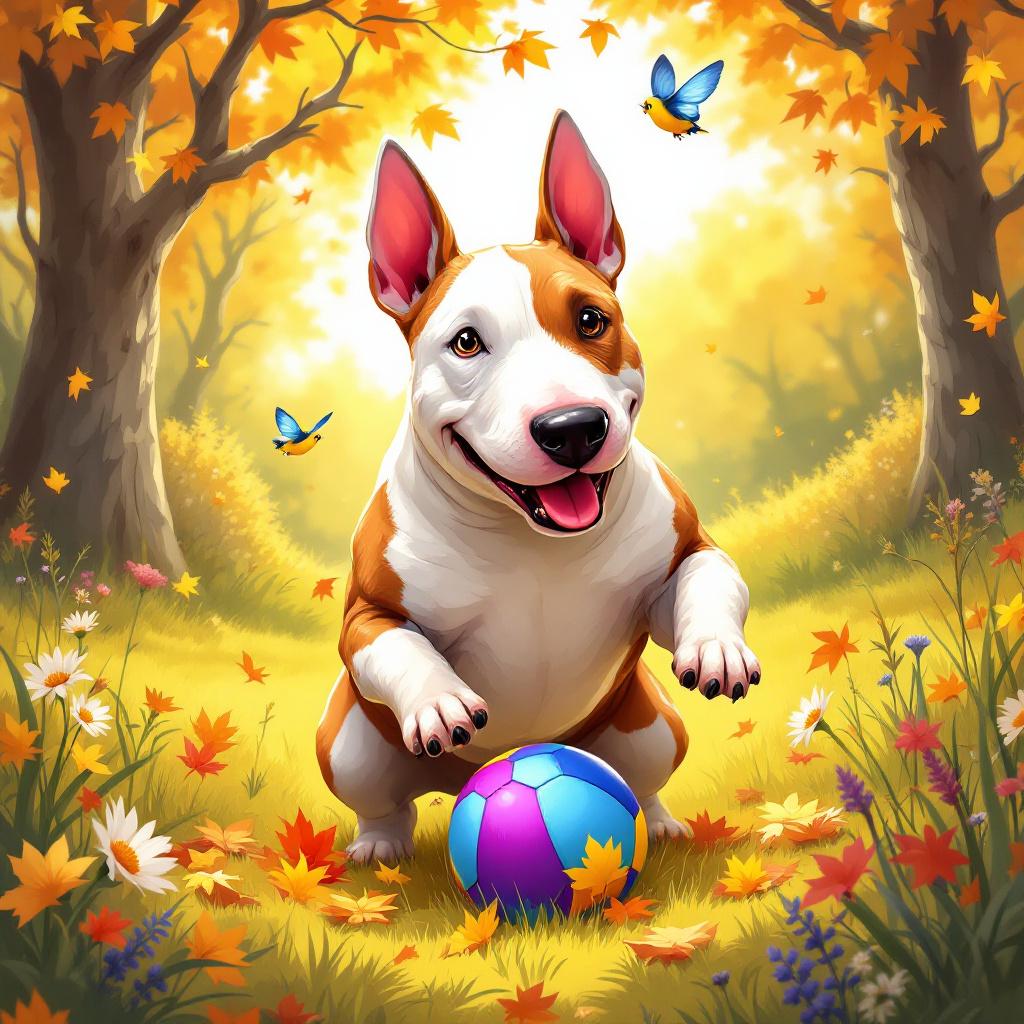
One might think that all this build hides an intimidating character. In truth, the Bull Terrier is a comedian in the making. Its humor manifests through unexpected capers, rolling in the grass, and modulated barks that seem to tell a story. Every toy becomes a stage prop and every corner of the garden, a circus ring.
For many, it is a challenge to resist its antics: trying to fill a bucket of water while it trots around, leaping straight into the arms (when still a puppy), or even sitting on the swing to accompany it on its ride. Here is recognized a sense of self-mockery rarely matched in dogs.
- Quick-witted: learns tricks and surprises quickly.
- Affectionate: demands as many cuddles as exercises.
- Social: enjoys company, human or canine.
Training, Exercise, and Mental Stimulation
Maintaining this temperament requires some organization. Patience is key: the Bull Terrier can be stubborn, especially if it senses that its fun is being curtailed. Reward- and play-based methods work very well, where pure firmness clashes with its obstinacy.
Recommended Activities
Count on it to turn a simple walk into a true expedition. Long countryside walks, frisbee sessions, or agility training (slalom, obstacle jumps) are excellent outlets. In an apartment, it is better to multiply “brain teasers”: scent mats, hide and seek, or interactive toys. A busy mind is less prone to mischief.
Socialization and Balance
One common mistake is to believe that its build alone commands respect. In reality, the Bull Terrier loves to socialize: it will gladly befriend the neighbor’s cat or the park dog, provided it is shown the way. A well-socialized dog, from its earliest weeks, manages frustration better and integrates into family life without fear or aggression.
Health, Care, and Longevity
The Bull Terrier generally enjoys good vitality, but some specifics deserve to be noted. First, the exposed ears easily catch dirt and parasites; a weekly check is advisable. Next, its skin can develop irritations, particularly between the folds of the head.
- Monitoring for ear infections: gentle cleaning of the ear canals.
- Regular skin inspection: hydration and checking for redness.
- Balanced diet: quality proteins and weight control.
Regarding genetic health, patellar luxation and certain heart conditions are on the list to prevent. Annual veterinary check-ups, combined with appropriate physical activity, help keep this companion alert up to 12–14 years.
Why fall for a Bull Terrier?
Choosing a Bull Terrier means embracing a bundle of comic energy and unconditional affection. Its unique silhouette sparks curiosity, but it is its antics that leave a lasting impression. For households ready to play, laugh, and move, it is a dream partner. It delights active families, stimulates children’s creativity – who must nevertheless learn to respect its strength – and creates memorable moments, often immortalized in viral videos.
“Every day with him feels like an improvised theater session: you never know what trick he will invent!”
In short, the Bull Terrier turns everyday life into an adventure, with its slapstick humor and unwavering loyalty.
Frequently Asked Questions
What is the typical temperament of a Bull Terrier?
Playfully mischievous and affectionate, it knows how to be protective of its family while maintaining a playful character. Early socialization will strengthen its balance.
Is the Bull Terrier suitable for all households?
It adapts particularly well to active families with sufficient space and an owner ready to dedicate time for exercise and play. A calm environment without stimulation can quickly bore it.
How to care for its coat and skin?
A simple rubber glove rub to remove dead hair is enough. For the skin, a gentle shampoo as soon as redness or dandruff appears, and a canine moisturizing cream prescribed by the vet if needed.
What health problems should be monitored?
Patellar luxation, certain heart diseases, and ear infections. Biannual veterinary visits allow for early detection and treatment.
How to manage its overflowing energy?
By increasing brisk walks, outdoor play sessions, and stimulating toys that challenge its intellect.