
Recall is a bit like the Holy Grail of dog training. Imagine: your dog is frolicking far away, you call him… and he comes back immediately, happy, without hesitation. 🐾 Well yes, it’s possible. But it doesn’t happen by chance. Recall is learned, built, and reinforced. And it’s one of the most useful — and sometimes most frustrating — lessons for any dog owner. Let’s see together how to turn this dream into reality.
🎯 Why is recall vital?
Good recall is freedom on a leash. It means being able to let your dog off-leash with full confidence, avoiding accidents, ensuring their safety. It also strengthens the owner-dog bond: a dog that comes back is a dog that trusts. In a park, in the forest, at the beach, near a road… recall can literally save a life. It’s not a luxury, it’s a cornerstone. And contrary to what people think, it’s not reserved for “trained” dogs. With the right methods, even a shy, excited dog or a puppy can learn to come back to you on voice command, a signal, or even their name. The key lies in consistency, positive reinforcement, and a controlled environment at the start of training. The more patient and consistent you are, the more your dog will associate it with a pleasant moment, and the less tempted they will be to go on an adventure.
❌ The most common mistakes

- Calling to scold: the dog associates “come” with a bad experience
- Using a neutral or annoyed tone: not motivating for the dog
- Repeating the command ten times: they learn to ignore it
- Chasing after them: becomes a game of chase
- Never rewarding: they lose interest in coming back
Recall is not just about a word. It’s a whole: your attitude, your timing, your consistency. These are the details that make all the difference.
📚 Steps to teach recall step by step
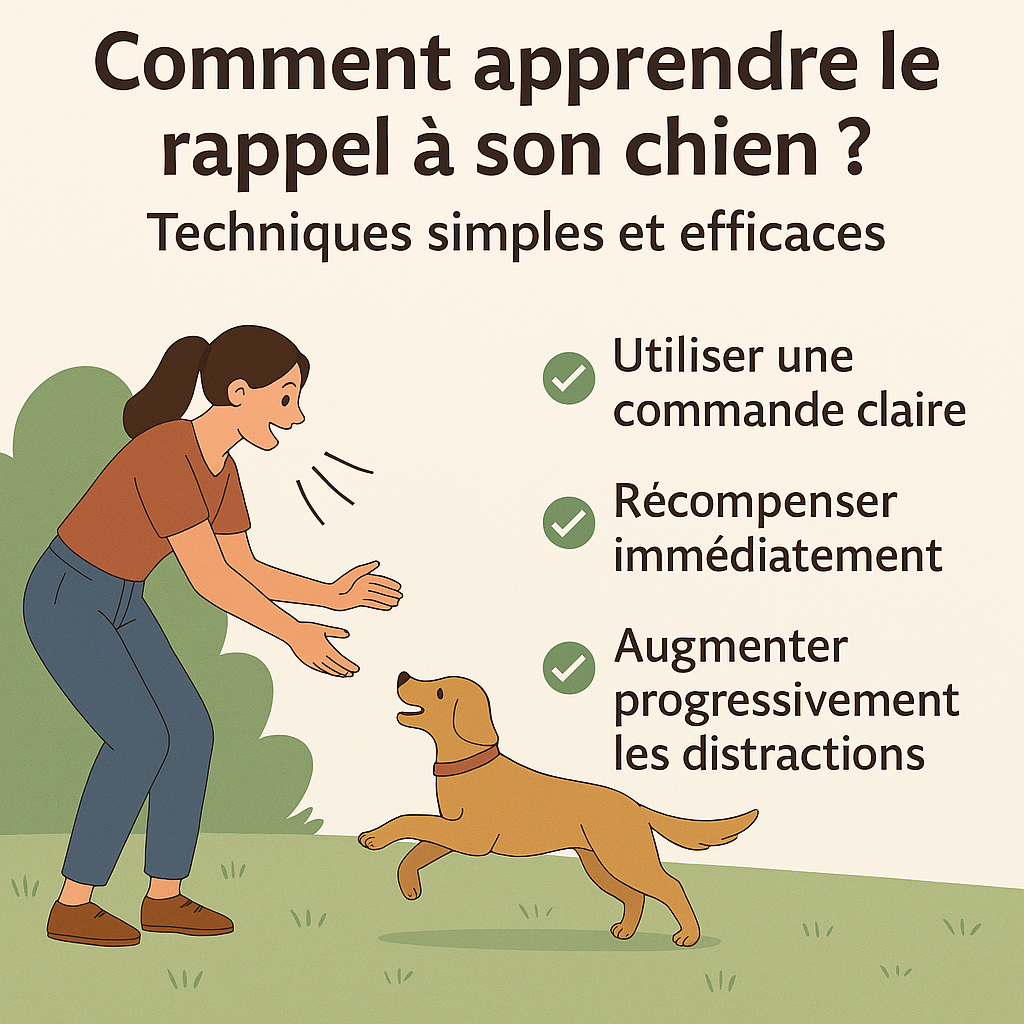
- Choose a clear recall word (e.g., “come,” “here,” “back”) and don’t change it
- Start indoors or in a fenced garden to avoid distractions
- Call with enthusiasm, crouch down, pat your legs
- Always reward: treats, toy, cuddle, freedom
- Use a long leash outdoors to prevent escapes and reinforce control
- Gradually increase difficulty (empty park → presence of dogs → strong distractions)
- Do “surprise” recalls during walks so they get used to coming back even without play ending
The key is repetition + joy. Every return must be a celebration. The dog must think: “coming back = jackpot.”
📊 Progression chart according to dog profile
| Type of dog | Average time for a reliable recall | Specific advice |
|---|---|---|
| Puppy (2-6 months) | 2 to 4 weeks | Take advantage of the “velcro period” |
| Adopted adult dog | 4 to 8 weeks | Create a relationship before demanding |
| Very sociable/distracted dog | 2 to 3 months | Reinforce in presence of distractions |
| Anxious or traumatized dog | Variable | Gentle work, sometimes with a trainer |
🩺 Special cases
🐾 Adopted adult dog: does not know your voice, your gestures. Start by creating a routine, use a long leash systematically at first.
🐕 Very playful dog: he will come back more easily for a favorite toy than for a treat. Use this leverage.
😰 Fearful dog: work first on a short leash, in a secure environment. Never force. Reward small progress.
🐶 Stubborn or Nordic dog: make the meeting more interesting than anything else. Vary the rewards, sometimes hide (hide-and-seek game). Motivation must come from you.
📚 FAQ
How long does it take for the recall to be reliable?
Count between 2 weeks and 3 months depending on age, environment, and consistency of exercises. But recall is reinforced… for life!
Do I always need to have a treat?
Not necessarily, but there must be motivation. Alternate: kibble, toy, freedom, verbal encouragement, petting. Vary to keep the “positive surprise” effect.
What if he doesn’t come back?
Don’t run towards him. Change direction, hide, wait calmly. If he comes back late, reward anyway: he came back, that’s what we reinforce.
🗣️ Testimonial
“My border collie didn’t listen at all in the park. As soon as I shouted ‘come’, he moved even further away. I started all over from the beginning, making recall a game. In 1 month, he came back like an arrow. And now, he even looks at me before moving away.” — Clément, 34 years old
🔚 Conclusion
Recall is not just a command. It’s an art. The art of creating a bond of trust, being consistent, joyful, motivating. By working in small steps, in good spirits, you offer your dog the greatest freedom: the ability to run… and come back, with pleasure. 🐕💨
🧪 Testing recall reliability in real conditions
A reliable recall is not measured in your living room, but amidst distractions. Before letting your dog off-leash, it is crucial to test him. Start in a fenced garden, then on a long leash in a park, and finally in semi-open places. Include “traps”: other dogs in the distance, passing jogger, bird taking off. Call. Observe. If he comes back every time, even hesitating, you are on the right track. However, if he ignores you one time out of two, continue the work. Recall reliability is built little by little, and the more you diversify situations, the more you ensure your dog has understood the importance of recall, even when distracted.
🗝️ The super-recall: emergency magic word
A “super recall” is a word that you only use in critical situations — and that triggers an exceptional reward. Example: “RAAAaappelle!” or “TURBO!” or a made-up word. This word is trained in ultra-positive contexts: favorite treats, throwing the favorite toy, food bowl. Never used for boring things. The day your dog runs towards the road, this word must trigger an immediate return. It’s a wildcard, a safety rope. Use it sparingly, so as not to “dilute” it and make it less effective. Reserve it for situations where your dog’s safety is at stake and always pair it with a reward worthy of the occasion.
🔁 How often should you maintain recall?
A good recall does not remain reliable without training. Even once acquired, it must be A good recall does not remain reliable without training. Even once acquired, it must be maintained as a living skill. Integrate it into your walks several times a week, and randomly: sometimes at the end of the walk, sometimes in the middle, sometimes just to say hello. Vary the rewards to keep the “wow” effect. Don’t fall into the routine of “he comes back = leash and end of the game,” otherwise he might avoid you. And above all: keep praising him, even modestly, for every return, to reinforce this positive association. Recall must remain a pleasure for your dog, not a chore.
🧍↔️🧍 Exercise: recall with two people
Simple, fun, very effective! Stand two people a few meters apart. Call the dog in turn with enthusiasm. When he arrives, reward immediately. Then the other person calls him. You can increase the distance, introduce distractions, or alternate toy/treat. This exercise improves responsiveness and strengthens the habit of coming back quickly as soon as called. It’s also a great game for children, under supervision.