
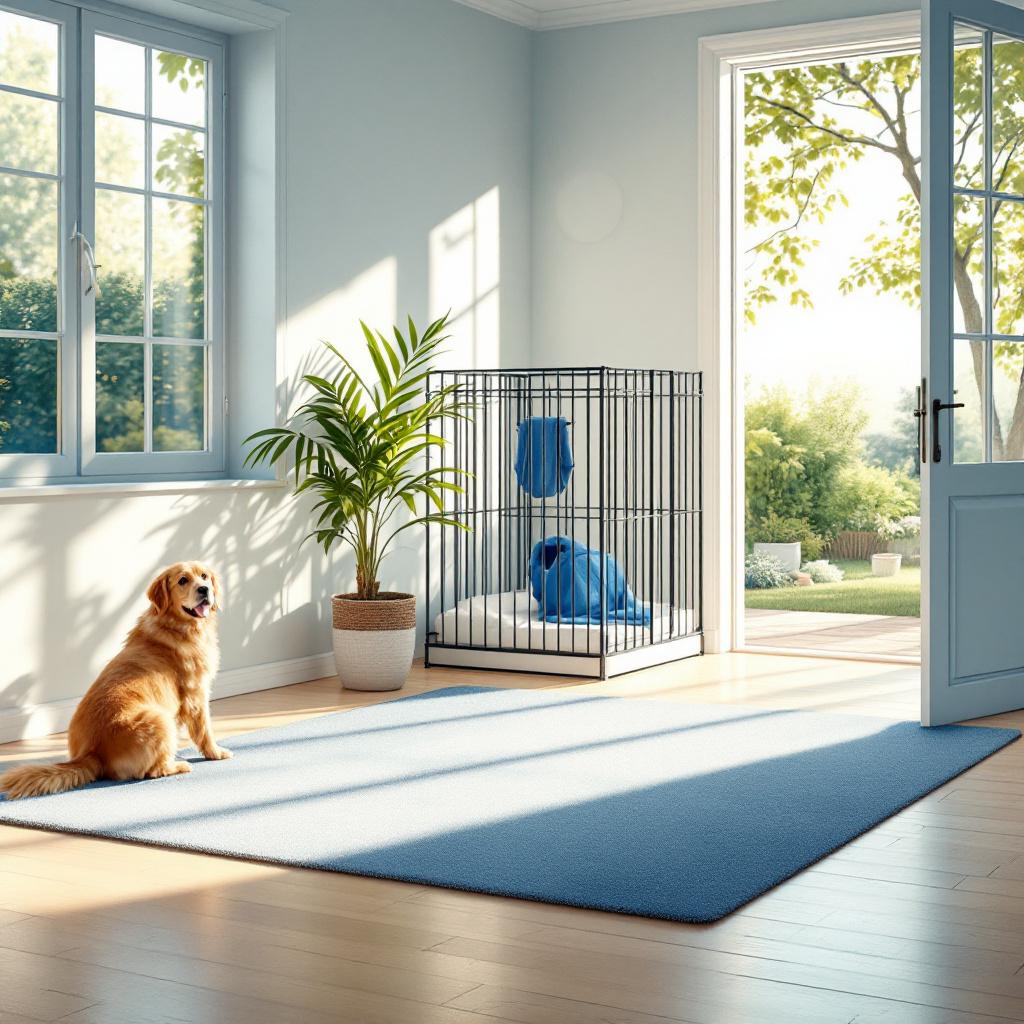

Choosing between training pads, a crate, or frequent outings depends on the puppy’s temperament, your organization, and your environment. The pad offers a quick fallback solution, the crate encourages routine and autonomy, while regular outings strengthen communication between you and your companion. Each method proves effective if applied with consistency and kindness.
Why start house training early
A puppy that acquires cleanliness before six months develops confidence and a bond with its owner more quickly. Its bladder gradually regulates, and domestic accidents become rare. Not to mention that structured training limits the animal’s stress and urine leaks turn into educational steps rather than disasters.
- Physiological development: bladder capacity increases around two months.
- Strengthening the bond: each outing and each reward reinforces complicity.
- Prevention of separation anxiety: a stable framework reassures the puppy.
Training pads

Pads, impregnated with attractive scents, are placed indoors to compensate for the inability to go out immediately. They are particularly suitable for city dwellers or households with tight schedules.
Advantages
- Accessibility: the animal can access it at any time, without warning.
- Easy maintenance: layering absorbs odors and liquid.
- Gradual progression: the pad can be moved closer to the door to get the puppy used to going outside.
Disadvantages
- Risk of food comfort: some puppies associate the pad with meals if placed in the kitchen.
- Frequent maintenance: neglecting changes leads to persistent odors.
- Dependence: the anticipated puppy might refuse to go outside permanently.
“Pads are primarily a transitional tool: they should not become a permanent refuge for needs.”
Training crate
The crate, or “box,” offers a reassuring cocoon where the puppy does not voluntarily relieve itself. Provided a protocol is respected, it establishes a rhythm and a gentle cleanliness training.
Key principles
- Appropriate size: the puppy must be able to turn around easily.
- Limited duration: no more than two consecutive hours outside of sleep.
- Positive association: soft toys, treats, and a comfort blanket.
Why it works
In nature, the dog avoids soiling its resting area. The crate reproduces this principle. Quickly, the puppy distinguishes “rest area” and “needs area.”
Points of caution
- Monitor anxiety: the puppy must not howl or twist to get out.
- Avoid feeding inside: meals are taken outside the crate to reinforce cleanliness.
Frequent outings
Nothing replaces direct contact with the outdoors. Taking your puppy out every two hours, upon waking or after play, gradually teaches it to wait for the right place.
Main Benefits
- Socialization: meeting other dogs, new smells, mental stimulation.
- Positive conditioning: each success is rewarded with a treat or a pet.
- Flexible routine: your puppy knows the daily rhythm and learns your schedule.
Constraints
- Requires availability or a substitute (neighbor, pet-sitter).
- Weather imperative: not easy in rain or extreme cold.
Comparison of the three methods
To select the most suitable approach, consider your lifestyle, your place of residence, and your puppy’s personality.
| Method | Ease | Puppy autonomy | Cost | Urban adaptation |
|---|---|---|---|---|
| Pad | ★ ★ ★ ★ | ★ ★ | € | ★ ★ ★ ★ ★ |
| Crate | ★ ★ ★ | ★ ★ ★ | €€ | ★ ★ ★ |
| Outings | ★ ★ | ★ ★ ★ ★ | € | ★ ★ |
Tips for making your choice
No puppy is the same: some flee confinement, others find calm in it. You can combine methods: for example, the crate during the day, outings at night, and a transitional pad.
- Observe behavior: restlessness, crying, marking.
- Adjust the frequency of outings according to age.
- Reinforce each progress with a treat and praise.
To deepen the step-by-step protocol, find a detailed guide covering mistakes to avoid and tips for each stage.
FAQ
1. At what age should cleanliness training start?
Generally from two months, when the puppy’s bladder can contract more effectively and it begins to understand expectations.
2. Can crate and regular outings be combined?
Yes, this remains the most balanced combination to offer both security and learning about the outdoors.
3. Does the pad delay outdoor outings?
If used improperly, yes. It should remain temporary and be gradually placed closer to the door to encourage the transition.
4. How to know if my puppy is afraid of the crate?
Crying, attempts to climb out, and excessive salivation indicate stress. Then the time spent should be reduced and toys and treats associated with it.
5. How to maintain motivation over the weeks?
Vary rewards (treats, pets, toys) and keep a cheerful tone for every progress, even minimal.