

| Key Points | Details to Remember |
|---|---|
| 🐶 Definition | Scottish Root, small bright white terrier. |
| 🔍 Origin | Bred to hunt martens and foxes. |
| 💖 Temperament | Intrepid, playful and affectionate. |
| 🏃 Exercise | Daily activity necessary. |
| ✂️ Grooming | Regular brushing and grooming. |
| 📆 Life Expectancy | Between 12 and 16 years. |
The West Highland White Terrier, often nicknamed the “Westie,” charms with its immaculate coat and boundless energy. At first glance, this small dog seems straight out of a winter tale, but in reality, it is forged by centuries of rocky terrain and hunting missions. Far from being just a couch companion, the Westie demands movement, attention, and a bit of boldness in its training. This article unravels its history, needs, tips for maintaining its snowy coat, and its strong character, so every future owner knows what to expect.
Origins and History
Birth in Scotland
In the heart of the Highlands, breeders wanted a terrier with a light coat, easily spotted in the heather. The Westie was born in the 19th century, resulting from crosses between Cairn Terrier and Dandie Dinmont. Its ancestors hunted badgers and foxes in narrow burrows. By selecting the whitest specimens, they avoided confusion with game and improved visibility. This aesthetic choice shaped an iconic silhouette.
Role in Hunting
In truth, the Westie was not just a proud aesthete: its small size and extraordinary courage made it a valuable assistant in flushing out pests. It was sent into narrow tunnels, where its light coat facilitated tracking. Contrary to salon images, this dog had to dig, swim, and slip through tight spaces. Today, although hunting is no longer on the agenda, this heritage translates into an insatiable curiosity and a need to sniff around every corner.
Character and Temperament
Intrepid Spirit
Despite its 10 wet kilos, the Westie shows unshakable confidence. One might think such a small dog would be easily intimidated, but it has no equal in challenging a Rottweiler… or a stray garbage bag. This boldness, combined with a dose of tenacity, forces the owner to set clear boundaries from the first weeks. Otherwise, the Westie turns into a little pack leader, demanding its share of attention with loud barking.
Affection and Sociability
Despite its solitary demeanor, the Westie loves company. It is gentle with children and welcoming to visitors. This trait contrasts with its past as a solo hunter: where one would expect it to be on guard, it rather offers cuddle sessions. However, be cautious when living with small rodents or hamsters: hunting is a persistent instinct. Early socialization limits these undesirable behaviors.
Health and Care
Grooming and Coat
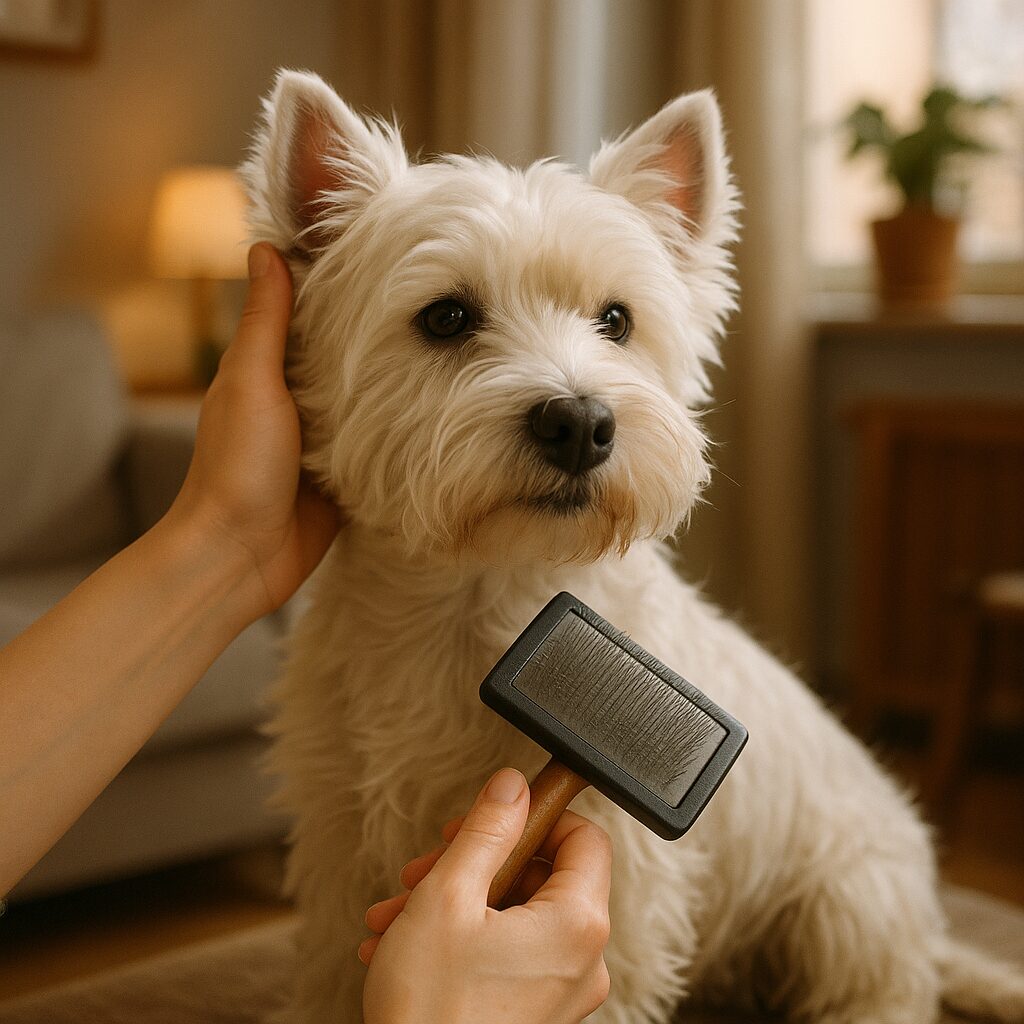
A Westie without regular brushing is a bit like a wool sweater that is never untangled: it doesn’t work well. Its double, dense, and waterproof coat requires a brushing session at least twice a week. During shedding season, a fine-toothed comb is used daily. Professional grooming every two to three months refines the muzzle’s shape and tones the undercoat. The result: a dog that keeps its “little cloud” appearance and an owner less overwhelmed by white hairs.
Appropriate Nutrition
The stocky silhouette of the Westie tolerates neither extreme thinness nor overweight. In reality, a dietary imbalance can quickly lead to joint or skin problems. We favor kibble rich in quality proteins, with controlled fat content. Including vegetables and omega-3 supplements helps preserve the shine of its coat. For each dog, the ration is calculated according to activity and metabolism: don’t hesitate to adjust over the months.
Training and Education
Positive Methods
The Westie does not respond well to punishments. In fact, it switches to “stubborn” mode and pursues its idea. On the contrary, the positive reinforcement method works wonderfully: treats, petting, and praise when it follows a command. Vary the rewards to maintain its interest. A simple reminder of the rule is often enough, as long as the instruction is always the same. A few short but regular sessions keep its concentration intact.
Socialization and Basic Commands
From adoption, alternate outings in urban and rural environments. Exposing the puppy to various settings limits separation anxiety and builds its confidence. Teach it the commands “sit,” “stay,” and “come” in a playful way. A well-socialized Westie better tolerates veterinary routines and encounters. And for excessive barking, it is better to offer a rewarded “quiet” command rather than severe reprimands.

Daily Life and Activities
Exercise and Play
An under-exercised Westie is a Westie overflowing with dark ideas: rummaging through trash, digging garden ditches, or barking at the neighbor. To avoid these misbehaviors, aim for 30 to 45 minutes of brisk walking, alternating between trotting and small fetch games. Balls, frisbees, hide-and-seek… varying activities and locations stimulates both its body and brain. A busy dog is a calm dog.
Apartment Adaptation
Contrary to its size, the Westie likes to have a bit of space. However, even a modest home can be suitable if regular outings are provided. Plan a cozy resting corner and a sturdy toy to channel its chewing needs. In a busy daily routine, split walks — morning, noon, and evening — compensate for the lack of a garden. With an adapted rhythm, the Westie finds its balance anywhere.
Choosing a Westie: Practical Advice
Selecting a Breeder
A good breeder is not afraid to show you the parents, the health record, and the breeding conditions. They will answer your questions about the lineage and any predispositions to genetic diseases (retinal atrophy, patellar luxation) straightforwardly. When visiting, observe the puppies’ behavior: a balanced temperament begins to emerge from the first weeks.
Budget and Equipment
Before giving in, establish a budget that includes the purchase, veterinary fees (vaccinations, sterilization), and maintenance. Brushes, grooming, durable toys, bedding… accessories represent a significant cost. Set aside an emergency fund for possible complete treatment. The financial investment is justified by the longevity and robustness of this breed, which becomes a family member for more than a decade.
FAQ
Is the Westie suitable for families with children?
Yes, provided the children have learned to respect the dog. The Westie loves affection, but can get upset if its ears or tail are pulled. Supervise the first interactions and show the younger ones how to approach the white terrier gently. In return, you will have a playful and protective companion.
At what age should professional grooming begin?
From the age of four to five months, a first grooming session helps familiarize the puppy with the sound of scissors and the grooming table. The goal is not a perfect cut, but to get used to the ritual. Afterwards, a visit to the groomer every two to three months is sufficient, depending on the growth rate and quality of the coat.
Does the Westie bark a lot?
It may bark to alert, express boredom, or frustration. The key is to channel these vocalizations through consistent training: teach it a silence command reinforced by a reward. Provide an appropriate exercise routine and occupation toys to limit barking out of boredom.
What are signs of good health in a Westie?
A shiny coat, bright eyes, and an alert dog are good indicators. Watch for the absence of redness between the toes and a regular appetite. Small breeds tolerate heat poorly: during high temperatures, provide a shaded area and fresh water at all times.