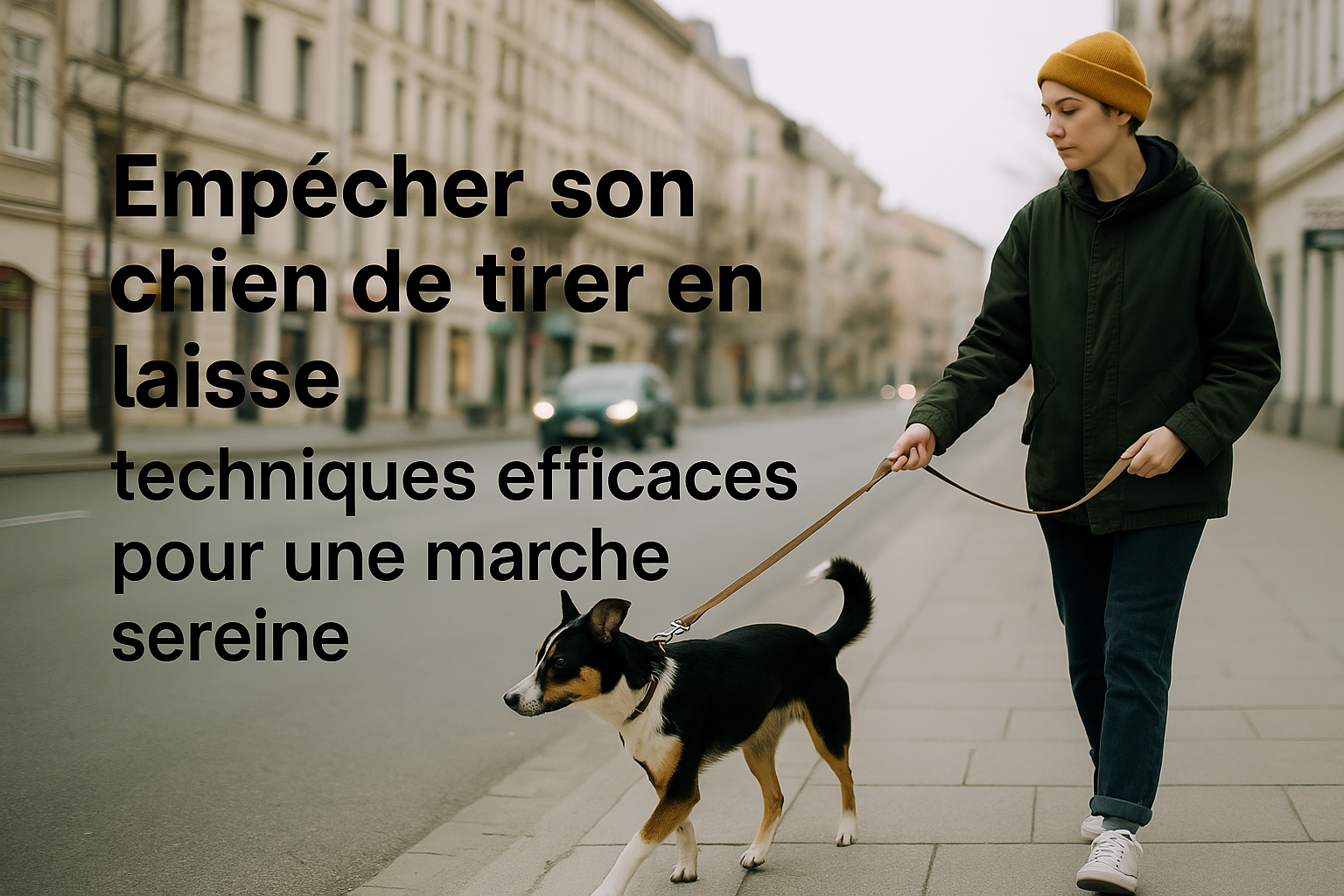

Ah, the walk. That moment of bonding… or of fierce struggle? If your dog turns you into a kite every time you go out, rest assured: you are not alone. Pulling on the leash is a behavior as common as it is frustrating. Fortunately, it’s not inevitable. By understanding why your dog pulls and adopting a few simple techniques, you can turn your walks into genuine moments of shared pleasure. 🎯
🎯 Why do dogs pull on the leash?
It’s neither out of malice nor to challenge you. The majority of dogs pull… because they were never taught not to. Pulling moves them forward, so they do it again. It’s simple, mechanical. And then there’s the excitement, the desire to sniff that bush, say hello to the dog across the street, follow an irresistible scent. For a dog, the world is a huge buffet of smells, and they want to explore it all at their own pace. If walking calmly by your side has never been taught to them — or r…
❌ Mistakes to avoid

- Using a retractable leash: it reinforces the reflex to pull to go further
- Moving forward when the dog pulls: it’s the best reward for them
- Shouting or pulling violently: increases tension, frustration, and can create fear
- Turning around at every pull without consistency: your dog doesn’t understand anything
- Changing methods every three days: repetition is needed to learn
Each repeated mistake can reinforce the bad behavior. The idea is not to punish, but to teach differently.
📚 Training methods for walking on a leash
- The stop & go: as soon as the leash is taut, you stop. The dog learns that pulling = stop
- The turnaround technique: as soon as they pull, you turn around without a word. They must follow your direction
- Positive reinforcement: reward as soon as they walk beside you, even for two seconds. The closer they are = the more they earn
- Practice calm walking before going out: in the garden, at home, without distractions
- Add a keyword (“heel,” “slowly”…) that you associate with the correct posture
Repeat, praise, vary the environments. The more your dog succeeds, the more they establish the habit. And keep in mind: better 10 well-done minutes than 30 minutes of tugging.
🧰 What equipment to choose?
| Type of equipment | Advantages | To avoid if… |
|---|---|---|
| Y-shaped harness (anti-pull) | Respects morphology, reduces tension | The dog pulls very hard without associated training |
| Short leash (1.20m to 1.50m) | Optimal control, reduces pulling play | The dog is too energetic without training |
| Classic flat collar | Lightweight, simple | Can injure if the dog pulls violently |
| Clicker (if method used) | Reinforces good behavior at the right moment | If poorly timed, disrupts learning |
Avoid choke or spike collars. They “work” through pain or discomfort, but create stress, confusion, and reactivity. Always prioritize comfort, safety, and the bond of trust.
📌 Special cases
Puppy: he does not yet know the rules. Use very short sessions, praise every calm step, and do not expect immediate miracles. He is discovering the world!
Anxious dog: a stressed dog will pull more. Work first on his confidence, avoid noisy places, and favor calm walks where he can regain control of his emotions.
Reactive dog: he pulls to flee or to attack. Work on a long line, at a distance from triggers, and use a specialized dog trainer if needed.
❓ FAQ
How long does it take to achieve a relaxed walk?
Between 2 weeks and 2 months depending on the regularity of sessions, the dog’s age, and the human’s consistency.
My dog pulls as soon as he sees another dog, what should I do?
Work at a distance, create a comfort zone. As soon as he sees the other dog without reacting, reward him. Then gradually reduce the distance. This is desensitization + positive association.
Should I punish him when he pulls?
No. Punishing risks making things worse. It is better to stop moving forward or change direction neutrally, then reward the good posture.
🗣️ Testimonial
“My female dog pulled so much that my arm hurt after every walk. I tried the Y-harness, shortened the leash, and followed a trainer’s advice. In two weeks, it was like night and day. Now, I finally enjoy walking!” — Sabrina, 41 years old
🔚 Conclusion
Preventing your dog from pulling on the leash is not a matter of strength, but of method, patience, and relationship. With the right tools and a bit of consistency, you can transform these leash walks into true harmonious walks. One step at a time, towards more serenity. 🐾
🧘 Create a calming walking routine
Leash walking does not start outside… but at home. Creating a calm pre-walk routine is an essential lever. Even before opening the door, make sure your dog is calm. Ask him for a “sit” or “stay” while you put on the leash. If he jumps, barks, or circles: wait. Breathe. Try again. The walk is a reward. If it happens in chaos, the rest will follow. Once outside, start by walking calmly a few meters, without heading straight to the park or the car. If your dog pulls, stop. Wait for him to come back to you or release the tension, then resume. It is through calm and consistent repetition that leash walking becomes smooth, pleasant… and above all shared.
🏡 Exercise: training calm walking indoors
Before braving the sidewalks, train leash walking… in your living room. Put on the leash, take a handful of treats, and walk a few steps. As soon as he is by your side, say “yes” (or use a clicker) and reward. Repeat several times. Then add turns, stops, half-turns. This indoor work allows the dog to understand the expected behavior without distraction. It is a step often neglected… yet so valuable.
🧠 Reminder: walking on a leash is not natural for a dog
It is too often forgotten: walking calmly beside a human, connected by a leash, is not natural for a dog. In his own world, he moves freely, sniffs everywhere, stops according to his own pace. The leash is a constraint imposed by the human. That is why it is essential to approach learning to walk not as something obvious, but as a skill to be taught patiently. Each dog learns at his own pace. Some grasp it quickly, others will need more time, repetitions, and positive reinforcement. Be consistent in your expectations and steady in your actions. The calmer and more methodical you are, the easier your dog will integrate it, and the more the walk will become a shared pleasure.
Keeping this in mind, we develop more patience, kindness… and effectiveness. It is by understanding the nature of our dog that we build the most beautiful walks.