

The intense gaze, ears perked up, energy to spare: the Malinois fascinates as much as it impresses. Behind this super-dog appearance lies a demanding breed, where choosing the puppy is never trivial. It’s not simply adopting an animal, but welcoming a partner who will accompany you for 12 to 14 years. So how do you avoid pitfalls, identify the right breeder, and select a balanced companion? Let’s dive into the exciting but demanding world of the Belgian Malinois shepherd.
In brief
🔍 Breeding accounts for 80% of success: prioritize professionals who test hips (OFA X-rays) and the temperament of the breeders. Beware of “puppy mills” offering attractive prices without follow-up.
🐾 Observe the litter between 6-8 weeks: a good breeder keeps the puppies together until this critical age to develop their self-control. Avoid isolated or hyper-reactive puppies.
🎯 The Campbell test reveals valuable clues: performed around 7 weeks, it assesses confidence, dominance, and sensitivity. An average score (neither too submissive nor too dominant) is generally suitable for families.
📆 The first 16 weeks are decisive: socialization must expose the puppy to 100+ different stimuli before 4 months according to the University of Pennsylvania study (2020). A delay is hard to catch up on.
Spotting a serious breeder: beyond the pedigree
A good pedigree is not enough. Passionate breeders will ask you as many questions as you ask them. They know every puppy in the litter inside out. Visit the premises: the puppies should grow up in a stimulating environment (varied floors, toys, household noises) but not overcrowded. Demand the health test results of the parents: hip dysplasia (OFA/HD score A or B), elbows, and sometimes eyes. The Fédération Cynologique Internationale reminds that these exams are non-negotiable for responsible breeders.

Red flags to never ignore
- Immediate availability without a questionnaire about your lifestyle
- Abnormally low price (below €1,500 in 2024 for a LOF puppy)
- Refusal to show the mother or the breeding premises
- Vaccinations or deworming not documented by a veterinarian
Decoding temperament: observe before choosing

Contrary to popular belief, the collar color predicts nothing. After 6 weeks, observe how the puppy interacts with its siblings. A future balanced dog participates in play without becoming hysterical, backs down in the face of maternal correction but comes back to explore. Gently test its sensitivity: a puppy that startles at the sound of a keychain then approaches curiously shows good resilience.
The simplified Campbell test
Conducted in a neutral place, this test evaluates 5 key reactions around 7 weeks:
| Test | Ideal reaction | To avoid |
|---|---|---|
| Social attraction | Comes with wagging tail | Flight or inhibition |
| Manual pressure | Struggles then calms down | Bites hard or cries |
| Sudden noise | Startles then explores | Prolonged terror |
“A Malinois too bold at 2 months will become unmanageable at 8 months without an expert hand” – Marc, dog trainer specialized in shepherds for 20 years.
Socialization: the critical window that changes everything
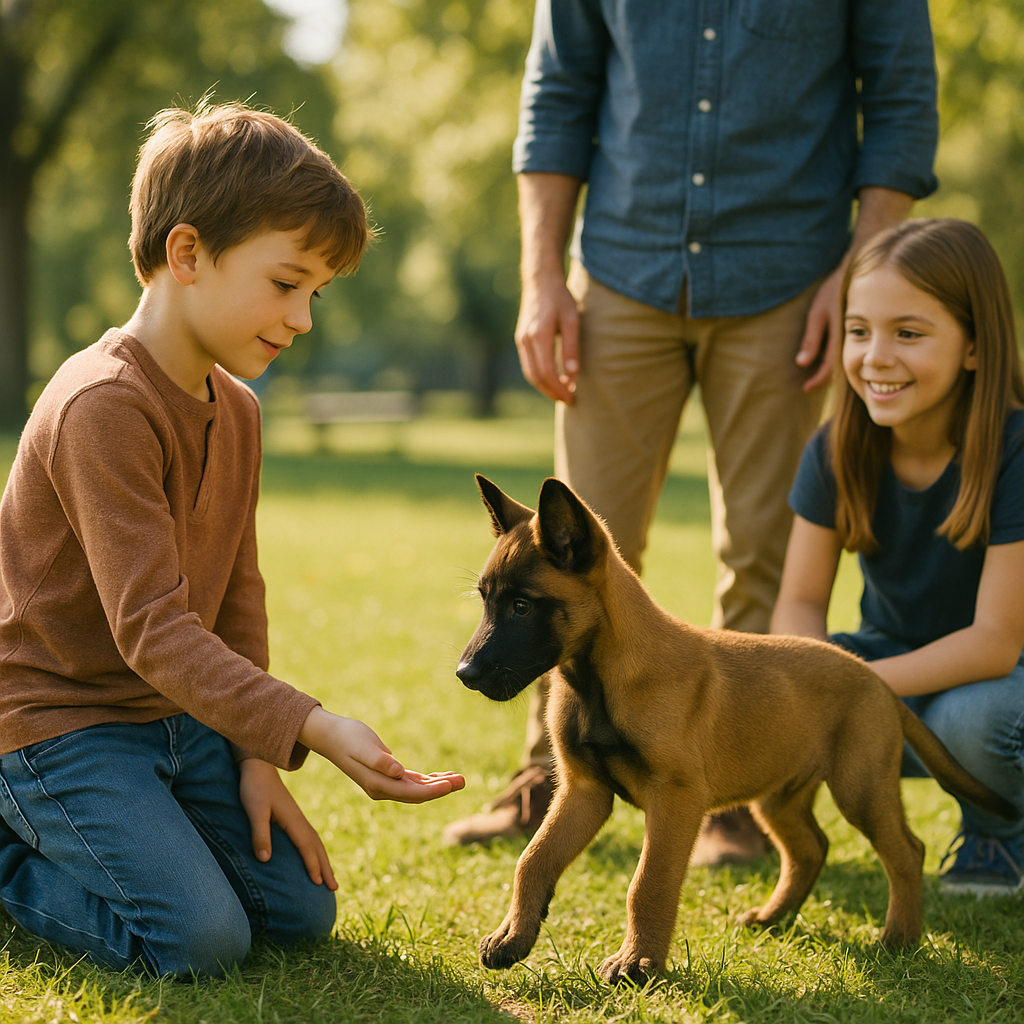
Between 3 and 16 weeks, the puppy’s brain is like a sponge. A study from the Veterinary School of Zurich shows that poorly socialized dogs are 5 times more likely to develop pathological fears. But beware: it is not about overwhelming the puppy with stimuli. Introduce each novelty in stages: first observe from afar, then approach at its own pace. Vary humans (hats, glasses, canes), surfaces (grates, tiles, gravel) and noises (vacuum cleaner, recorded thunder).
Typical weekly program
- Weeks 8-9: Different humans (deep/high voices), short car rides
- Weeks 10-11: Meetings with calm and vaccinated dogs, household noises
- Weeks 12-16: Busy markets (carried), veterinarian “friendly visit”
The first months at home: avoiding fatal mistakes
Just because a Malinois is intelligent doesn’t mean it has to learn everything at 3 months. Prioritize:
- Learning calmness: Ignore jumping, reward four paws on the ground
- Bite inhibition: Sharp “Ouch!” + interruption of play if biting hard
- Progressive solitude: Start with 5 minutes behind a barrier
Avoid long walks before 4 months: its developing joints are fragile. Favor mental games like seek-and-find or snuffle mats. And above all, don’t fall into the trap of hyper-control: a Belgian Malinois shepherd sometimes needs to learn to manage its frustrations alone.
Fundamental education: the 4 pillars of a balanced Malinois
Forget “training,” think “cooperation.”
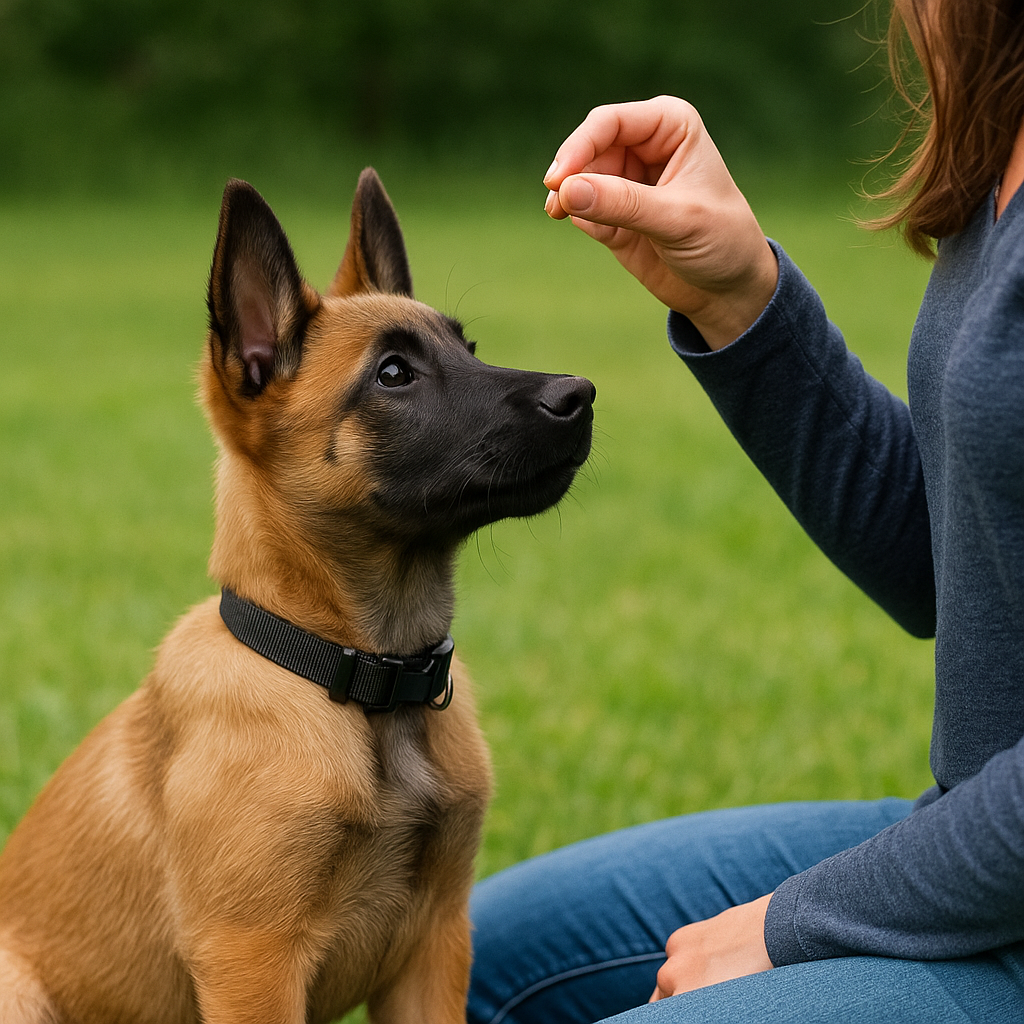
Your puppy must find it more rewarding to work with you than against you. Use their natural motivation:
Priorities before 6 months
| Skill | Frequency | Tip |
|---|---|---|
| Recall | 10x/day (short sessions) | Always reward even if slow |
| Self-control | Integrated into meals/games | “Do not touch” before bowl |
| Handling | Daily | Gently inspect paws/teeth |
A group training class specific to shepherd dogs is recommended from 4 months. These breeds learn quickly but generalize poorly: a perfect “sit” at home guarantees nothing in the park.
Frequently Asked Questions
At what age should you adopt a Malinois puppy?
Never before 8 full weeks. The 8-10 week period is ideal to fully benefit from the socialization window. Some serious breeders keep puppies until 10 weeks for basic training.
Male or female: what temperament differences?
Males are often more demonstrative and persistent in play. Females tend to be more focused and quick learners. But genetics and training matter more than sex.
My Malinois nips everything: is this normal?
Yes, until 5-6 months. Provide appropriate chew toys (braided ropes, deer antlers). Always redirect to these objects. Teething around 4 months intensifies this behavior.
Can you adopt a Malinois as a first dog?
Possible with extreme commitment in time and training. Prefer a “family” line that is less intense. Without canine experience, a specialized shepherd trainer is essential from the start.