
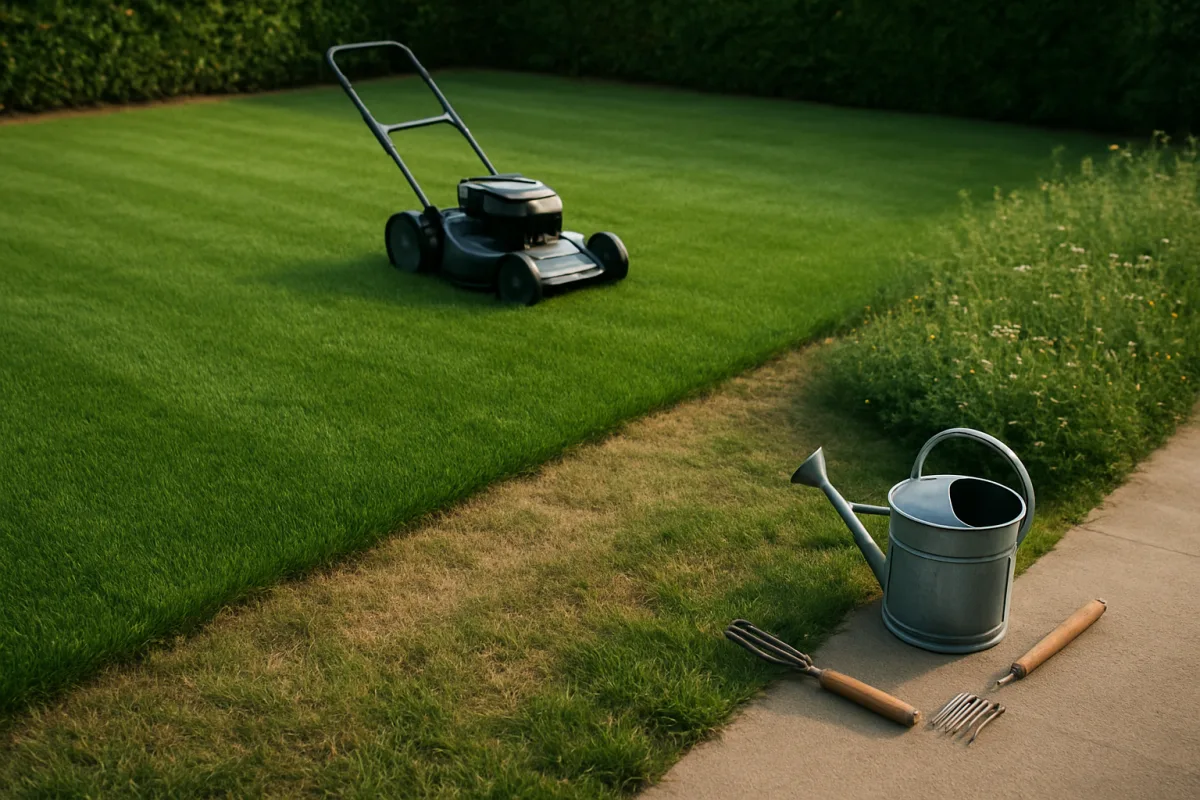
| 📌 | Definition: English lawn is a very dense, fine, and uniform turf, designed for aesthetics before durability. |
| 💡 | Strength: visually, it provides a clean and regular appearance, close to the decorative lawns of well-kept gardens. |
| ⚠️ | Major limitation: it poorly tolerates water stress, repeated trampling, and soils that are too poor or too wet. |
| 💧 | Actual maintenance: regular mowing, frequent watering, fertilization, and disease monitoring are part of daily care. |
| 💶 | Total cost: the budget is not limited to seeds; it includes water, tools, fertilizers, and time spent. |
| 🌱 | Alternative: a rustic lawn or a flower meadow significantly reduces maintenance and often improves garden biodiversity. |
English lawn: disadvantages, maintenance, and alternatives for an easier garden
The English lawn seduces with its impeccable appearance. It gives an impression of control, cleanliness, and uniformity. But if you look at the subject with some perspective, the disadvantages of the English lawn quickly become apparent: sustained maintenance, frequent watering, fragility in summer, actual cost higher than imagined. Before installing this type of turf, it is therefore necessary to assess the garden context, climate, and available time.
What is an English lawn?
The English lawn is a decorative turf made up of fine, tight, and homogeneous grasses. Its goal is not to withstand all uses but to offer a visually clean carpet, almost without imperfections. It is precisely this appearance that distinguishes it from a rustic lawn, which is more flexible, more tolerant, and often easier to live with.
In practice, we mostly talk about an English-style lawn when seeking a short height, a uniform color, and a very neat look. This aesthetic requirement leads to concrete constraints: high seeding density, close mowing, thoughtful watering, and well-prepared soil. The garden looks more elegant, but the growing conditions become stricter.
Why does the English lawn require so much maintenance?
Because it is designed for fineness, not tolerance. A short and dense grass quickly becomes unbalanced if mowing is irregular, the soil compacts, or nutrition decreases. The slightest imbalance is visible. The result therefore requires a precise routine, with repeated actions throughout the season.
Practically, English lawn maintenance is not limited to mowing. You also need to control cutting height, manage edges, monitor sparse areas, and intervene on thatch. If the lawn receives a lot of foot traffic, restoration becomes more frequent. The garden then demands real discipline, not just an aesthetic gesture.
- Regular mowing: during the growing season, one cut per week is often the minimum.
- Aeration and scarification: useful to limit compaction and thatch.
- Fertilization: necessary to maintain density, especially on poor soil.
- Targeted weeding: weeds are more visible in a very fine lawn.
- Health monitoring: spots, yellowing, moss, or diseases must be treated early.
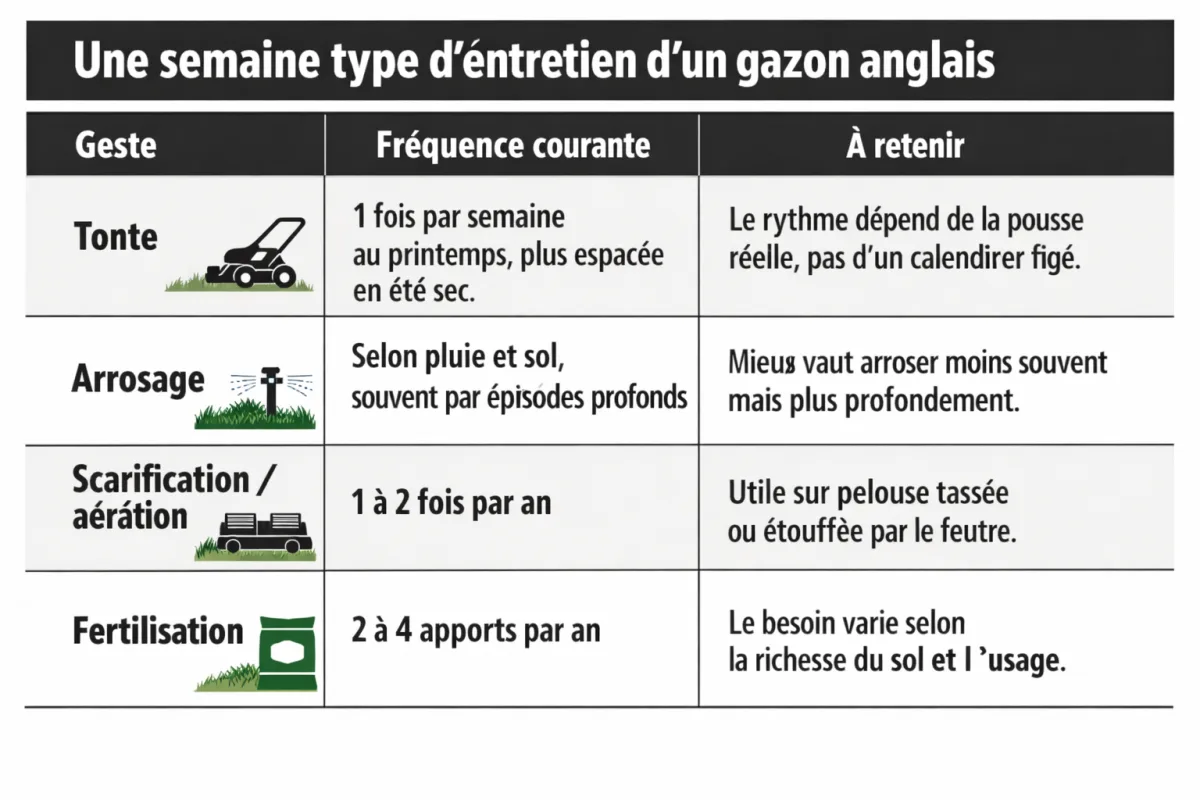
A typical maintenance week is no small matter
In a medium-sized garden, the routine quickly weighs in. Mowing takes 30 to 90 minutes depending on the area. Watering, when necessary, requires real organization. You must add edge control, observation of lawn color, and sometimes intervention on a damaged area. Over the year, it easily reaches 40 to 70 hours of work for a demanding lawn.
| Action | Common frequency | Key takeaway |
|---|---|---|
| Mowing | Once a week in spring, more spaced out in dry summer | The rhythm depends on actual growth, not a fixed calendar. |
| Watering | Depending on rain and soil, often in deep episodes | Better to water less often but more deeply. |
| Scarification / aeration | 1 to 2 times per year | Useful on compacted or thatch-choked lawns. |
| Fertilization | 2 to 4 applications per year | The need varies according to soil richness and use. |
What are the main disadvantages of English lawn?
The limitations always come back to the same points: water, time, fragility, and cost. The problem is not just having a beautiful lawn. It is maintaining it in a very consistent state, while the climate, soil, and garden uses often pull in the opposite direction. Here are the five points to consider before making a decision.
- Time-consuming maintenance: mowing, edging, scarification, and health monitoring add up quickly.
- Frequent watering: in summer, English lawn shows water shortage more quickly.
- Fragility to trampling: intensive family use leaves marks.
- Lawn maintenance cost: water, tools, fertilizers, and patching damaged areas increase the bill.
- Lower ecological impact: not very favorable to garden biodiversity when the surface is very dominant.
Why does watering quickly become a problem in dry summer?
An English lawn reacts quickly to water stress. When temperatures rise and rain is scarce, the fineness of the foliage accentuates yellowing. On a south-facing ground, the effect is brutal. Without regular water supply, the lawn loses density and shows sparse areas.
In a dry region, the difference between a decorative lawn and a rustic lawn becomes clear. The first type often requires regular watering to remain uniform. The second tolerates breaks better. This is where the choice must be rational: if water becomes an issue, the English lawn loses part of its appeal.
Does the English lawn withstand a very busy family garden?
Not always. As soon as there are children, a dog, repeated games, or passages between the terrace and the house, the surface compacts and shows marks. The English lawn prefers calm uses. Repeated trampling breaks the density, opens the soil, and favors irregular patching. The impeccable appearance disappears quickly.
In this case, the problem is not only aesthetic. A compacted surface absorbs water less well and breathes poorly. The gardener must then reseed, aerate, and sometimes restore the soil structure. In a family garden, a more rustic solution or a mixture of more resistant grasses is often more coherent.
Why do soil and drainage change everything?
A fine lawn poorly tolerates both excess water and lack of it. On heavy soil, water stagnates, root oxygenation decreases, and diseases develop more easily. On very sandy soil, water escapes quickly and watering becomes more frequent. In both cases, the English lawn loses its advantage.
After a wet winter, this point often comes up among gardeners: the lawn tires, patches loosen, and moss progresses. This is a classic scenario on compacted or poorly leveled ground. Before sowing, soil preparation counts as much as seed choice.
How much does an English lawn really cost?
The lawn maintenance cost is not limited to the initial sowing. You have to add soil preparation, equipment, water, fertilizers, and patching. On a small surface, the difference seems modest. On 150 to 300 m², the annual budget quickly becomes significant, especially in case of sustained watering or areas to redo.
For a medium-sized garden, installation can represent several euros per square meter depending on the chosen method: sowing, rolls, leveling, topsoil, compost addition. Then come the invisible costs. Water weighs heavily in summer. Fertilizers and equipment too. The real issue is therefore the total cost over several years, not the initial purchase price.
Gardeners who think in terms of usage duration often reach the same conclusion: a very decorative lawn costs less to look at than to maintain. ADEME regularly reminds that landscaping choices must integrate water, energy, and maintenance, not just the final image.
How to limit the disadvantages if you still want an English lawn?
There is no miracle solution. However, several levers reduce the damage. You must choose a suitable mix, prepare the soil seriously, adjust mowing, and accept that a perfect lawn never stays perfect for long. The goal is not to eliminate constraints, but to make them bearable.
Choosing a More Resistant Seed Mix
A lawn is not a one-size-fits-all formula. Some mixes tolerate drought better, others withstand foot traffic more. In a dry garden, you need to look for drought resistance, even if the visual aspect is a bit less refined. In a family garden, hardiness should take precedence over maximum density.
Preparing the Soil Properly
Drainage, leveling, and aeration determine everything that follows. Compacted soil dooms the lawn to struggle from the start. Before sowing, you need to break the crust, remove stones, correct stagnant water areas, and add the necessary organic matter. This step prevents many failures.
Adjusting Watering and Mowing
Watering should be deeper rather than more frequent. It is better to encourage rooting than to maintain a permanent superficial moisture. For mowing, cutting too short weakens the lawn even more. Keeping a slightly higher height improves heat tolerance and limits drying out.
| Parameter | Bad Habit | More Sustainable Adjustment |
|---|---|---|
| Watering | Little but very often | More spaced out, deeper |
| Mowing | Very short | Slightly higher height |
| Soil | Compacted and uncorrected | Aerated, amended, drained if needed |
| Use | Demanding a perfect look all year round | Accepting a lively and seasonal appearance |
What Are the Alternatives to English Lawn for an Easier Garden?
If your goal is to reduce maintenance, you need to change your mindset. You no longer seek the most uniform lawn, but the surface best suited to the climate, soil, and actual use. This is often where rustic lawns, wildflower meadows, or ground covers have the advantage.
The Rustic Lawn
The rustic lawn is the most direct alternative. It keeps the look of a lawn but with sturdier and less demanding grasses. It requires fewer mowings, tolerates foot traffic better, and withstands weather fluctuations more. For a family garden, it is often the most balanced choice.
In many gardens, it halves the maintenance pressure. Mowing remains necessary, but the frequency decreases. The appearance is less strict, more natural, and often more coherent with a sun-exposed terrain or actual use.
The Wildflower Meadow
The wildflower meadow completely changes the approach. You accept a freer height, fewer mowings, and more plant diversity. The ecological benefit is clear: more flowers, more insects, more visual relief. It is a good answer when garden biodiversity matters as much as aesthetics.
It is not suitable for all uses. If you want a space to play, run, or picnic often, the meadow should be confined to a dedicated area. But on borders, garden backs, or little-used surfaces, it makes much more sense than a show lawn.
The Garden Without Lawn
When the main use is circulation, rest, and ornamentation, you can also remove part of the lawn. Flower beds, mulching, grassed slabs, gravel, or ground covers reduce the chore of watering and mowing. This is not a surrender. It is often a clearer way to organize the garden according to its true use.
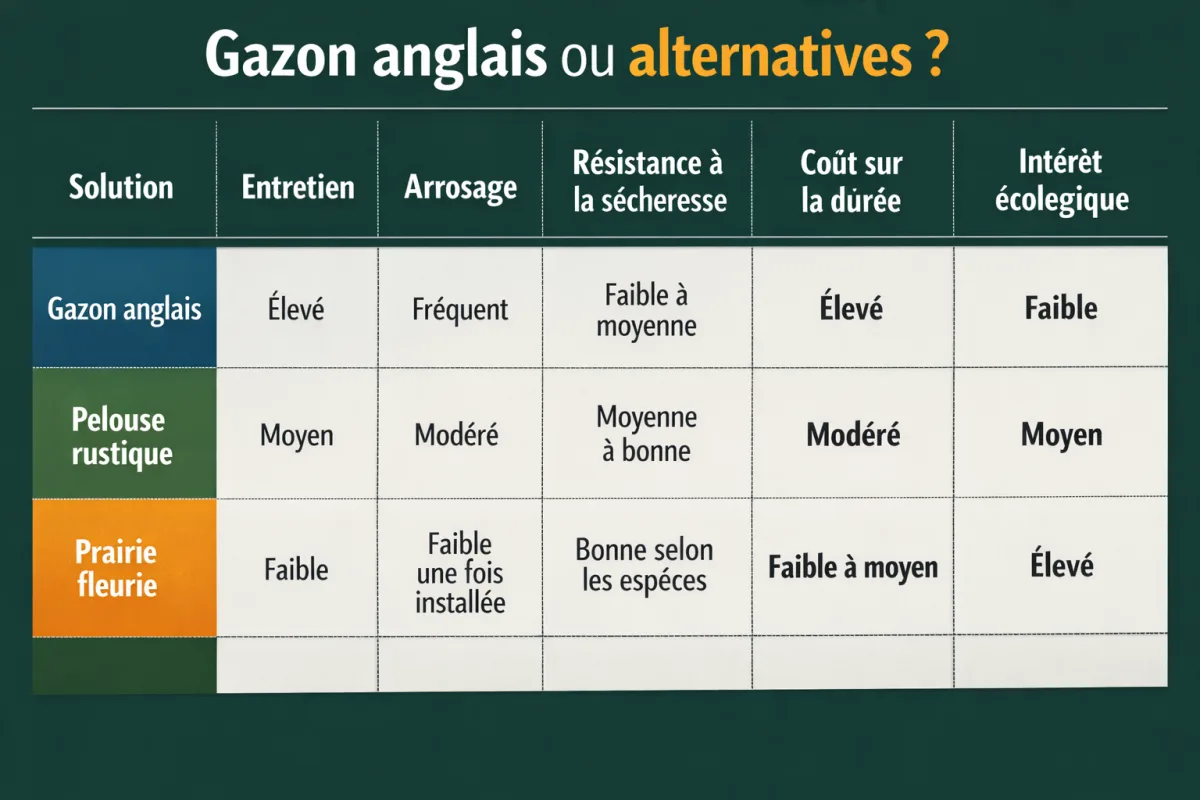
Comparison Table: English Lawn or Alternatives?
The right choice depends on available time, climate, and level of visual expectation. For a garden that must remain easy to live with, comparing surfaces on concrete criteria avoids regrets. Aesthetic alone is not enough.
| Solution | Maintenance | Watering | Drought Resistance | Cost Over Time | Ecological Interest |
|---|---|---|---|---|---|
| English Lawn | High | Frequent | Low to Medium | High | Low |
| Rustic Lawn | Medium | Moderate | Medium to Good | Moderate | Medium |
| Wildflower Meadow | Low | Low once established | Good depending on species | Low to Medium | High |
FAQ on the Disadvantages of the English Lawn
Does English lawn require a lot of maintenance?
Yes. It needs frequent mowing, monitoring of watering, correcting sparse areas, and soil treatment. During an active season, the workload is significantly higher than that of a hardy lawn.
Can you keep an English lawn green without frequent watering?
Not sustainably in dry summer conditions. Without sufficient water, the lawn yellows, growth slows, and density decreases. Soil, exposure, and weather affect the rate of deterioration, but the need for water remains real.
Is the English lawn suitable for a family garden?
Only if usage is moderate. With children, pets, and frequent foot traffic, it quickly shows wear. A hardy lawn better withstands this type of daily life.
What is the best alternative if you want less maintenance?
The hardy lawn is often the best compromise. If the main goal is to further reduce mowing and promote garden biodiversity, a wildflower meadow becomes more relevant.
If the garden is dry, heavily used, or if there is already little time to maintain a regular routine, a hardy lawn or a wildflower meadow will often yield a more consistent result than an English lawn. The right choice is not the smoothest one. It is the one the ground can truly support, season after season.