
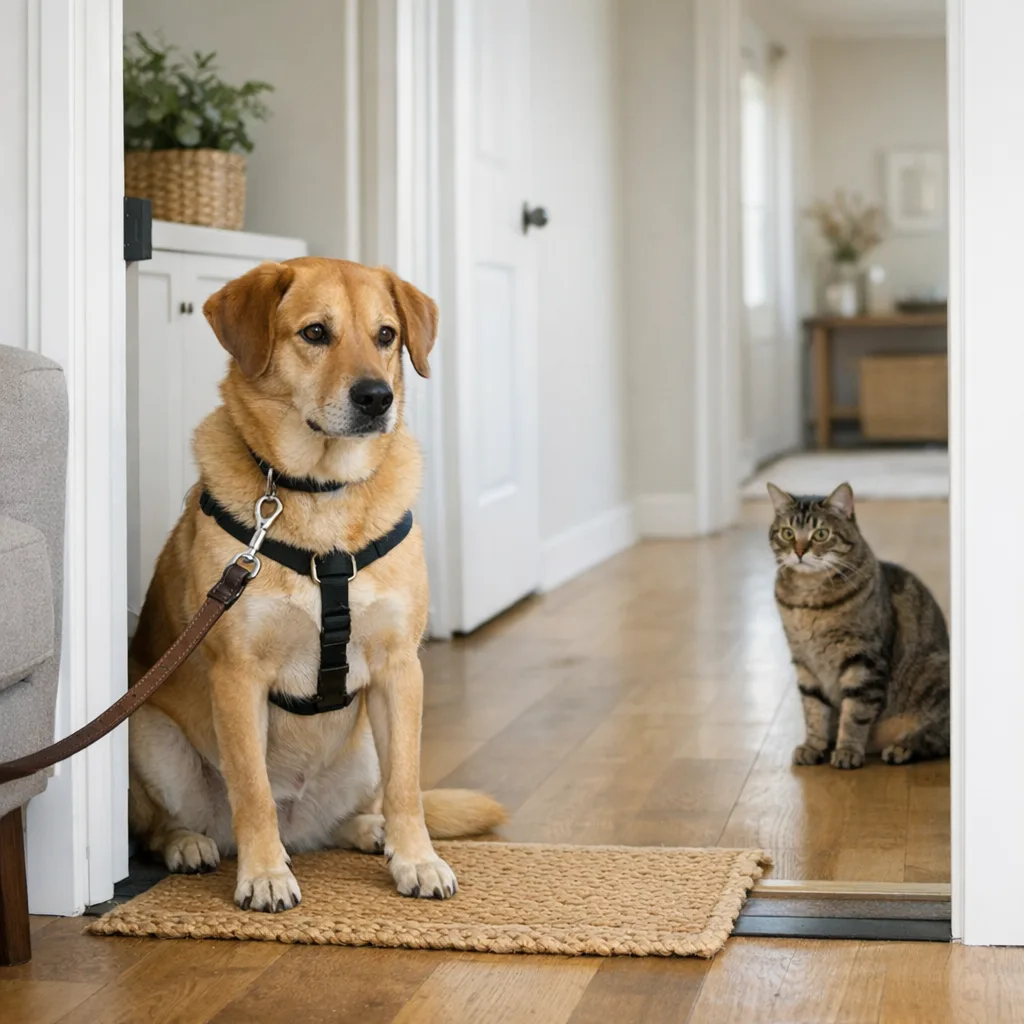
| 📌 | Definition: successful dog-cat cohabitation is a calm shared life, with predictable interactions, without chasing or constant fear. |
| 💡 | Key principle: never force contact; organize the space, resources, and progression to reduce stress. |
| 🛠️ | Method: separation at first, controlled first meeting, then desensitization and positive reinforcement over several days or weeks. |
| ⚠️ | Common mistake: letting dog and cat “figure it out” on their own. This increases the risk of chasing, fixation, and conflict. |
| ⏱️ | Timeframe: adaptation can take from a few days to several months depending on the age, temperament, and history of the animals. |
| ✅ | Realistic goal: peaceful cohabitation, not forced friendship. |
Dog-cat cohabitation: simple method to make them live together without stress
Yes, dog-cat cohabitation can work very well, provided the pace of both animals is respected and their environment is managed. The secret is not to “put them together” quickly, but to build a predictable, safe, and positive relationship, step by step.
The majority of difficulties come from a mix of territoriality, different body language, and, in some dogs, a chase instinct. In practice, the most reliable method is based on three pillars: resource separation, controlled first meeting, and slow progression.
Why isn’t dog-cat cohabitation always natural?
For many animals, the difficulty does not come from “bad relations,” but from a different perception of the world. The dog is often more social, more mobile, and more prone to chase; the cat, on the other hand, is more territorial, more sensitive to blocked access, and needs control over its safety distances.
Very different body languages
A dog that stares, approaches directly, or wags its tail may be perceived as enthusiastic by a human, but as intrusive by a cat. Conversely, a cat that freezes, turns its head away, or moves away is not “capricious”: it often seeks to reduce pressure. This difference in codes explains why the first dog-cat meeting must be structured.
“The right goal is not to make the other animal ‘love’ the other, but to make its presence predictable and non-threatening.”
Principle of work in veterinary behavior
Territoriality, predation, and control stress
The cat needs to be able to choose where it eats, sleeps, and hides. The dog can get excited very quickly in response to fast movement, especially if the cat runs. This is where predation or chasing triggers. The good news is that these behaviors can be worked on with desensitization, counter-conditioning, and positive reinforcement.
- The problem often comes from the pace, not a “bad character.”
- The cat needs escape routes, height, and refuge zones.
- The dog must learn to stay calm in the presence of the cat.
- Safety always takes precedence over speed.
How to prepare the house before the arrival of the second animal?
Before making dog and cat live together, the house must be organized as a zoned space. The goal is simple: avoid competition for the same resources and allow each to rest, eat, and move around without interruption. This preparation greatly reduces stress from the first days.

Resources must be separated
We first think of food, water, and litter, but we need to go further: bedding, toys, hiding spots, and resting points must also be distributed. A cat that has to cross an area frequented by the dog to reach its litter box will hold back, be exposed to stress, and sometimes develop avoidance behaviors.
Comparison table: needs of the dog and the cat
| Need | Dog | Cat |
|---|---|---|
| Space | Identifiable resting area, basket, quiet corner | Height, hiding spots, free access to multiple paths |
| Meals | Meals at fixed times, without intrusion | Small food intakes, protected place, tranquility |
| Stress | Need for activity and controlled exercise | Need for distance, control, and avoidance |
| Communication | More direct, more mobile, sometimes insistent | More subtle, more discreet, often defensive |
Quick checklist before arrival
- Plan at least one refuge room for the newcomer.
- Set up separate and distant bowls.
- Place the cat’s litter box in a place inaccessible to the dog.
- Provide a barrier, a pen, or a door that can be closed.
- Put accessible high points for the cat.
- The house must be designed to avoid direct confrontations.
- The cat must be able to take refuge and observe from a height.
- Bowls, bedding, and litter boxes must never be shared at the beginning.
How to introduce a dog and a cat without stress?
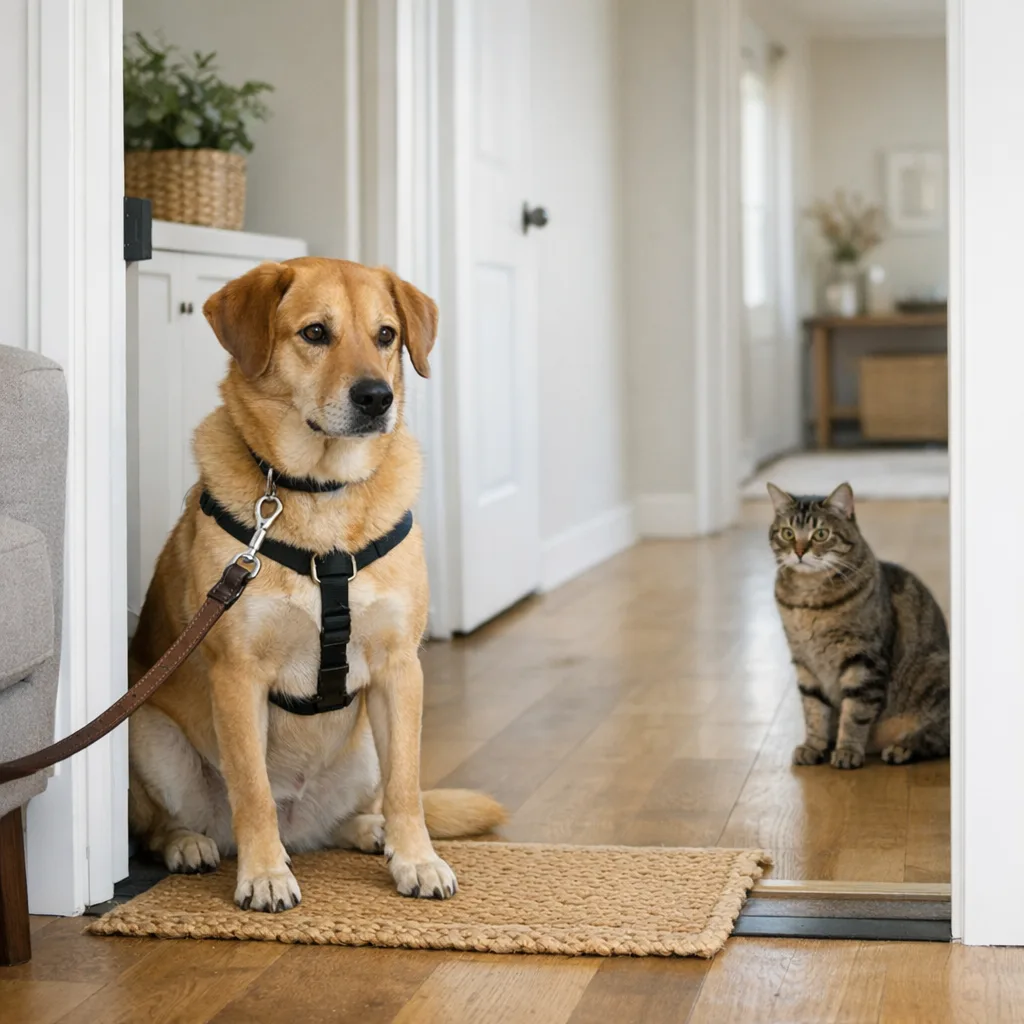
The first dog-cat meeting must be short, neutral, and controlled. The goal is not for them to become close immediately, but for them to associate the other with a stable and non-threatening experience. A successful introduction reduces tension and prevents chasing or fear from becoming a reflex.
Simple 5-step method
| Step | Goal | Concrete action | Mistake to avoid |
|---|---|---|---|
| 1. Smells | Create familiarity | Exchange blankets or toys | Putting the animals face to face too soon |
| 2. Visual separation | Reduce pressure | Use a door, gate, or barrier | Letting them run freely in the house |
| 3. First sight | Associate the other with something pleasant | Treats or meals on each side | Forcing contact or proximity |
| 4. Brief contact | Test tolerance | Dog on leash, cat free to leave | Blocking the cat in a corner |
| 5. Repetition | Establish a calm habit | Several short sessions, always supervised | Extending the duration too quickly |
The right pace: calm, short duration, reward
Desensitization consists of exposing the animal to the other in small doses to reduce the emotional reaction. Counter-conditioning transforms the presence of the other into a positive signal: treats, play, meals, or calm voice. Positive reinforcement rewards the desired behavior, such as the absence of fixation or returning to calm.
“If one of the two can no longer eat, relax, or move freely, it means we went too fast.”
Practical principle in animal behavior
- The leash is not a magic solution, but a safety tool.
- The cat must remain free to move away.
- The goal is to create positive associations, not to “hold” the animals together.
The first days of cohabitation: what routine to establish?
The first days are a phase of active observation. Partial separation is maintained, brief sessions are organized, and any improvisation is avoided. Routine reassures both species because it makes the presence of the other predictable. It is often at this time that the difference between simple curiosity and true stress is seen.

Recommended routine over 7 days
- Morning: separate meals and brief visual interaction if everything is calm.
- Daytime: alternating access to spaces, without letting the dog chase the cat.
- Evening: short session with rewards for each calm behavior.
- Night: separation if the tension level remains uncertain.
What is generally observed in the field
In a household where the dog was very excited at the sight of the cat, progress is often visible as soon as the sessions become shorter and more predictable. Conversely, a very cautious cat may need several weeks before accepting the dog’s presence in the same room. Each dog-cat pair is unique.
A common example: a very greedy adult dog calms down faster if the cat’s presence signals treats, whereas a shy cat first needs space, then only positive associations. This is why the method must be adapted to the temperament, age, and history of each animal.
- The first days serve to establish safety, not proximity.
- Short sessions are often more effective than long ones.
- Progress is measured by a decrease in stress, not by the speed of rapprochement.
What are the signs of stress or danger to watch for?
Knowing how to read stress signals in cats and dogs allows intervention before conflict. Signs of appeasement, flight, fixation, or aggression should not be ignored. If you see tension rising, immediately reduce the difficulty instead of “letting it happen”.
Signs of stress in cats
- Pinned back ears, flicking tail, or very low body.
- Sudden stillness, rapid flight, or prolonged hiding.
- Hissing, growling, dilated pupils.
- Refusal to eat, use the litter box, or leave their refuge area.
Signs of stress in dogs
- Intense fixation on the cat.
- Rigid body, rapid breathing, vocalizations.
- Chasing, repetitive barking, difficulty disengaging.
- Constant agitation or inability to settle down.
| Signal | Possible interpretation | Recommended reaction |
|---|---|---|
| Fixation | Rising excitement or intention to chase | Increase distance and reward looking away |
| Flight | Need for security in the cat | Allow access to a refuge area |
| Hissing / growling | Clear warning | Stop interaction immediately |
| Chasing | Risk of intensified pursuit | Separate, calm, resume later and more slowly |
“A cat’s hiss or a dog’s growl are not tantrums: they are distance messages.”
Basic behavioral reading
- An animal that freezes is not necessarily calm.
- Cat stress is often seen in avoidance and withdrawal.
- The dog must be able to interrupt its fixation without punishment.
Special cases: how to adapt the method to the pair?
Dog-cat cohabitation is managed differently depending on the age, size, and energy of the pair. A puppy and an adult cat do not have the same needs as an adult dog with a kitten. Adapting the method avoids placing an animal in a role it cannot fulfill.
Puppy and adult cat
The puppy is curious, clumsy, and often too insistent. The adult cat, on the other hand, can quickly become exasperated by jumping, running, and solicitations. It is therefore necessary to teach the puppy to settle down very early, offer calm times, and provide the cat with vertical escape routes. This setup can work well if the puppy learns frustration.
Kitten and adult dog
The kitten is fragile and unpredictable in its movements, which can trigger chasing in an adult dog. Here, prevention is the priority: dog under control, very short meetings, physical barriers if necessary, and close supervision. The dog should never be allowed to “test” the kitten out of curiosity.
If the dog chases the cat
The scene must be stopped immediately, without shouting or harsh punishment. Separate them, reduce the difficulty, reintroduce a greater distance, and reward calm behavior. If the behavior persists, work on desensitization and counter-conditioning with a professional.
Anonymized field example
In a household with a young and sporty dog, simply placing the cat up high and doing 3-minute sessions with treats reduced chasing within two weeks. The change did not come from direct contact, but from the repetition of calm experiences.
Anonymized case study
- The puppy needs to learn calmness very early.
- The kitten must be protected from a dog that is too fast or too excitable.
- If the dog chases, revert to the previous step.
What mistakes must absolutely be avoided?
The most common mistakes are often made with good intentions: wanting to go too fast, trying to reassure by force, or thinking that a “first fight” will clarify the hierarchy. In reality, these choices increase stress and prolong tension. For a successful dog-cat cohabitation, caution is better than improvisation.
| Mistake | Why it’s a problem | Good alternative |
|---|---|---|
| Forcing contact | Creates fear, flight, or defense | Brief and separated introductions |
| Leaving animals alone too early | Risk of chasing or biting | Constant supervision at the start |
| Sharing litter box or bowls | Increases competition and stress | Separate and accessible resources |
| Punishing the dog for looking at the cat | Increases negative association | Reward looking away |
| Neglecting the cat’s refuge | The cat feels trapped | Height, hiding places, and quiet rooms |
| Confusing curiosity with relaxation | Progressing too fast | Observe eating, posture, and mobility |
- Speed is the most common mistake.
- Sharing resources should be avoided initially.
- Punishment often worsens the situation.
How long does a successful cohabitation take?
There is no universal timeframe. Dog-cat cohabitation can stabilize in a few days with very young and well-socialized animals, but it can also take several weeks or even months. The good benchmark is not the calendar, but the gradual reduction of tension and the appearance of calm behaviors.
Realistic timeframes
- 24 to 72 hours: observation, separation, and adjustment phase.
- 1 to 2 weeks: first more relaxed contacts if all goes well.
- 3 to 8 weeks: common period for consolidating routines.
- Several months: possible if one of the two is very fearful, a hunter, or poorly socialized.
Behavioral veterinarians often remind that progress should be measured by progression, not performance. If the cat eats, explores, and sleeps normally, and if the dog looks away from the cat on request or signal, the cohabitation is moving in the right direction.
- The timeframe varies greatly depending on temperament and history.
- The goal is stress reduction, not immediate friendship.
- The good sign is predictability of interactions.
When should you ask a professional for help?
If you observe intense fear, aggression, injuries, persistent blocking, or a dog that never lets go of the cat, you should seek professional advice. A veterinary behaviorist, a competent behaviorist, or a specialized trainer can analyze the dynamics of the duo and adjust the protocol.
Situations that require prompt advice
- Bite, deep scratch, or injury.
- Repeated chasing despite separation and supervision.
- Cat stops eating, using its litter box, or going outside.
- Dog in a constant state of hypervigilance.
- Stress that worsens instead of decreasing.
Useful and recognized resources
“When safety is compromised, we do not try to ‘habituate’ faster: we protect, reassess, and start again later.”
Principle of caution in veterinary behavior
- Injuries, intense fear, or persistent blocking justify professional help.
- Supervision remains essential at the beginning.
- Prompt advice often prevents establishing a lasting bad reflex.
FAQ on dog and cat cohabitation
How long does it take for a dog and a cat to get used to each other?
It varies greatly. Some pairs relax in a few days, others need several weeks or months. The right pace depends on the age, temperament, socialization, and history of each animal.
Can they sleep together one day?
Yes, sometimes, but this is neither a mandatory goal nor a sign of success by itself. If they sleep close to each other, it is generally after a long period of trust, stable routine, and absence of tension.
What to do if the dog chases the cat?
Immediately interrupt the scene, separate the animals, and return to a greater distance. Then work on calmness with short sessions, a leash, rewards, and, if needed, a behavior professional.
Should the cat or the dog be introduced first?
The most important thing is not the order, but the way of introducing. Ideally, start with scents, then move to visual separation, before very short and supervised contacts.
Can a cat live with a very energetic dog?
Yes, if the house is well arranged and if the dog quickly learns to calm down. But the more exciting the dog is, the stricter the management of distances, hiding places, and supervision must be.
Key points to remember
- Successful dog-cat cohabitation is based on gradual progress, not speed.
- Prepare the house with separate resources and refuge areas.
- The first meeting must be short, calm, and supervised.
- Watch for signs of stress in the cat and fixation in the dog.
- Adapt the method to the duo: puppy and adult cat, kitten and adult dog, very energetic dog.
- In case of aggression, injury, or intense fear, seek professional help.
Conclusion: aim for peaceful cohabitation, not forced friendship
Dog and cat cohabitation is not won by force, but through intelligent organization, fine reading of signals, and respectful progression. If you keep safety as a priority, you greatly increase your chances of having a dog and a cat together in a peaceful climate, without unnecessary stress.