| 📌 | Definition: a dog anti-escape collar marks an authorized zone and warns the animal before any exit from the perimeter. |
| 💡 | Key advantage: it helps secure a garden without necessarily installing a physical fence everywhere. |
| 🔍 | Types: wired, wireless, GPS, with beep, vibration, spray or adjustable stimulation depending on the system. |
| ⚙️ | Main criterion: the actual range and signal stability matter more than the commercial promise. |
| 🛡️ | Safety: proper adjustment, gradual learning, and observing the dog take precedence over correction. |
| 💶 | Budget: expect about €80 to €500 depending on the system, coverage, and options. |
Dog Anti-Escape Collar: The Complete Guide to Choosing an Effective and Suitable System
A dog anti-escape collar is not meant for “quick training.” It is used to set a clear boundary when the terrain, the dog’s profile, or the environment make a traditional fence insufficient. The right system is judged not by power, but by the coherence between the signal, the area to protect, and the animal’s sensitivity level.
Understanding the Dog Anti-Escape Collar
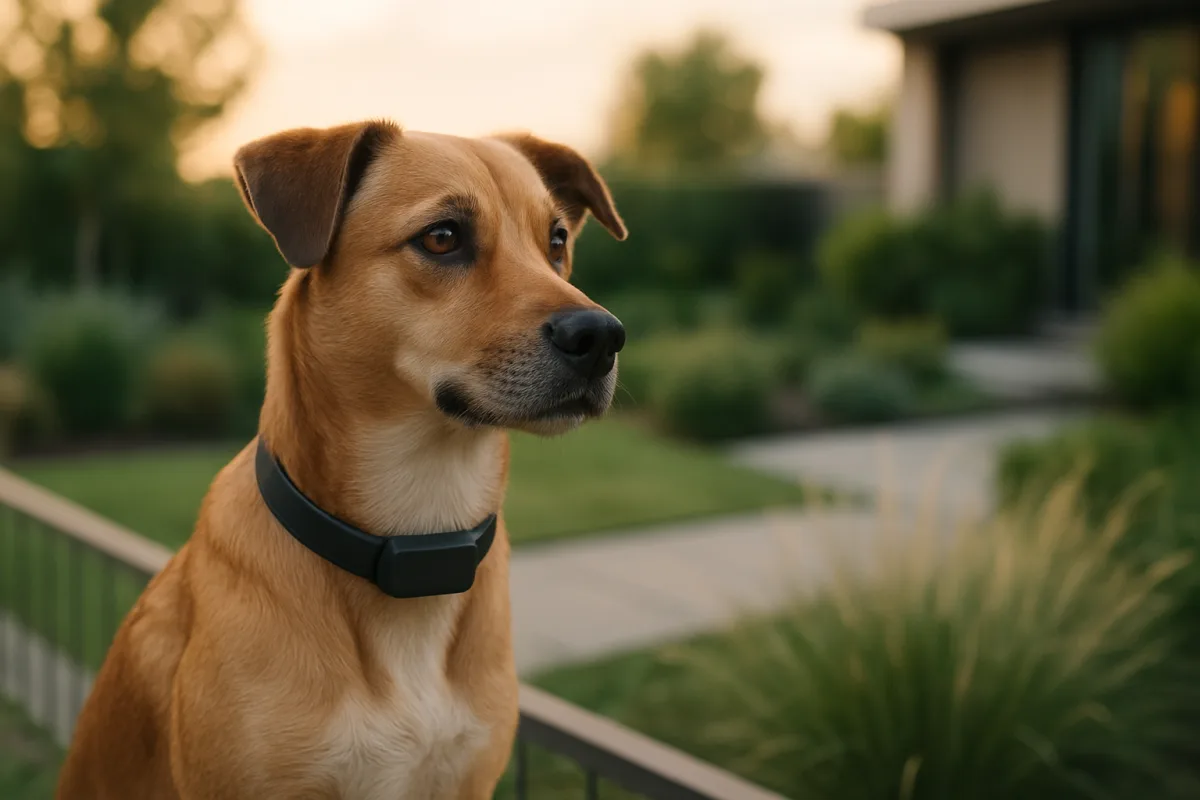
The principle is simple: a device defines a boundary zone and the receiver collar warns the dog when it approaches the limit. Depending on the model, the alert is given by beep, vibration, spray, or adjustable stimulation. The purpose is to turn a vague edge of the property into a clear landmark for the dog.
Three often confused solutions must be distinguished:
- The dog anti-escape fence: a system that creates an invisible boundary, often with a buried wire or a transmitter.
- The wireless anti-escape collar: a base emits a circular zone around the device, easy to install but less flexible.
- The dog GPS collar: it locates the animal and allows geofencing, but does not always replace a real boundary barrier.
How Does a Dog Anti-Escape Collar Work?
The system works in two stages: it first signals to the dog that it is approaching a limit, then it can trigger a correction if the animal continues forward. The idea is not to surprise, but to establish a clear landmark. The more serious the learning phase, the less correction should be needed.
The Principle of the Safety Zone
The safety zone is the space the dog learns to respect. It can cover a small urban garden or a large property, depending on the chosen technology. The adjustment must remain gradual: test the limit, observe the dog’s reaction, then adjust the threshold if necessary.
The Wired Anti-Escape Collar
The wired system relies on a transmitter connected to a perimeter cable, often buried or fixed at the edge. It is the most precise solution to draw a complex shape, manage flowerbeds, a driveway, or a passage area. It requires more time initially, but offers a stable boundary.
The Wireless Anti-Escape Collar
The wireless system creates a bubble around a central base. Installation is quick and useful if you want to secure a garden without digging. However, the shape is often circular and the actual range depends on the terrain, walls, and interference. It’s practical but less adjustable than a buried cable.
The Dog GPS Collar
The dog GPS collar is primarily used for geofencing and location tracking. It is relevant for an escape-prone dog, an open terrain, or a quick search after leaving the zone. However, it does not always create as clear a boundary as a wired system, and some models require a subscription.
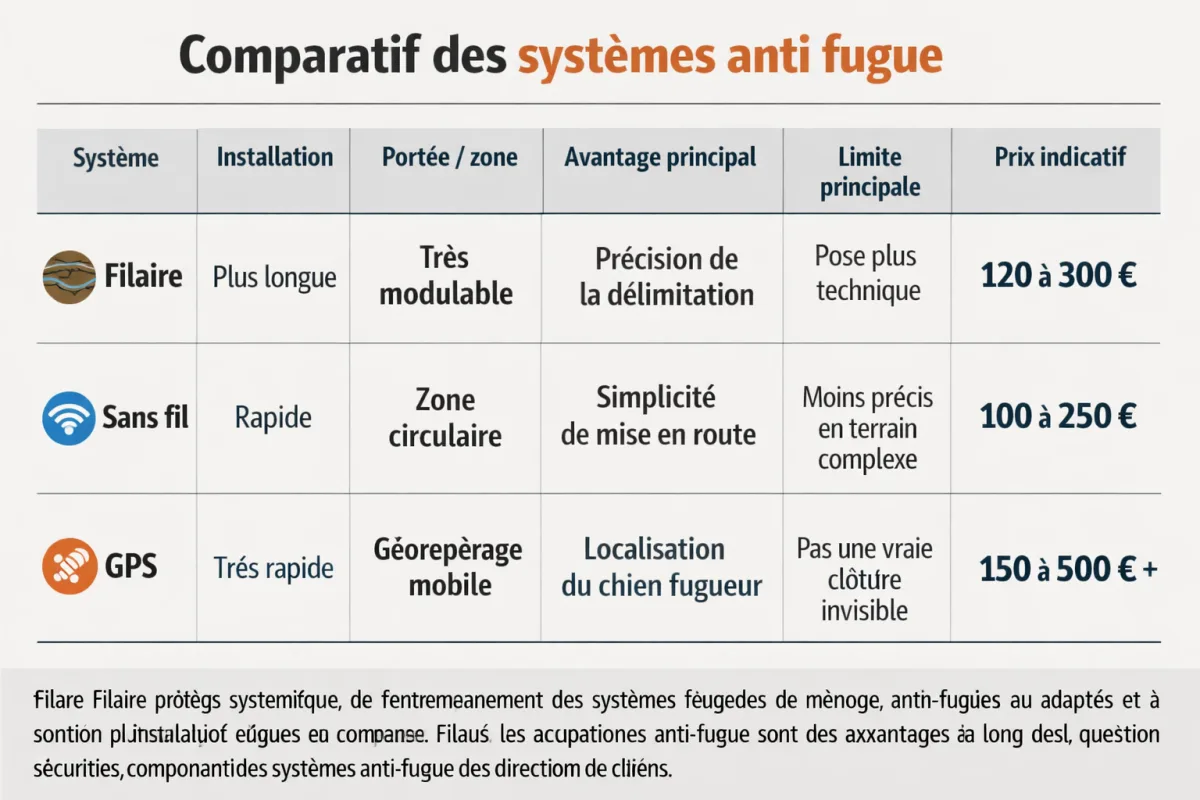
Quick comparison of anti-escape systems
| System | Installation | Range / area | Main advantage | Main limitation | Indicative price |
|---|---|---|---|---|---|
| Wired | Longest | Highly adjustable | Precision of boundary | More technical installation | €120 to €300 |
| Wireless | Fast | Circular area | Ease of startup | Less precise in complex terrain | €100 to €250 |
| GPS | Very fast | Mobile geofencing | Locating the runaway dog | Not a true invisible fence | €150 to €500+ |
Which anti-escape dog collar to choose according to your terrain and your dog?
The right choice first depends on the real context. A small regular garden does not require the same solution as an open terrain, a very dynamic dog, or a sensitive animal. It is better to start from the dog’s tolerance threshold, the shape of the terrain, and the desired level of autonomy, then decide.
The criteria to check before purchase are concrete:
- Size and weight of the dog: a collar that is too heavy or too wide disrupts use.
- Temperament: a sensitive dog responds better to a sound or vibration alert than to a strong correction.
- Area to cover: a large terrain often points towards wired.
- Range of the anti-escape collar: the effective range must be measured on site, not just read on the box.
- Battery life: if the collar must remain active every day, the battery becomes a real criterion.
- Water resistance: an active dog in the rain needs a truly waterproof casing.
- Multi-dog compatibility: some kits accept several receivers, others do not.
| Profile | Most logical solution | Why |
|---|---|---|
| Small regular garden | Wireless | Quick installation, simple area to understand |
| Large terrain or complex shape | Wired | Precise and customizable boundary |
| Runaway dog to locate | GPS as a complement | Location after leaving the zone |
| Anxious or very sensitive dog | Sound/vibration signal first | Reduces the risk of unnecessary stress |
How to install an anti-escape dog fence without mistakes?
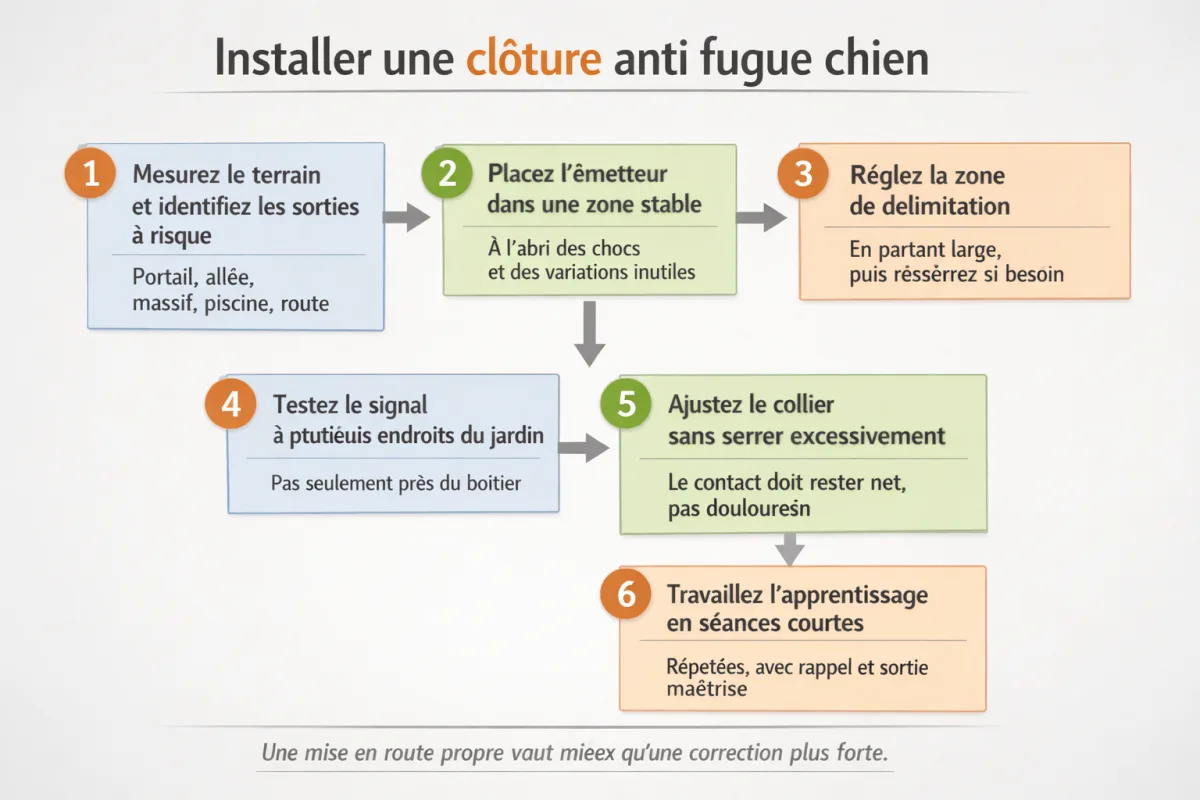
Installation is decisive. A poorly installed system gives an unstable signal, thus a dog that does not understand the rule. You must prepare the terrain, check the actual area, test the range, and devote time to training. A clean startup is better than a stronger correction.
- Measure the terrain and identify risky exits: gate, driveway, flowerbed, pool, road.
- Place the transmitter in a stable area, protected from shocks and unnecessary variations.
- Adjust the boundary zone starting wide, then narrow if needed.
- Test the signal at several spots in the garden, not just near the box.
- Adjust the collar without tightening excessively: the contact must remain clear, not painful.
- Work on training in short, repeated sessions, with recall and controlled outings.
Common mistakes are always the same: starting with too high a level, ignoring interference, neglecting collar adjustment, or wanting to go too fast. On a young dog, excessive pressure breaks the signal reading. On an older dog, it can create mistrust instead of the desired reference.
Safety, well-being, and precautions
An anti-escape collar must protect the dog from external danger, not create a new source of stress. Behavioral veterinarians and trainers who work properly follow the same logic: observation first, adjustment next. If the dog freezes, avoids the garden, or scratches its neck, the system is poorly tolerated or poorly adjusted.
Before using the system, always check:
- the dog’s age and its ability to understand a simple command;
- compatibility with its morphology, especially for small breeds;
- reaction to sound and vibration signals before any stronger correction;
- absence of redness, rubbing, or avoidance behavior;
- the daily duration of use, which should remain reasonable.
In practice, the system should be an aid. It does not replace recall, outing routines, or consistency of the framework. The right question is not “does it correct?”, but “does my dog understand the signal without tensing up?”.
How much does a dog anti-escape collar cost and what quality/price ratio should you aim for?
The price mainly depends on the level of precision, the number of dogs to equip, waterproofing, and the quality of the receiver. An entry-level model may be sufficient for a small simple garden, but it quickly becomes limited as soon as the area is large or the dog is very lively.
| Range | Price | What you get |
|---|---|---|
| Entry-level | 80 to 150 € | Basic functions, limited range, suitable for simple uses |
| Mid-range | 150 to 300 € | Better signal stability, finer adjustments, decent battery life |
| High-end | 300 to 500 € and more | Multi-dog, better waterproofing, advanced settings, possible GPS tracking |
For maintenance, watch three points: the batteries or battery, the condition of the contacts, and the casing’s integrity. A collar that slips, oxidizes, or loses its autonomy also loses reliability. This is where the real quality/price ratio plays out, not just at the time of purchase.
What are the alternatives to the dog anti-escape collar?
The collar is not the only answer. In some cases, a simpler, gentler, or clearer solution for the dog does a better job. The goal remains the same: prevent escape without creating confusion in learning or multiplying unnecessary corrections.
- Physical fence: the clearest solution, especially for very sensitive dogs or exposed areas.
- Long leash: useful for recall training and to check behavior without risk.
- Recall training: essential even if an anti-escape device is installed.
- Dog GPS collar: a useful complement to find a dog that has left the perimeter, not to block escape beforehand.
FAQ about the dog anti-escape collar
Is the dog anti-escape collar dangerous?
It can become problematic if poorly adjusted, used too long, or chosen without considering the dog’s temperament. When used properly, with a progressive learning phase, it remains a delimitation tool. As soon as a dog shows stress, the settings and method must be reviewed.
Wired, wireless or GPS: which to choose?
The wired system is the most precise for delimiting a complex area. The wireless is the easiest to set up for a regular garden. GPS is interesting for locating a runaway dog, but it does not always replace a real safety perimeter.
What range to choose for a typical garden?
The right range is not the one boldly advertised on the box, but the one that remains stable at your place. For a small area, a wireless system may suffice. For a large plot or an irregular perimeter, wired often remains more consistent.
From what age can it be used?
It is better to wait until the dog is mature enough to understand clear training. For a puppy, the focus is often on building recall and framework, not correction. In case of doubt, ask a veterinary behaviorist’s advice.
How long does it take for the dog to get used to it?
Some dogs understand the logic of the signal very quickly. Others need several days, sometimes more, especially if they are very excited or wary. Regularity, simplicity of settings, and consistency of outings make the difference.
Does the GPS collar replace a dog containment fence?
No. The GPS helps to locate the animal, but it does not necessarily prevent leaving the area at the first movement. To secure a garden, a clear boundary is needed first. The GPS mainly serves as an additional safety net.
The right choice is not the strongest system. It is the one that respects the signal, covers your property without dead zones, and allows the dog to learn without overload. If you hesitate between two models, start from the actual terrain, the dog’s temperament, and your ability to set up a consistent framework. This is where the effectiveness of a dog containment collar is decided.