

| Key Points | Details to Remember |
|---|---|
| 🐾 Origins | Evolution of the Briard with herds since the Middle Ages |
| 🧬 Morphology | Wavy coat, balanced size and solid bone structure |
| 💡 Character | A dog both |
| 🎓 Training | Learning based on consistency and complicity |
| 🛁 Maintenance | Regular brushing to preserve the coat and avoid knots |
| ❤️ Health | Screening for retinal atrophies and joint care |

The Briard is first encountered in medieval engravings, already very close to herds. Today, its long, wavy coat captures attention as much as it charms with its loyal and vigilant temperament. From the mountain to the meadow, this shepherd dog carries ancestral know-how and a remarkable adaptability. Let’s dive into its world to understand how this large build with silky fur remains a versatile and protective companion.
History and Origin of the Briard
Medieval Roots and Pastoral Tradition
The earliest mentions of the Briard date back to the enclosures of Provence and Normandy, where it guarded sheep and cattle. It is found under the name “berger de Brie” or “chien de Brie,” referencing the eponymous region. Its stocky silhouette and thick coat protect against cold and dampness, essential qualities for watching over livestock at dawn or dusk. Over the centuries, breeders have refined its abilities, preserving its infallible scent and sharp intelligence, indispensable for thwarting predators or gathering a stubborn herd.
The Briard Today
Officially recognized by the Central Canine Society at the end of the 19th century, the Briard has gradually moved away from solely pastures to enter family life. In shows and obedience competitions, it now displays a proud head carriage and expressive gaze. In France, it remains the champion of herds, but it is often found with active families attracted by its dynamism and loyalty. Its adaptability is also measured in its aptitude for work, whether tracking, agility, or even therapy with patients.
Morphology and Wavy Coat

Size, Build, and General Appearance
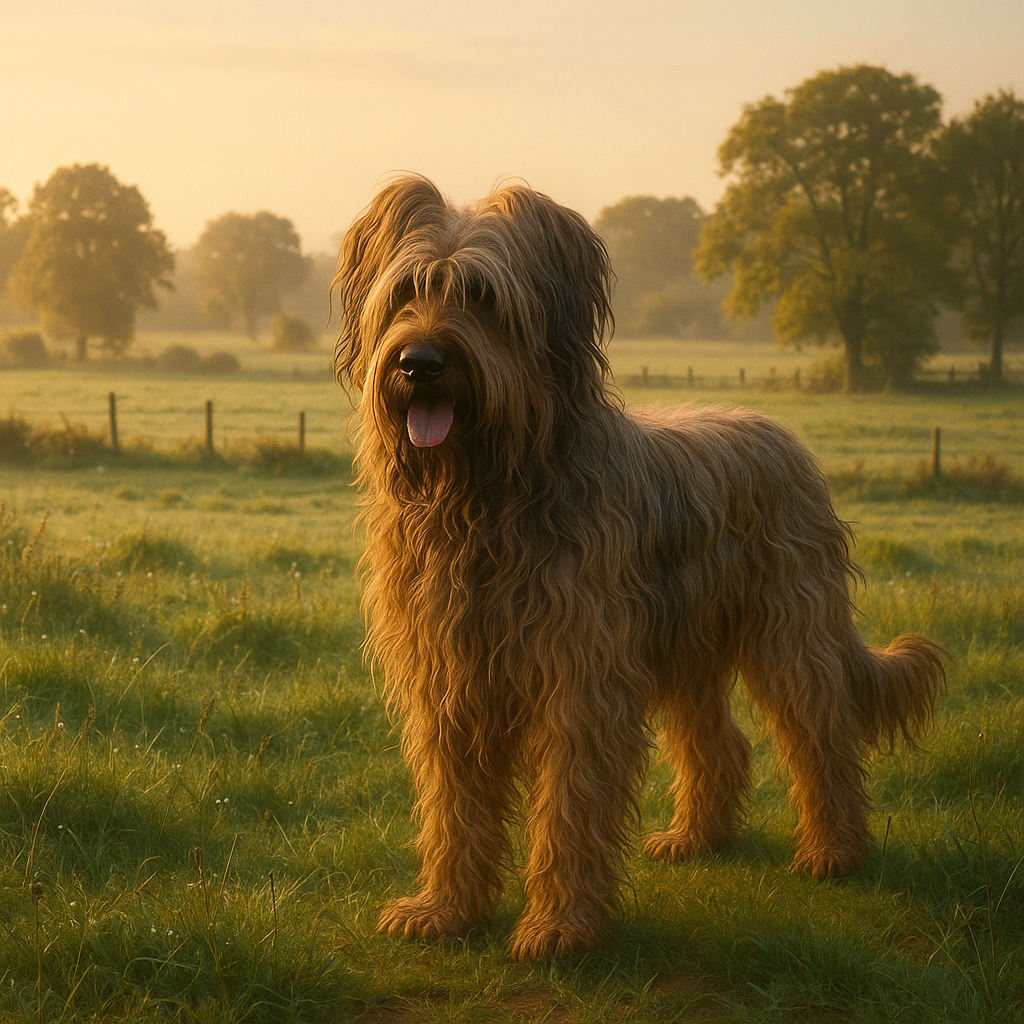
The Briard displays an impressive stature: the male measures between 62 and 68 cm at the withers, the female slightly less, around 58 to 66 cm. Its build is sturdy without heaviness, an essential balance for long hours of walking on rough terrain. The broad limbs emphasize a smooth and regular gait, while the head, long and powerful, carries deep eyes. There is no sign of any aggressive expression: its tail carriage and ear carriage (which can be natural or cropped depending on local practices) reflect its state of mind, between confidence and vigilance.
The Wavy Coat and Its Care
The Briard’s coat is distinguished by its wavy texture, never curly like some Eastern European shepherd dogs. Its undercoat is dense, and the topcoat forms those shiny strands that fall in fringes along the body. To prevent matting and ensure ventilation, a weekly brushing is recommended, accompanied by a deeper combing every three to four weeks. As shedding approaches, slight clumps of undercoat are spotted and removed to keep the skin healthy and prevent irritation.
Temperament and Character
A Vigilant and Versatile Companion
The Briard combines a protective instinct inherited from shepherds with great sociability. It naturally keeps a watchful eye on its environment, offering a sense of security without ever falling into excessive aggression. With children, it is patient and playful, capable of adjusting its energy according to the context. Among various herding dogs, it shares certain qualities with the Polish lowland shepherd, notably the ability to work autonomously while remaining attentive to its owner.
Socialization and Alert Phases
In the presence of strangers, the Briard takes a moment to observe. It barks, not out of nervousness, but to signal intrusion and warn its household. Once reassured, it relaxes easily and can welcome guests. This ability to distinguish real threats from mere visitors is refined during socialization, which begins in the first weeks. Without this step, it risks generalizing its alert reactions – a flaw quickly corrected by regular encounters in varied environments.
Training and Activities
Basic Learning and Consistency
Training a Briard first involves establishing a relationship of trust where each command has meaning for the dog. Basic exercises – sit, lie down, recall – rely on reward and consistency. Short sessions are favored to maintain concentration, incorporating scent games or light obstacle courses. Conversely, harsh methods quickly backfire on the owner: this sensitive dog retains negative memories and can become wary.
- Vary training locations to strengthen recall.
- Associate toys and treats with a consistent keyword.
- Introduce guarding commands adapted to family needs.
Canine Sports and Work Missions
Its shepherd instinct naturally leads it to tracking and obedience sports, disciplines in which it excels due to its endurance. In obedience, there is fine coordination between owner and dog; in agility, its size surprises by the speed it displays over jumps and tunnels. Some owners even offer it animal mediation or search and rescue missions, fields where the Briard deploys all its curiosity and scenting ability.
Health and Longevity
Genetic predispositions and screening
Like many large breeds, the Briard can present joint disorders (hip dysplasia) and eye conditions (progressive retinal atrophy). Before adoption, screening by X-ray and ophthalmological examinations is recommended. A reputable breeder provides health certificates, guaranteeing transparency regarding the absence of these pathologies.
Routine care and hygiene
Beyond the coat, tear stains can leave marks under the eyes: cleaning with a mild solution is enough to prevent unsightly stains. The nails, subjected to walks on hard ground, generally wear down naturally, but regular checks ensure they do not crack. Finally, a quality diet rich in omega-3 fatty acids contributes to the good health of the skin and wavy coat.
Adopting and living with a Briard
Choosing between breeder and shelter
Are you hesitating between a puppy from a breeder and an adult from a shelter? The breeder offers the guarantee of pedigrees and early follow-up, while adoption from a shelter can save a dog destined for euthanasia. In both cases, make sure to assess the birth environment and the dog’s socialized behavior before welcoming it into your home.
Daily needs and balance
This active dog requires at least one hour of brisk walking per day, complemented by games or scent work outdoors. In the city, a large park is sufficient, but the routine will need to be enriched with sports or mental activities at home. The Briard, loyal and generous, gives a lot of affection; in return, it demands a stable presence and stimulation to avoid boredom.
FAQ
- What is the average age of a Briard?
- The Briard lives between 10 and 12 years, provided it has good hygiene and regular veterinary care.
- At what age should Briard training begin?
- Initial training can start as early as 8 weeks, focusing on play and gentleness.
- Does the Briard shed a lot?
- It molts twice a year, during which daily brushing helps limit hair loss in the house.
- Is it compatible with other animals?
- Well socialized, it coexists without problems with another dog or a cat, provided there is a gradual introduction.