

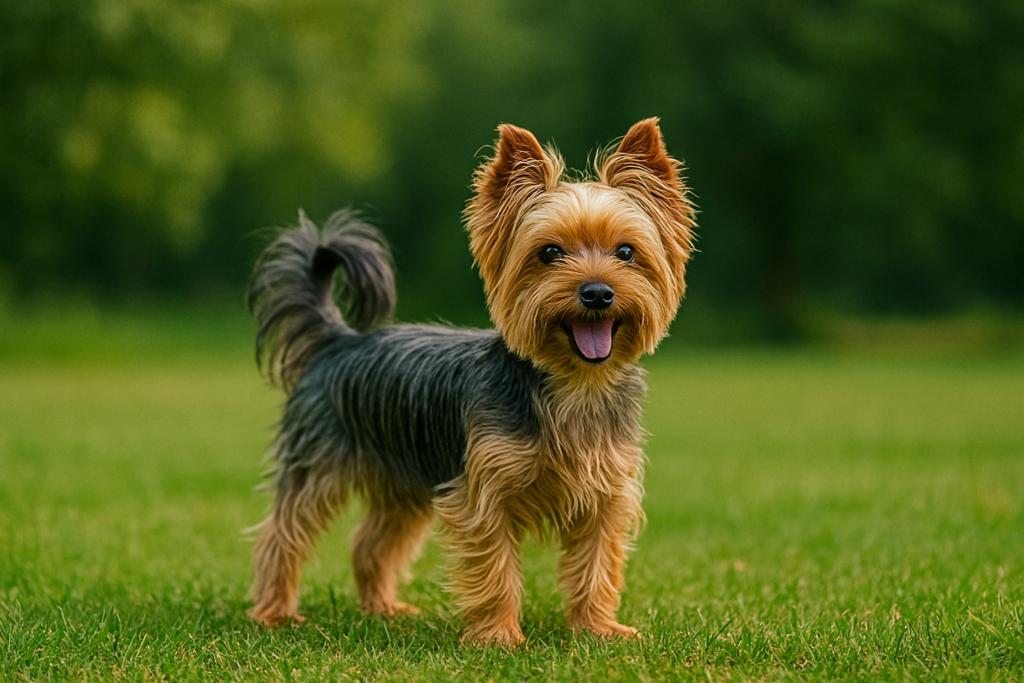
Don’t be fooled by its plushy face and featherweight: the Yorkshire Terrier, or “Yorkie” to those close to it, is a dog with real character! Known for its long, silky coat, it also stands out for its dynamism and great loyalty to its owner. In this article, we review everything you need to know to get along well with this little bundle full of pep.
General Presentation
The Yorkshire Terrier originates from the north of England, where it was originally used to hunt rats in mines and textile factories. Today, it has become a wonderful companion dog, appreciated for its liveliness and elegance. An adult typically weighs between 2 and 3 kg, with a shoulder height of about 20 cm. Yes, it’s a mini-dog, but with energy to spare!
Its life expectancy can reach 13 to 16 years, which is quite long for a dog. However, it requires some special care, especially for its coat, and an environment where it can express its temperament.
Character and Behavior
The Yorkie is known for its strong-willed and sometimes stubborn character. Despite its small size, it is fearless and won’t hesitate to bark (sometimes a bit too much) to make it clear that it is there. Joking aside, this dog is very attached to its owner and loves to spend time on their lap or in their arms.
Early socialization is recommended, as it can be wary of strangers or other animals. In other words, from puppyhood, it is gradually accustomed to seeing people and meeting other dogs outdoors.
Did you know? The Yorkshire Terrier is often among the smallest dogs in the world, but it more than makes up for it with its courage and energetic temperament.
Physical and Mental Needs
Despite its fragile appearance, the Yorkie remains an active dog that needs to expend its energy. Don’t think it will spend its days napping on the couch!
- Regular walks (2 or 3 times a day), even if they can be shorter than for a large dog
- Indoor and outdoor games (ball throwing, hide and seek)
- Mental stimulation: small obedience exercises, puzzle games
- Dog meetings to avoid shyness or aggression towards larger dogs
In other words, don’t underestimate the energy of this mini-terrier. It needs activity, both physical and mental, to be truly fulfilled.
Health & Genetic Predispositions
The Yorkshire Terrier is generally robust for a dog of this size, but it can have some specific vulnerabilities:
| Disease | Symptoms | Prevention |
|---|---|---|
| Patellar luxation | Intermittent limping, leg held in the air | Veterinary check-ups, avoid jumps that are too high |
| Dental problems | Tartar, bad breath, pain | Regular tooth brushing, quality kibble |
| Hypoglycemia (in puppies) | Lethargy, trembling | More frequent meals, veterinary monitoring |
Dental care is particularly important: small jaws can quickly accumulate tartar. Regular scaling (or even weekly brushing) is often recommended.
Recommended Diet
The Yorkshire has a small stomach, so you need to pay attention to the quantity and quality of its food.
- Choose premium kibble “special small breed”
- Divide the ration into 2 or 3 mini-meals (especially for puppies)
- Check the protein, fat, and mineral content to support its growth
- Monitor its weight: even small, it can quickly gain a few extra grams
An overweight Yorkshire can quickly develop joint or heart problems. It is therefore better to measure its rations precisely.
Coat Care / Grooming
One of the distinctive features of the Yorkie is, of course, its long and silky coat, which requires regular maintenance. In “long coat” mode, you need to brush and comb daily (or almost) to avoid knots. You can also opt for a shorter cut, which is easier to manage.
Baths should be planned when the coat is dirty or greasy, using a gentle suitable shampoo. And for a little glamorous touch, some owners attach a small bow or elastic at the top of the head to clear the eyes. Cherry on the cake: the result is just too cute!
Favorite Activities
- City walks: No need for large spaces, it already loves exploring every sidewalk
- Indoor games: In an apartment, it enjoys chasing a toy
- Mini agility: Some Yorkies have fun on courses adapted to their size
- Obedience & small tricks: It likes learning new tricks to shine in company
Ideal for What Type of Owner?
The Yorkshire Terrier is suitable for people looking for an affectionate companion dog but ready to invest in its grooming and training (it can have a bit of character). It adapts well to apartment living, provided it is offered regular outings and stimulation.
On the other hand, if you want a very obedient dog from the start, know that the Yorkie can be a bit stubborn (if you want a little training challenge, it’s perfect!).
Recommended Products
To make your Yorkie’s life sweeter (and yours too):
- Small breed kibble: suited to its jaw and metabolism
- Quality comb and brush: essential to avoid knots
- Gentle shampoo for long coats: for a silky and shiny coat
- Light harness or collar: the Yorkie has a fragile neck, so be careful with pulling
Whipped cream on the cherry: don’t forget the little fashion touch (clips, bows, etc.) if you want to give it an irresistible look!
FAQ & Anecdotes
Is the Yorkshire Terrier fragile?
He is small, but not necessarily more fragile than any other dog. With quality food, proper care, and a safe environment, he can live a long and healthy life.
How to prevent him from barking all the time?
Good early training and clear rules (which teach him not to react to every noise) are essential. Obedience and socialization exercises can also help.
Funny anecdote
It is true that some Yorkies adopt a somewhat “proud” gait, head held high and chest puffed out, as if they were strutting on a runway! From there to say they are little canine models, there is only a step…
In summary, the Yorkshire Terrier is a lively and charming dog, who will make the happiness of owners looking for a dynamic and endearing ball of fur. Certainly, he requires a bit of maintenance (especially grooming), but in return, he will give you lots of affection and joy every day. So, ready to adopt this mini-terrier with an XXL personality? 🐾