

| Key Points | Details to Remember |
|---|---|
| 🐕 Origins | Shiba Inu: small Japanese dog; Corgi: Welsh farm dog |
| 🏙 Urban Adaptation | Shiba appreciates tranquility; Corgi is sociable but demanding |
| 🏃♂️ Exercise | Shiba: calm walks; Corgi: needs intense play |
| 🐾 Maintenance | Shiba: easy-to-brush coat; Corgi: double coat, regular brushing |
| 👨👩👧👦 Sociability | Shiba: independent; Corgi: very affectionate |
| 🩺 Health | Shiba: joint predispositions; Corgi: watch the weight |

Choosing a canine companion in the city is not just about a visual crush. Between the sometimes moody character of the Shiba Inu and the perpetual good humor of the Pembroke Corgi, the differences are obvious… and daily. This article explores the origins, lifestyle, and imperatives of each to help you make the decision that fits your urban rhythm, your available space, and your exercise habits.
Origins and Contrasting Temperaments
At first glance, Shiba Inu and Pembroke Corgi share a compact build and a playful look. In reality, their histories diverge. The Shiba Inu, one of the oldest Japanese breeds, evolved to hunt in mountainous terrain. Strong and agile, it has retained a pack instinct marked by strong independence. The Pembroke Corgi, meanwhile, descends from Welsh herding dogs, bred to gather livestock. This role shaped its sociable temperament, always ready to cooperate and seek attention.
This original distinction is reflected in urban life. The Shiba, accustomed to personal reflection, will more easily accept times of solitude, provided it has its routine. The Corgi, surrounded by sheep all day, seeks to maintain connection and can be noisy if not given playful moments.
The Shiba Inu: Discretion and Autonomy
A Shiba comfortable in its mind is generally a calm dog indoors, sometimes taciturn with strangers. One might think it is distant, but in truth it builds a form of discreet complicity with you. The promise of an owner: respect its need for calm, establish a framework, and offer two to three daily outings, without excessive energy dispersion.
The Pembroke Corgi: Mischief and Sociability
The Pembroke Corgi has the gift of gathering attention, whether from family or the passing mail carrier. Every encounter becomes an excuse for a little show. While this expressiveness is charming, it also comes with a constant need for mental and physical stimulation. Underestimating its bouncing potential risks a restless, sometimes destructive dog.
Exercise Needs and Adaptation to City Life

Between an elevator pitch and a real walk, apartment living requires a careful balance. The Shiba Inu is often content with calm walks around the neighborhood, provided you dedicate about thirty minutes morning and evening. It then expends steady energy, without exploding at the slightest provocation.
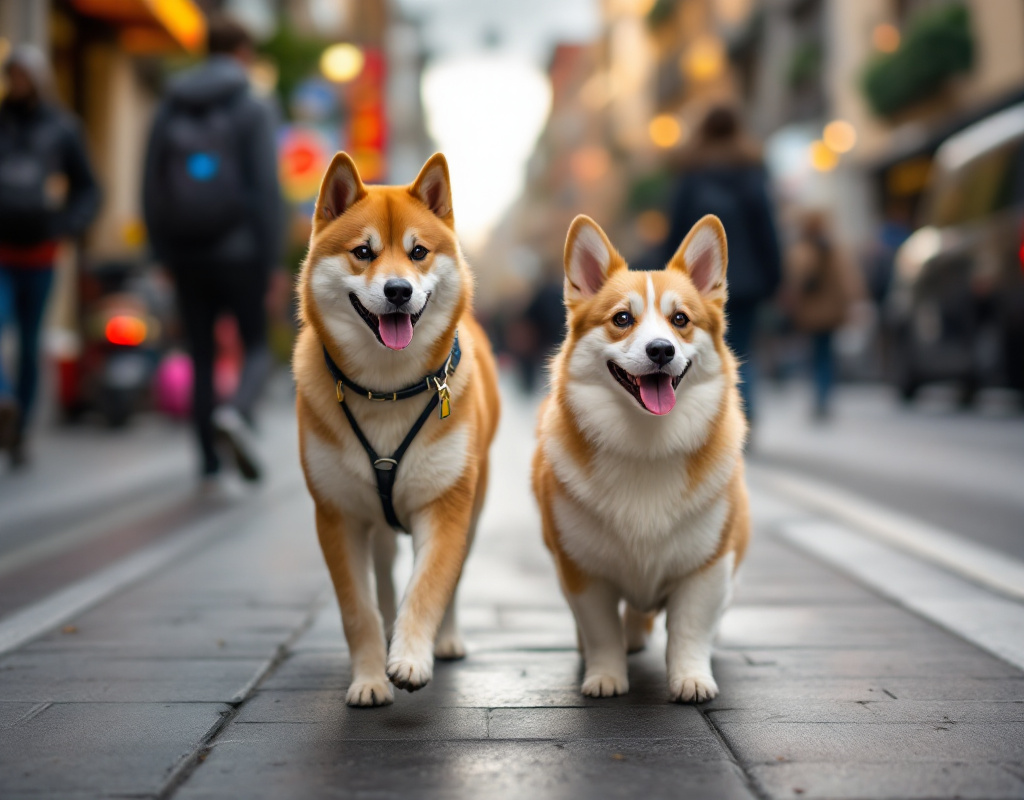
The Corgi, for its part, needs an additional session of more intense play: fetch, an improvised agility course in the living room, or even a little run in the park. In the city, this can revolve around benches or pedestrian walkways. Without this energetic quarter-hour, it develops excess energy which sometimes manifests as hyperactivity or repetitive barking.
- Shiba: 45 to 60 minutes of gentle walking spread throughout the day.
- Corgi: 30 minutes of walking + 20 minutes of lively play.
- Take advantage of stairs or a hallway for short endurance exercises.
Social Interactions and Family Life
Choosing a dog is also choosing a relational partner. The Shiba often prefers to stay on the sidelines, adopting its own pace. In the presence of children, it tolerates moderate curiosity, provided it remains gentle. Early training in tolerance will help reduce tensions.
The Corgi, the life of the party, joins the circle. It is cooperative with younger children but can adopt a rough style of play. Again, the key lies in education and setting clear rules from day one. You will have a companion always ready for a chase, sometimes to exhaustion… or to boredom if you slacken stimulation.
Grooming, Maintenance, and Health
Coat-wise, the Shiba Inu has a rather economical temperament: a weekly brushing session is enough to limit shedding. However, during shedding season, it requires increased attention to avoid accumulation in the apartment.
The Corgi, endowed with a dense double coat, requires brushing two to three times a week all year round. In the warmer season, this frequency may increase to accompany the shedding of its winter coat. Health-wise, the Shiba is often prone to hip fragility, while the Corgi remains sensitive to overweight, which can unnecessarily strain its short, sturdy joints.
- Veterinary visits: at least an annual check-up to detect possible joint or eye disorders.
- Weight control: adjust feeding to avoid overweight in the Corgi, monitor caloric intake in the Shiba during periods of lower activity.
- Dental care: brushing twice a week to prevent tartar and gingivitis.
Practical Advice for Making the Right Choice
At the end of this comparison, several criteria emerge to guide your decision:
- Lifestyle: if you are looking for a dog capable of managing absences and quiet days, the Shiba is built for this controlled independence.
- Daily interaction: for a playful and clingy companion who demands your presence and games, the Corgi naturally stands out.
- Available space: a small apartment without a balcony will suit the Shiba better, while a more open dwelling will favor the Corgi.
- Watch the development: every dog is an individual. Meet several subjects of each breed to feel their temperament before deciding.
FAQ
Does the Shiba Inu handle public transportation well?
The Shiba can travel stress-free if accustomed from a young age to noises and movements. Provide an appropriate crate or harness for better safety.
Can a Corgi live in an apartment without a garden?
Yes, provided frequent and varied outings are offered. The Corgi mainly needs mental and playful exercise more than a large outdoor space.
What diet should be favored for these two breeds?
Choose a formula rich in quality proteins, adapted to age and activity level. Limit excess carbohydrates to avoid weight gain in the Corgi and digestive issues in the Shiba.