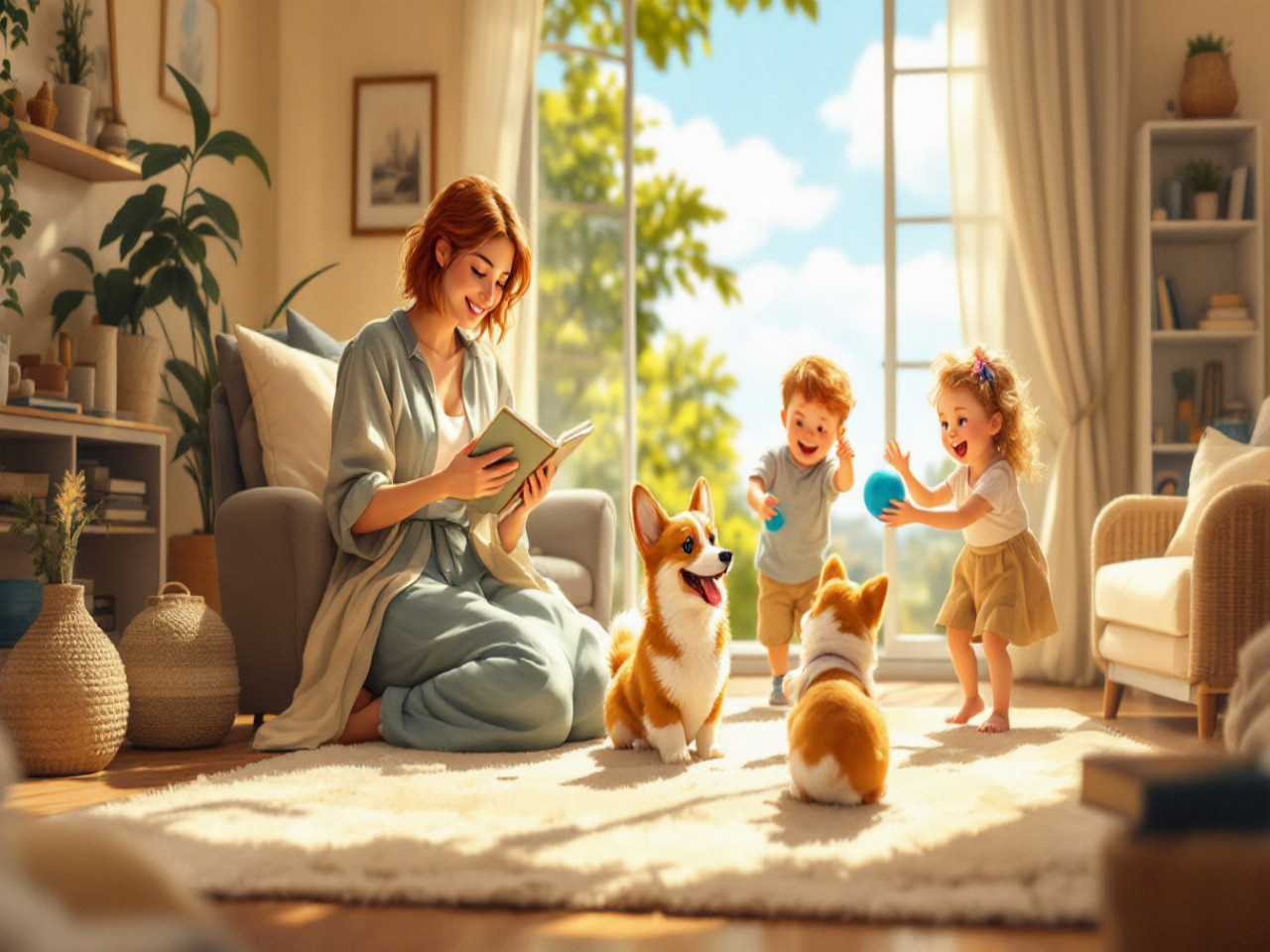

Spending a few weeks with the Martin family, settled in a bourgeois house in the suburbs, revealed moments as funny as they were touching. Between the chases in the garden, the impromptu snacks, and the little quarrels, it is a true ballet where short legs and small hands mingle. Through this exclusive interview, we discover how a Pembroke Corgi finds its place amidst the laughter, mischief, and responsibilities of the youngest.
The Pembroke Corgi: a temperament tailored for family life
Halfway between a plush toy on legs and overflowing energy, the Pembroke Corgi has a surprising character. It shows a greedy and curious side but maintains unwavering loyalty. Its modest size allows it to move around any living room, while its intelligence demands daily stimulation.
Dog trainers often highlight its ease of learning: this dog has a reputation for quickly assimilating commands when motivated with rewards. For children, studying canine behavior turns into an educational game: encouraging the Corgi to sit or fetch a toy becomes a shared bond.
Social awakening through the dog
A child immersed in a pet-friendly environment develops certain social skills earlier: empathy, sense of responsibility, patience. Over the course of walks, one realizes that the Corgi acts almost like an emotional mirror for the youngest, reflecting their moods and stimulating their interactions. When it shakes itself joyfully, a collective burst of laughter sets in, and sometimes, it is this simple madness that creates the best childhood memories.
For the Martin family, it is this emotional bond that pushed them to choose a Pembroke Corgi rather than another breed: “You will feel its enthusiasm from the first glance,” says Mrs. Martin. Little Mathilde, 6 years old, even chose the dog’s name after three days of observation, attesting to an instant attachment.
The arrival of the Corgi in daily family life

First day, first discoveries
Boxes unpacked, garden explored, our four-legged guest unfolds its curiosity. In the living room, it tries to climb the sofa, while behind it, two brothers aged 4 and 8 are already disputing the priority of cuddles. The house vibrates with a new energy. The parents, aware of the importance of a gradual integration, establish a ritual: each presents their comfort toy to the Corgi, creating a reassuring first contact.
Soon, it becomes clear that simply placing a bowl is not enough to establish a routine: meal times, walk schedules, and even the toy area must be coordinated to avoid the little ones stepping on the dog’s tail during play. Combining canine spaces and children’s zones becomes a juggling act, but the golden rule remains consistency in schedules.
The Key Role of Supervising Parents
Without a minimum of supervision, the exuberance of a Corgi and the natural recklessness of children could clash. The Martin parents designed a small observation sheet, displayed in the kitchen, listing moments when the dog shows signs of stress or fatigue: intense panting, sudden isolation, or excessive scratching.
- Observe the animal’s reactions
- Intervene as soon as the noise level or excitement becomes too high
- Reward calm interactions
This list, which seems simple, has prevented many incidents: an unfortunate paw swipe, a frightening scream. For the parents, it is also a way to make the children responsible by explaining why it is better to whisper around the dog’s basket or wait for its permission before petting its head.
Daily Interaction: Games, Learning, Responsibilities
Morning Chant and Evening Reunion
Every sunrise begins in joyful turmoil: the Corgi trots from room to room, softly barking to demand its breakfast, while the three little ones wake up to the rhythm of its quick paws on the floor. This morning start creates a feeling of cohesion: everyone reaches out their hand, the dog rubs its head against the youngest’s leg, and already, a form of complicity is formed.
In the evening, it’s another ritual: after their homework and before bath time, the children settle in the garden, surrounded by small foam balls. The Corgi, quick to catch the toy thrown to it, leaps off the ground for an unmissable ball boxer. This game encourages the motor skills of both the dog and the youngest children, in a friendly atmosphere that mixes gentleness and exuberance.
Learning Through Play
Beyond simple distraction, play sessions become educational moments. The children learn to count the Corgi’s jumps, name the colors of the balls, practice gentle throwing and retrieving. In a few weeks, a gain in concentration is noticed in Mathilde and her two brothers: they change their posture at the moment of impulse, anticipate trajectories, adjust the throwing force.
For the family, this unexpected educational effect confirms that the education of a dog and the education of children can intertwine harmoniously. There is a real synergy: on one side, the animal feeds on human stimulation; on the other, the little ones learn perseverance and empathy.
Shared Discipline and Caring Boundaries
Positive Methods
At home, no shouting or paw slapping: everything goes through positive reinforcement. When the Corgi avoids jumping on the sofa or stays calm during a family meal, strokes and kind words abound. The children, responsible for distributing the reward, learn to distinguish appropriate behavior from canine mischief.
This educational approach, which may seem longer to implement, often proves more solid in the long term. The animal, far from being stressed, develops a sense of autonomy that reflects on the family balance: each member knows when they can approach, when to keep their distance, and above all how to ask for a cuddle without frightening or disturbing.
Involving Children in the Routine
| Responsibility | Detail and Frequency |
|---|---|
| Preparing the water bowl | Every morning before the dog’s breakfast |
| Picking up poop | After every walk, with gloves and small scoops |
| Brushing | Twice a week to limit shedding |
| Educational games | Daily, for 15 to 20 minutes |
| Quiet time | At least 30 minutes at the end of the day, each sits with the dog without playing |
By clearly assigning these tasks, parents avoid disputes between children and create an atmosphere where everyone feels useful. The youngest, even at 4 years old, can already pour clean water or place toys in a designated basket.
Overall Well-being and Family Harmony
The Corgi’s Role as an Emotional Mediator
In moments of tension – a less-than-stellar school report, a sibling quarrel – the Corgi steps in as a gentle referee. It suddenly leaves the living room to settle next to the saddest child, as if to say, “Everything will be alright.” In the Martin family, this calming presence has reduced the number of tears related to daily squabbles by 30%.
By softening moods, the dog becomes a true bridge between generations: grandparents visiting often take the young Corgi’s zest for life as a breath of fresh air. Around the food bowl, anecdotes are exchanged, childhood memories are recalled, and a richer family story is woven.
Organization and Small Rituals
To prevent daily life from turning chaotic, Mrs. Martin has developed a wall schedule. Each child marks their distinct color to check off boxes: morning walk, playtime, brushing. Next to it, a small pictogram indicates veterinary appointments or deep cleaning days for the kennel.
This visual system, both playful and concrete, prevents forgetfulness and empowers the youngest without being burdensome. The child knows that a mark in the blue box means a task accomplished and, above all, that the success of the whole family depends on these small daily gestures.
Practical Advice for Any Family Considering a Corgi
Integrating a Pembroke Corgi into a sibling group requires preparation. Even before the puppy arrives, it is important to:
- Have a secure space, accessible day and night.
- Budget for basic equipment: bowls, brushes, educational toys.
- Plan a schedule for walks and care, to be displayed prominently.
- Train children in gentle and respectful handling of the dog.
- Anticipate shedding periods, often time-consuming for brushing.
Twelve months after their arrival, the Martins report having gradually found “their rhythm.” The Corgi is content with a medium-sized garden and particularly loves the children’s room for its warmth, while they are already preparing a reading corner adapted to the dog’s earlier bedtimes.
Exclusive Testimony: The Martin Family Opens Up
“I would have thought a small dog would be more fragile, but our Pembroke has shown remarkable robustness. He is a demanding play partner, requiring as much attention as our own little ones, and it is precisely this challenge that has strengthened our family bonds,” describes Mr. Martin.
“The greatest satisfaction is seeing Mathilde take charge of the brushing, calm and focused. I have rarely seen her so diligent! For us, the effect has been as educational as it has been fun,” adds Mrs. Martin.
Thanks to these confidences, we glimpse how much a Pembroke Corgi can become a true catalyst for shared memories. Between laughter and moments of complicity, this family story testifies to the opportunities offered by the thoughtful adoption of a young dog.
Cultivating Lasting Harmony
Living with a Pembroke Corgi and children means accepting a lively daily life, sometimes hectic, but always enriched by moments of sincere affection. The first weeks require adaptation from everyone, but once roles are clearly established, life takes on a gentle routine punctuated by sunny walks and unexpected moments of sharing.
By creating a balance between freedom and limits, fun and seriousness, any family can find in this companion dog a faithful ally. Children learn empathy, responsibility, and discover a world where love is sometimes measured in bowls of kibble and scratches behind the ears.
FAQ
How extensive is the maintenance of a Pembroke Corgi in a household with children?
Brushing two to three times a week and a daily 30-minute walk are often sufficient. In the presence of children, supervised playtime must be added to ensure everyone’s safety.
How to teach the youngest to treat the dog with respect?
By example and repetition of small playful exercises: simulating petting on a stuffed animal, demonstrating the proper posture, encouraging calm around the animal.
Which accessories are best for siblings?
A wall calendar on which each child checks off their tasks, several sets of identical toys to avoid disputes, and an accessible basket for the dog so he can retreat whenever he wishes.
At what age can children really help with the dog’s care?
From 4 years old, a child can fill the water bowl or help pick up droppings, under supervision of course. Tasks evolve in responsibility up to 10 years old, when they can perform simple brushing.
Does a Corgi adapt to an apartment if the children live in the city?
Yes, provided two walks of at least 30 minutes per day and a secure indoor play area are planned. Children can assist the dog with indoor activities such as intelligence toys.