
| Key points | Details to remember |
|---|---|
| 🐶 Definition | Working dog accustomed to marine tasks |
| 🌊 Origin | Birth in the fisheries of the Algarve |
| 🤿 Activities | Excellent swimmer and skilled diver |
| 🧠 Temperament | Intelligent, curious, and obedient |
| 🏋️♂️ Exercise | Daily workouts essential for its balance |
| 🤝 Family | Loyal companion with children and other animals |

On the Portuguese coasts, a four-legged partner has long assisted sailors in their fishing and rescue operations. Today adopted as a companion dog, the Portuguese Water Dog retains its love of the waves and the lively spirit that characterizes it. Between sporting demands and family tenderness, this foam builder appeals as much to seaside enthusiasts as to city dwellers looking for an energetic companion.
Origins and history of the Portuguese Water Dog
Originating on the shores of the Algarve, the Portuguese Water Dog was initially the right-hand of fishermen. Tasked with pulling nets, carrying messages between boats, or retrieving fish fallen into the water, it proved versatile and tireless. Under the influence of Mouride sailors, its role became more defined: it would dive and stay underwater to guide drifting wrecks.
The first traces in the Algarve
In the 16th century, local chronicles mention a brown or black dog with curly hair, capable of facing the roughest waves. Fishermen, often isolated, would readily repeat that this companion was inseparable from their survival. This reputation has been passed down from generation to generation, conferring on the breed an almost mythical status on the southern coast of Portugal.
From maritime work to domestic friendship
When the modernization of boats reduced its mission at sea, the Portuguese Water Dog shifted towards family life. Its intelligence and desire to please make it today a valuable ally during obedience sessions or animal-assisted therapies. Yet, as soon as it spots a body of water, its rescuer instinct resurfaces, ready to dive.
Physical characteristics and temperament

Appearance and morphology
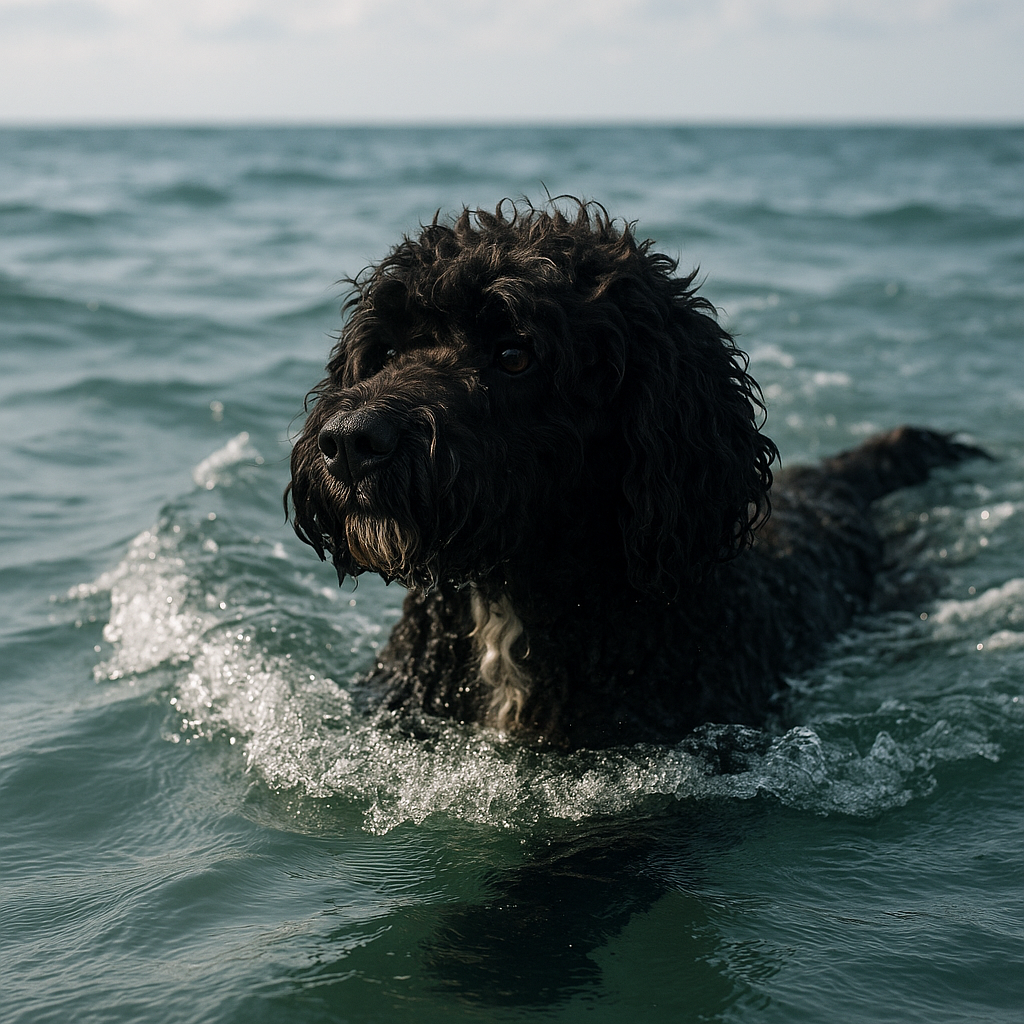
This medium-sized dog sports an athletic musculature under a curly or wavy coat, resistant to water. Its webbed paws and powerful tail recall its marine destiny. Colors range from charcoal black to dark brown, sometimes adorned with white patches on the chest. Every feature betrays a perfect adaptation to wet environments, whether on the beach or rivers.
Personality and Intelligence
One might think that such a dog only thirsts for exercise, but it combines liveliness of mind and sincere affection. Obedient and attentive, it quickly grasps instructions, as long as they remain varied. Boredom, on the other hand, can push it to rummage, dig, or bark to attract attention. It is therefore better to offer it mental challenges, whether playful or water-related.
Exercise and Mental Stimulation Needs
Suitable Aquatic Activities
The Portuguese Water Dog thrives in the water: swimming, aquatic frisbee, or diving under the supervision of a confident owner. Regular sessions strengthen its cardiovascular system and reinforce the bond between you. Even in a calm lake or pool, it will regain the enthusiasm of the waves, especially if a human companion encourages it to dive.
Games and Learning
Beyond the water, this dog loves search exercises and agility courses. Treat-dispensing toys, tracking sessions, or learning tricks enhance its concentration. This creates a lasting balance where stress and frustration have no place. For you, it is an opportunity to vary long seaside walks with mini-challenges at home.
Health and Care
Coat Care
The curly coat, which appears wild, requires regular maintenance. Weekly brushing prevents knots and distributes sebum, essential for natural waterproofing. To keep the skin healthy, favor a gentle shampoo, specific to active dogs. In summer, a light clipper trim can ease maintenance without harming its thermoregulation.
Health Particularities
This breed remains robust, but some conditions deserve attention: hip dysplasia, eye problems, or Von Willebrand disease. Annual visits to a specialized veterinarian will ensure early detection. Unlike some mastiffs, the Portuguese Water Dog presents a lower risk of overweight, especially if its exercise needs are met.
The Portuguese Water Dog in Family Life
Adaptation with Children
Its patience and gentleness make it an ideal play partner. Nevertheless, its overflowing energy requires supervision: short indoor play sessions, then outdoor moments to let tension subside. Under supervision, it becomes a confidant for children, gladly practicing swimming as a team game.
Coexistence with Other Animals
When socialized from a young age, it mingles easily with other dogs, even cats. Its pack instinct translates into respectful curiosity: it approaches gently, sniffs, and waits to receive a welcome signal. However, with small rodents, it is better to monitor its excitement to avoid untimely attacks.
Frequently Asked Questions
What is the lifespan of a Portuguese Water Dog?
Generally, this breed lives between 12 and 14 years, provided regular veterinary check-ups and appropriate physical activity are maintained.
How to maintain its curly coat?
Weekly brushing and a gentle shampoo are sufficient, complemented by a light clipping in summer to facilitate thermoregulation and limit matting.
Is the Portuguese Water Dog suitable for beginners?
With time dedicated to training and activities, a motivated owner can perfectly handle this dog with a sharp intelligence and playful temperament.
Can this dog tolerate apartment living?
If you provide frequent outings and mental challenges, it can adapt to a small living space, but without regular access to water, its fulfillment remains incomplete.