
Spotting the first signs of aggression in a dog helps avoid risky situations and establish a relationship of trust. By observing its body language and vocalizations, one quickly identifies clues before they escalate into biting or attacking. This practical guide details key indicators, underlying reasons, and preventive actions to ensure everyone’s safety.
🐶 Constant observation: watch posture, ears, tail, and facial expressions to anticipate discomfort.
👁️ Subtle signals: yawning, lip licking, or fixed gaze often indicate tension.
⚖️ Essential context: age, environment, and the dog’s personal history influence its aggression threshold.
🛡️ Preventive actions: gradual socialization, positive reinforcement, and setting up retreat areas.
Why decode canine aggression?
Every dog can show aggression for various reasons: fear, protection, or pain. Understanding these mechanisms promotes appropriate care. In a family or professional setting, anticipating these behaviors enhances the animal’s well-being and the safety of those around.
Definitions and mechanisms
Aggression is not an innate and fixed trait but a response to a stimulus. We distinguish:
- Defensive aggression: reaction to a perceived threat.
- Territorial aggression: protection of a space or object.
- Fear aggression: following a traumatic experience.
- Dominance aggression: assertion of hierarchical status.
Risk factors
Several elements influence a dog’s tendency to show aggression:
- Genetics: certain breeds express increased vigilance.
- Education: a lack of clear rules creates insecurity.
- Socialization: late exposure to peers or humans limits tolerance.
- Health: chronic pain or discomfort alter behavior.
Warning Signs of Aggressiveness

Before the teeth appear, the dog sends a whole range of signals. Knowing how to read them is key to defusing tension.
Body Language
A dog’s body expresses its emotions: a stiff posture or raised fur signals strong tension. Ears laid back and tail tucked between the legs indicate anxiety.
| Signal | Interpretation |
|---|---|
| Tense muscles | Preparation for action (attack or flight) |
| Raised fur | Intimidation or defense |
| Low position | Fear and desire for protection |
Vocalizations and Facial Expressions
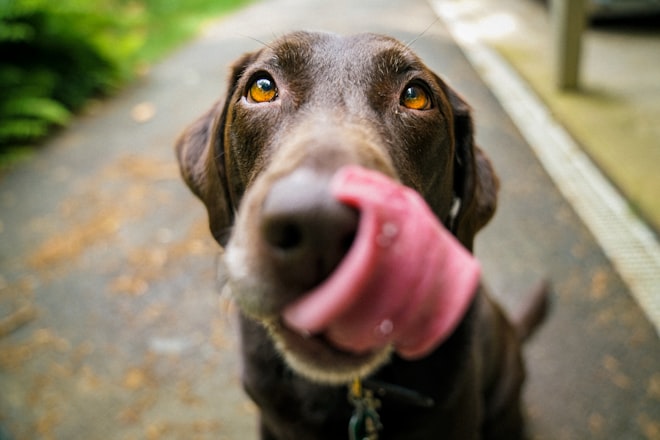
Growls, hoarse barks, or whines are clear messages: “Back off” or “Stop.” Yawning and lip licking, often misinterpreted, actually indicate stress rather than boredom.
“A simple fixed and motionless stare can precede a bite if it is not interpreted in time.” – Dr. Émilie Bertrand, canine behaviorist
Forms of Aggressiveness and Their Specificities
Distinguishing each type of aggression helps adapt the intervention. Reactions are not equivalent: you should not treat a territorial dog the same as a frightened dog.
Territorial Aggressiveness
This behavior appears when a dog considers a place or object as its own: house, kennel, bowl. A stranger approaching without caution can trigger an immediate reaction.
Protective Aggressiveness
Dogs very attached to their family sometimes show intolerance toward strangers. Under the guise of protection, they block the way and growl to deter.
Fear Aggressiveness
Dogs traumatized by mistreatment or an accident react violently to the slightest perceived threat, even if it is just an outstretched hand. The key lies in gradual desensitization.
Preventing and Defusing Tensions
Acting upstream means building a climate of trust and safety for both the dog and its surroundings.
Socialization and Positive Training
- Expose the puppy to different environments (noises, surfaces, people) before 4 months old.
- Reward every progress with a treat or a caress.
- Avoid punishments and shouting, which reinforce mistrust.
Respect Vital Space
Set up quiet areas where the dog can retreat (basket, bed). Prohibiting access to certain rooms or using baby gates helps the dog feel secure.
Signal Gentle Hierarchy
A clear and consistent framework reassures the dog. Routines (walks, meals) at fixed times establish stability, reducing the need to “take control.”
Choosing the Right Companion: Breeds and Temperaments
Consider the breed’s character before adoption: some lines have a natural vigilance which, without socialization, can become a risk. To help compare different profiles, consult our comparison of guard dog breeds. You will find advantages and disadvantages to guide your choice.
Practical application: detect and react
When faced with a warning sign:
- Immediately stop the interaction without sudden movements.
- Offer the dog a space to withdraw, let it move away.
- Avoid direct eye contact, a sign of confrontation.
- Use a calm voice, offer a treat to distract attention.
In case of serious aggression, isolate the dog safely, consult a veterinarian to rule out a medical problem, then a behaviorist for targeted re-education.
FAQ
How to differentiate stress from rough play?
A dog at play quickly relaxes its posture, invites play with a lowered forehead, and alternates positions. A stressed dog remains tense, growls are monotone.
A dog growls, should I punish it?
Rather than punishing, identify the source of discomfort. Punishing a growl risks removing the warning before a bite.
At what age should socialization be addressed?
The ideal period is between 2 and 4 months, but it is never too late to progress gently.
Is a guard dog more aggressive?
No, a well-trained and socialized dog remains balanced, regardless of breed. Guard lines simply require increased attention to socialization.
When to consult a professional?
At the slightest doubt about the severity or frequency of signals, call a behaviorist or a certified dog trainer.