

| Key Points | Details to Remember |
|---|---|
| 🐕 Definition | Robust and balanced dog breed originating from the Canary Islands |
| 🌍 Origin | Remnants of mastiffs imported by Spanish conquerors |
| ⚖️ Temperament | Combines courage, loyalty, and calmness within a structured environment |
| 🏋️♂️ Exercise | Significant needs for physical activity and mental stimulation |
| 🏠 Habitat | Adapted to a spacious and secure environment |
| 🩺 Health | Monitoring of hips, heart, and joints |

The Perro de Presa Canario fascinates with its powerful appearance and surprisingly measured temperament. Often imagined as a formidable mastiff, it actually reveals itself capable of great gentleness, provided that its training and living environment are designed to soothe its energy. This article deciphers the origins, characteristics, and practical advice for living harmoniously with this undeniably charismatic dog.
History and Origin of the Presa Canario
When reflecting on the first conquistadors on the Canary Islands, one better understands the evolution of the Presa Canario. Mastiff-type dogs, imported from Spain in the 16th century, were used for guarding livestock and assisting in fights. Over the centuries, natural selection and local demands amplified traits such as strength, while maintaining a certain balance to avoid uncontrolled aggression.
The Beginnings in the Canary Islands
Local breeders quickly understood that overly bulky musculature harmed endurance on volcanic terrain. They then refined the lineage to combine power and agility. This selective shaping gave birth to the modern Presa Canario, capable of patrolling for long hours without showing signs of excessive fatigue.
Recognition and Standardization
It was not until 1982 that the breed found its first official framework in Spain, before obtaining international recognition from the Fédération Cynologique Internationale (FCI) in 2011. The standard now specifies the ideal size, proportions, and character subtleties: neither too aggressive nor excessively docile.
Physical Characteristics

General Morphology
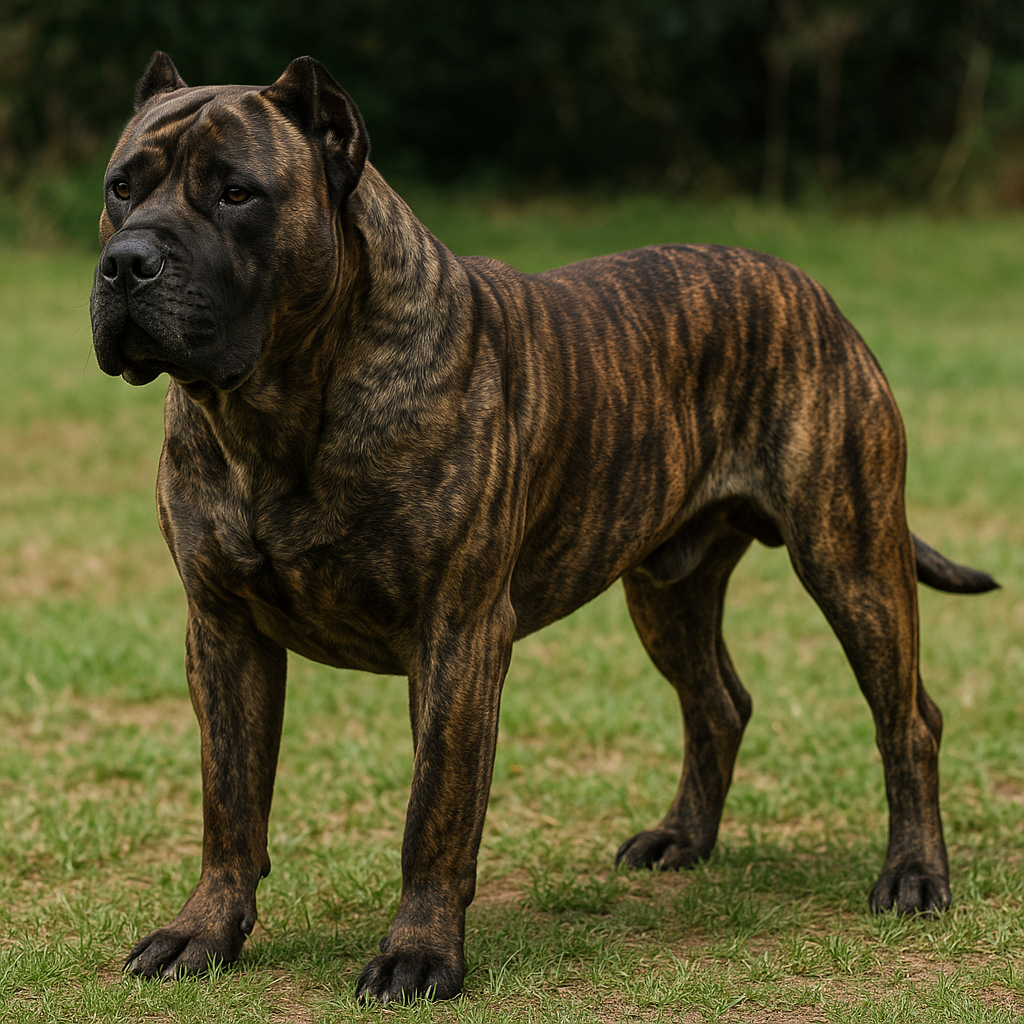
With a muscular build and solid bone structure, the Perro de Presa Canario displays a body that is both compact and robust. Males weigh between 40 and 55 kg with a height at the withers of 60 to 66 cm, while females are about 7 kg lighter in size and weight. The clean lines and square head testify to controlled power, without excess fat.
Coat and Variants
The fur is short, dense, and generally has a fawn, brindle, or black base. Although color does not affect temperament, some owners find that the brindle coat particularly highlights the musculature while remaining easy to maintain. Weekly brushing is sufficient to preserve the coat’s shine.
Temperament and Behavior
Beyond its impressive build, the Presa Canario develops a very strong bond with its family. Its protective instinct makes it vigilant, but not necessarily aggressive if properly socialized from a young age.
- Loyalty: deep and constant attachment to its owner.
- Trust: need for clear routines and landmarks to express its inner calm.
- Guarding: keen sense of surveillance without excessive aggression tendencies.
- Intelligence: ability to quickly understand rules, with a hint of independence.
Ideal Living Conditions
With such a size, it is preferable to have a garden or a secure outdoor space. An apartment can be suitable if you commit to frequent outings and activities. Some owners offer obstacle courses or tracking games to channel energy and stimulate the mind.
Training and Socialization
The key lies in consistency and kindness. It starts early, around eight weeks, by exposing the puppy to various environments: busy streets, canine encounters, vehicle noises. Each interaction, even brief, builds its tolerance and confidence.
- Positive reinforcement: praise and food rewards rather than punishments.
- Regular exercise: walking sessions, canicross, or fetch games to healthily expend energy.
- Basic obedience: sit, lie down, recall, essential for everyone’s safety.

Health and Care
This molosser enjoys a lifespan of 9 to 11 years, provided a balanced lifestyle. Some genetic or mechanical pathologies deserve particular vigilance:
| Problem | Symptoms | Prevention |
|---|---|---|
| Hip dysplasia | Limping, stiffness after exertion | Veterinary check-ups and moderate exercise |
| Cardiomyopathy | Fatigue, cough, exercise intolerance | Regular cardiac examinations |
| Obesity | Weight gain, lethargy | Adapted diet and physical activity |
Adopting a Perro de Presa Canario
Looking for a recognized breeder or a specialized shelter is essential. Prefer a lively, curious puppy without signs of excessive shyness. Health certificates, dysplasia tests, and genealogical traceability are all guarantees of seriousness.
FAQ
Is the Presa Canario suitable for families with children?
Yes, provided early socialization and consistent training. Children must learn to respect the dog’s space and interact calmly.
How much kibble should be provided daily?
On average, an adult consumes 400 to 600 g of premium quality kibble, divided into two meals, adjusted according to activity and physical condition.
Is it easy to travel with this breed?
The size requires a spacious transport crate. Many Presa Canarios tolerate car travel if gradually accustomed.



