| Key Points | Details to Remember |
|---|---|
| 🐶 Definition | Origin and history of the Miniature Australian Shepherd |
| 📏 Size and morphology | Average height of 33–43 cm and compact build |
| 💼 Character and temperament | Intelligence, liveliness, and sociability |
| 🛡️ Guarding ability | Alertness and well-developed protective instinct |
| 🎓 Training | Early and consistent training to channel energy |
| 🏠 Maintenance | Regular brushing and daily exercise needs |

Often celebrated for its elegant appearance and affectionate nature, the Miniature Australian Shepherd intrigues when its potential as a guard dog is mentioned. Despite its delicate appearance, it harbors a lively and protective temperament. The challenge is to determine whether, behind this small stature, there lies a true sentinel capable of watching over its home.
Origins and influences of the Miniature Australian Shepherd
Born from rigorous selection at the end of the 20th century, the Miniature Australian Shepherd descends directly from its elder sibling, the standard Australian Shepherd, and crosses with the Corgi: an approach aimed at preserving working intelligence while gaining compactness. By reviewing this historical chapter, one perceives how various standards merged to shape a dog with a sharp mind, capable of thriving in smaller spaces without sacrificing its energy or curiosity.
Appearance and morphology

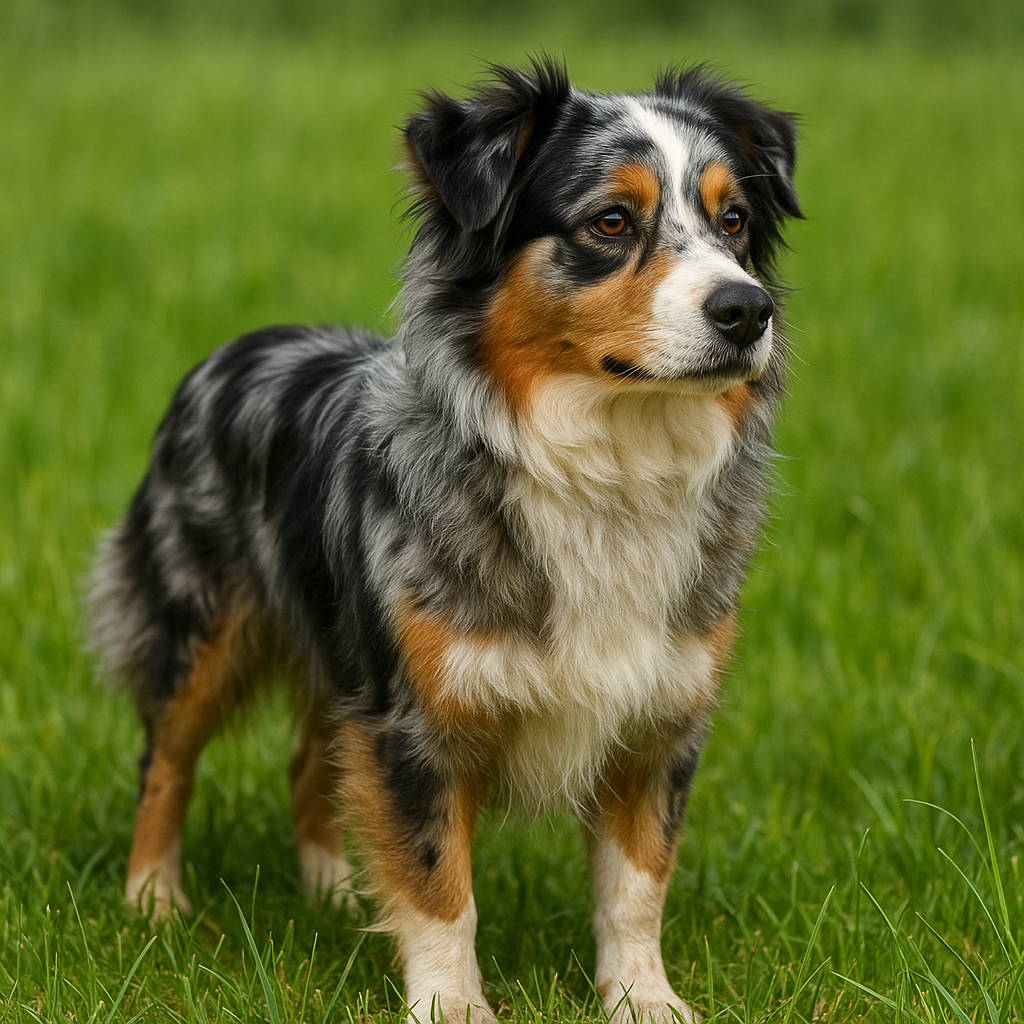
The Miniature Australian Shepherd displays a harmonious and muscular silhouette, rarely taller than 40 cm at the withers. Its coat, medium-length with a double layer, presents a rich palette of colors: blue merle, red merle, black tricolor… This fur, beyond its visual appeal, plays a protective role against bad weather and scratches during walks in semi-wild environments.
Temperament and protective instincts
Intelligent and responsive, this dog retains reflexes inherited from its shepherd ancestors, notably the ability to watch over a group or territory. At home, it will express this instinct through measured barking when a stranger approaches or when an unusual noise is heard. A natural vigilance which, guided by appropriate training, can become a powerful ally.
Comparison with other guard dog breeds
When studying the performance of this family model compared to more robust profiles, it is noted that its qualities lie in mobility and speed of execution rather than brute strength. To keep an eye on the differences, it is useful to consult analyses dedicated to guard dog breeds where the Miniature Australian Shepherd stands out for its adaptability but appears less intimidating than the Neapolitan Mastiff or Boerboel.
Training and guard dog education

To channel this protective instinct, a rigorous preparation from a young age is essential. The exercises must combine basic obedience (sit, lie down, recall) and realistic situational training (simulating entry onto your property). Consistency in signals is crucial: the dog must understand that protection is part of its responsibilities, under the control of its owner.
Maintenance and daily needs
Despite its small size, it requires at least one hour of sustained physical activity per day: ball games, agility, or long walks. In terms of grooming, brushing twice a week is enough to limit tangles and hair loss. Eye and ear health should be monitored, as some lines may have predispositions to dysplasias or sensory disorders.
Advantages and limitations for guarding
- Advantages: vigilance, adaptability to small spaces, quick intelligence.
- Limitations: size not very intimidating to an intruder, sometimes excessive vigilance causing stress.
Recommended owners and environments
The Miniature Australian Shepherd is suitable for an experienced owner, capable of imposing kind discipline and providing physical and mental stimulation. City dwellers with a garden or nearby green spaces will find excellent companionship, while strictly urban life without regular outings can lead to anxious or destructive behaviors.
FAQ
- Does the Miniature Australian Shepherd bark a lot?
- Its surveillance instinct drives it to signal any sound or visual intrusion, but well-conducted training can modulate this aspect.
- Is it easy to live with in an apartment?
- Its need for daily exercise is high: an apartment without frequent outings is not ideal, unless you commit to fulfilling its energy.
- Can it replace a large mastiff for guarding?
- It does not have the intimidating build of a Mastiff or Boerboel, but compensates with speed and perseverance.
- At what age should training for guarding begin?
- From 3–4 months, obedience exercises and gradual situational training can begin.
- Does this dog tolerate solitude?
- It does not like to be left alone for too long: provide occupation toys or regular walks.