
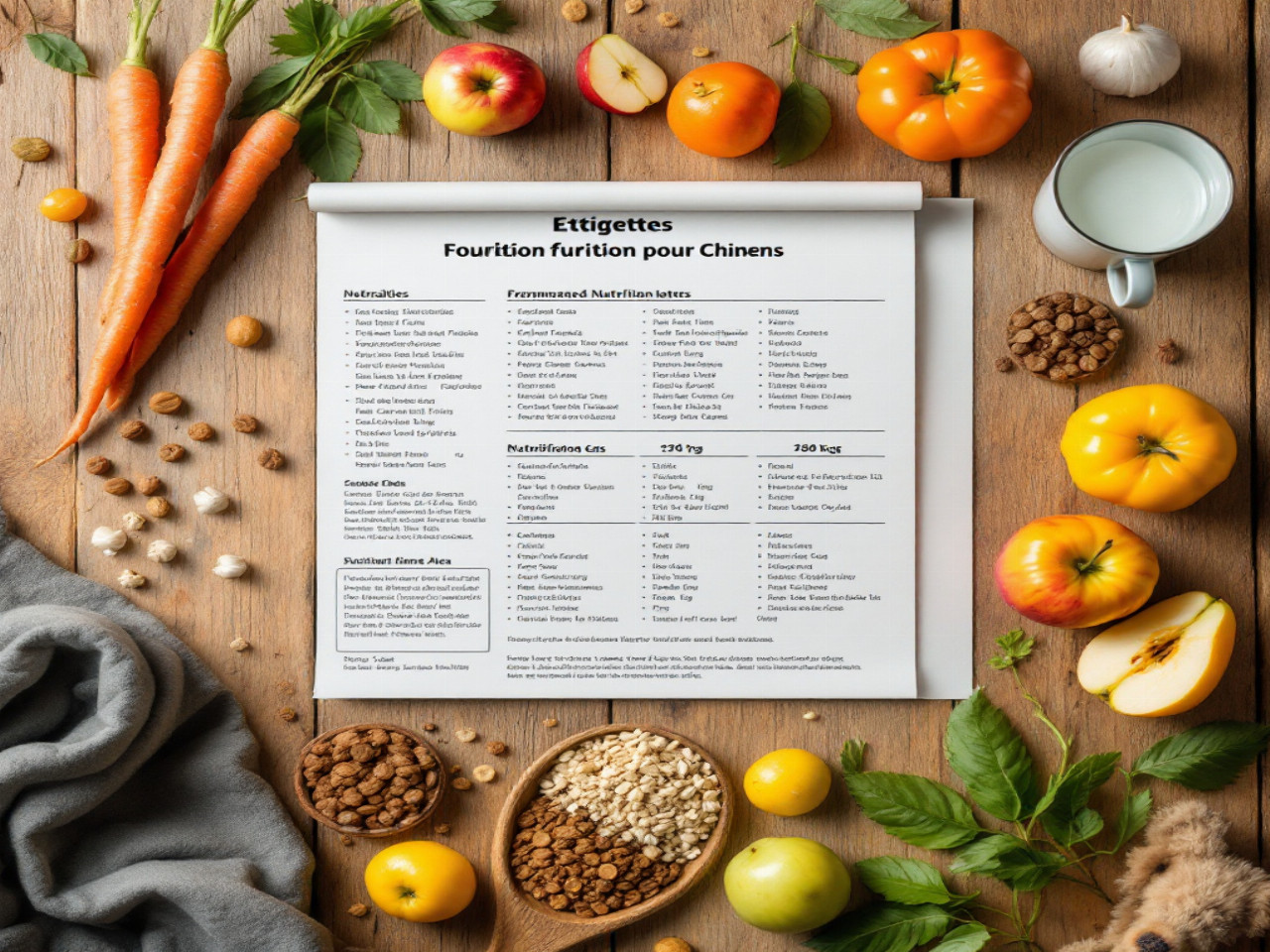

You are facing a bag of kibble or canned food for your dog and you hesitate about what you are reading? Don’t panic, this dive into the world of labels will help you become an expert on the composition, nutrients, and even the little marketing tricks hidden behind each line. Beyond simple decoding, we will give you the keys to adapt your purchases to your dog’s profile and ensure their health every day.
Why understanding labeling is crucial
You might think all dog foods are the same, but in reality, the composition varies greatly from one brand to another. An ingredient highlighted on the front may be in very small quantity, while less reputable substances may be hidden in the last lines. Reading these labels carefully ensures you choose a product that matches your dog’s age, size, activity, and any sensitivities. Moreover, it allows you to spot controversial additives and avoid false friends – those terms that sound good but don’t necessarily provide real nutritional benefits.
Mandatory information on the label
The list of ingredients
Ingredients are listed in descending order by weight, just before processing. If poultry is at the top, it means there is more fresh or dehydrated poultry than any other component. Be careful though: it’s not clear if it’s prime muscle or skin. To dig deeper, look for the mention “deboned” or “dehydrated” – these indicate a reduced water content, therefore more dry matter, hence more concentrated nutrients.
The guaranteed analysis
This section summarizes the percentages of proteins, fats, ash, and fibers. It forms the basis for comparing two products: 28% protein vs 22%, 15% fat vs 10%… But beware, the quality of proteins (animal vs plant) influences their digestibility. The more animal-based the source (meat, fish), the more the amino acids will be suited to canine needs.
Additives and preservatives
You will often find E numbers followed by a letter (E300, E330…) or names like “rosemary extracts” to replace synthetic antioxidants. Some additives can trigger allergic reactions or digestive disorders. Favor formulas with natural antioxidants (tocopherols) and without artificial colorings (cochineal red, brilliant blue), whose nutritional benefit for dogs is almost nil.
Interpreting percentages and weights
Net weight vs net weight after draining
In wet products, there is a distinction between total weight (full bowl) and weight after draining (net weight without excess juice). This detail is not just an accounting trick: it affects the actual amount of proteins and lipids your dog receives. Two identical cans in appearance can offer very different nutrient levels after draining.
Calculating proportions for a balanced meal
To adjust rations, you need to convert these percentages into dry quantities. A kibble with 30% protein and 15% fat means, per 100 g of dry matter, 30 g of pure protein. If your dog weighs 20 kg and requires 2% of its weight in dry matter, that represents 400 g: or 120 g of protein per day. This kind of calculation helps control caloric intake and prevent obesity or underweight.
- Dog’s weight × % ration (e.g. 2%) = gross daily ration
- Ration × % protein = protein intake
- Ration × % fat = fat intake
Marketing claims to watch out for
“Grain-free,” “organic,” “superfood”… These claims catch the eye, but too often they mask an increase in fats or a replacement of grains by legumes very rich in fiber and poorly digestible. The word “premium” is not regulated. Take it for what it is: a sales argument. Prefer a detailed guaranteed analysis and a simple ingredient list. The real pluses: meat in first position, added fruits/vegetables, and natural antioxidants.
Adapting your choice to your dog’s needs
Age, activity level, sterilization, and any health issues (sensitive digestion, fragile joints) influence the type of food to prioritize. For a senior dog, aim for a moderate calorie intake but more fiber and omega-3 for joint flexibility. A sporting dog will require denser energy (high-quality fats, proteins with high biological value). In case of intolerance, opt for a “single protein” formula: a single protein source to better target the potential allergen.
Concrete example: decoding a label
To illustrate, let’s quickly analyze a typical bag of kibble:
| Element | Details | Role |
|---|---|---|
| Dehydrated chicken | 30% | Main source of animal proteins |
| Pea flour | 15% | Vegetable proteins and fibers |
| Salmon oil | 5% | Omega-3 for skin and coat |
| Plant extracts | 0.2% | Natural antioxidants |
| Guaranteed analysis | Proteins: 28% – Fats: 14% – Fibers: 3% | Essential values to balance the ration |
A good balance depends as much on the quality of proteins as on the control of fats and fibers: the addition of each percentage shapes the health and vitality of your companion.
FAQ on reading labels
1. Should cereals be absolutely avoided?
Cereals like rice or corn can be perfectly digestible and provide necessary carbohydrates. It all depends on your dog: some tolerate them very well, others less so. Do not avoid the term “with cereals” if the ingredient list remains clear and without excess fiber.
2. Are natural additives always safe?
Beware of allergens even in natural additives (preservatives based on rosemary or vitamin C). Some dogs also react to them. The key is to vary the ranges and note any reaction after changing food.
3. How to compare two kibbles with 28% protein?
At the same percentage, prefer the one whose main source is animal and identified (duck, beef). Examine the third position: if it is a seed or a vegetable, it may mean more fiber load and fewer truly digestible proteins.
4. Are “grain-free” labels always worth the price premium?
Not necessarily. A “grain-free” food may include legumes in large quantities, which are not suitable for all dogs. Prioritize evaluating nutrient balance and digestibility.
5. What is the best strategy for a sensitive dog?
Opt for a limited ingredient formula (“limited ingredients diet”) with a single protein source and a limited number of vegetables. This facilitates identifying a potential allergen and quickly adjusting their diet.