

Dog training is neither a luxury nor a whim. It is a fundamental pillar of life with a dog. A well-trained dog is a happy, balanced, and above all understood companion. Whether you have adopted an energetic puppy or an adult dog with a bit of character, this guide will give you all the keys to lay solid foundations. Prepare the treats, let’s get to the heart of the matter! 🍖
Why is dog training essential?
A dog without training is a bit like a car without brakes: unpredictable, potentially dangerous, and difficult to manage. Training establishes a reassuring framework, both for the animal and its humans. It prevents annoying behaviors (excessive barking, destruction, aggression) and promotes a calm and trusting relationship.
But beyond discipline, it is a real opportunity to create a strong bond with your companion. Every mastered command, every progress, is a shared victory.
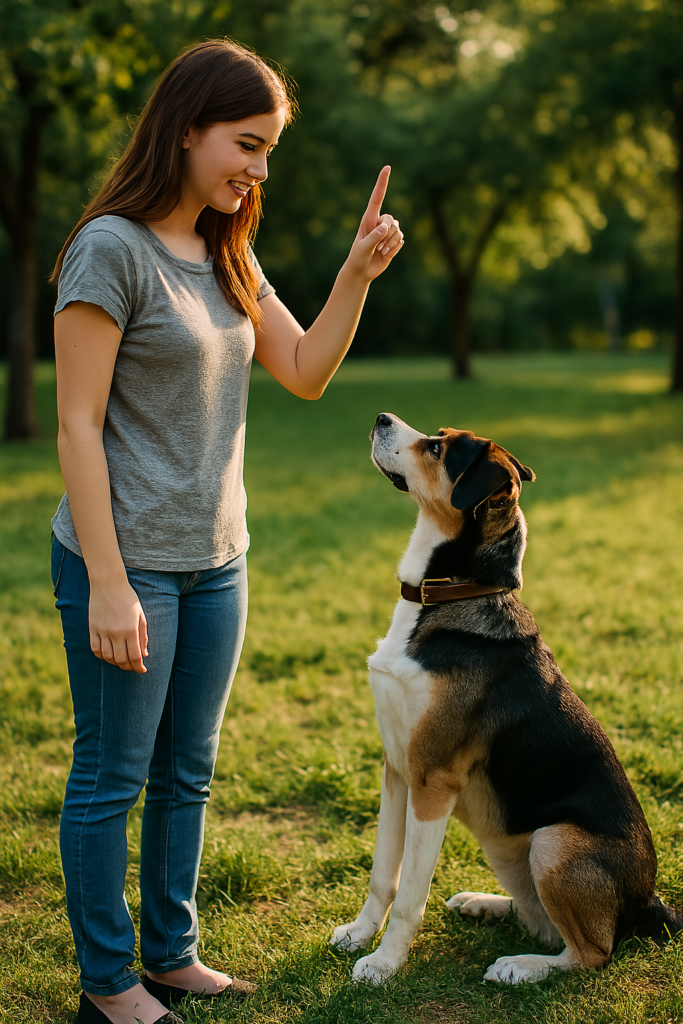
The fundamental principles of positive training

Far from the authoritarian methods of the past, modern training is based on respect, kindness, and understanding the animal’s needs. We are talking about “positive” training here, based on reinforcing good behaviors rather than punishing bad ones.
- Reward: a treat, a caress, or a gentle voice to praise good behavior.
- Ignore or redirect: instead of scolding, attention is diverted towards a desired behavior.
- Consistency: one command = one action = one reaction. The whole family must use the same words.
In other words, you don’t train a dog like a robot. You help it understand the rules of the game and reinforce what works.
Key steps for successful learning
1. Create a conducive environment
Avoid distractions, choose a quiet place. A distracted dog learns poorly. The first sessions should be short (5-10 minutes) but frequent. Better three 5-minute sessions than one 20-minute session where everyone ends up frustrated.
2. Start with the basics
Sit, stay, come, go to your place… These are the foundations. Each command must be associated with a simple word said in a clear tone.
3. Introduce distractions gradually
When the dog masters a command at home, test it outside, then in the presence of other people or animals. The goal is to generalize the learning.
4. Reinforce over time
Learning is never “acquired for life.” You must regularly maintain what has been learned, without falling into routine. Vary the rewards, locations, and times.
Concrete exercises to practice daily
Here are some simple but essential exercises:
| Command | Goal | Tip |
|---|---|---|
| Sit | Channel energy | Use a treat to guide the dog, always calmly |
| Recall | Freedom + safety | Work on a long leash, with a cheerful voice |
| Stay still | Self-control | Start with a short distance then gradually increase |
| Loose leash | Pleasant walk | Change direction as soon as the leash tightens |
💡 Tip: end each session with a playtime. This associates training with a positive moment.
Essential equipment for effective training
- Treats: small, tasty, easy to chew
- Long leash: to work safely outdoors
- Clicker: sound tool to mark good behaviors
- Interactive toys: to reward in other ways
It is always handy to have a treat pouch on your belt to reward at the right moment. Cherry on top: some dogs prefer a ball or a cuddle over a treat. It’s up to you to test!
Tips by age and temperament
Puppies
Very receptive but quickly tired. Focus on socialization and basic commands. Keep sessions very short and have fun!
Adult dogs
Sometimes more stubborn, but also more focused. You may need to unlearn some habits before progressing. Patience and consistency are your best friends.
Fearful or reactive dogs
Never force. Adapt exercises to their tolerance threshold. A canine behaviorist trainer can help you progress calmly.
Useful links and additional resources
To better understand what your dog thinks and feels, check out our page on canine behavior.
Need equipment? Find our selection of dog accessories tested and approved 🦴.
FAQ
At what age can training start?
From 8 weeks. Puppies are like sponges at this age.
How long does it take for a dog to learn?
It depends on the dog, regularity, and motivation. Some commands are learned in a few days, others take weeks.
Can an adult dog be retrained?
Yes, provided you are patient and consistent. Many adult dogs make excellent students!
Illustrations


⛔ Common mistakes to avoid
It is true that dog training may seem intuitive, but some mistakes often recur and slow progress:
- Inconsistency: using several words for the same command (“come” vs “here”) confuses the dog.
- Sessions too long: a saturated dog ends up tuning out. Aim for short but frequent sessions.
- Lack of rewards: without motivation, no learning. Don’t be stingy with encouragement!
- Unjustified punishments: punishing without the dog understanding creates fear, not learning.
📅 Long-term benefits
Dog training is not just a temporary tool to manage daily life. It is a lasting investment in the quality of life with your dog. A trained dog will be able to accompany you everywhere: in the city, at friends’ houses, on vacation. He will be calmer, more balanced, freer. And you, more serene.
In other words, training is giving your companion the keys to a full, fulfilling life, well integrated into human society.
📖 Testimonial
“When I adopted Léon, he pulled on the leash like crazy, barked at everything that moved. I thought it was just his nature. In 3 months of gentle and consistent training, he became a calm, attentive, and close dog. Today, I can take him everywhere with me without stress.” — Camille, 34 years old
📚 Why does this approach really work?
What makes positive training so powerful is that it is based on the dog’s natural learning mechanisms. Unlike authoritarian methods, it does not instill fear of humans, but a sincere desire to cooperate. The dog learns that good actions bring pleasant things: treats, games, attention, walks. This intrinsically motivates him to repeat these behaviors. Moreover, this approach avoids common side effects of punitive methods, such as anxiety, aggression, or mistrust. By strengthening the trust bond, positive training improves not only obedience but also your dog’s emotional well-being, creating a calm and motivating learning environment.
🌟 Summary of key benefits
- 🧠 Enhanced cognitive development of the dog
- ❤️ More stable and close master-dog relationship
- 🏡 Easier integration into the family environment
- 👨👩👧👦 Suitable for the whole family, even children
- 🏞️ More freedom possible (recall, managing excitement)
🧩 Final tips to go further
What you need to keep in mind is that training never completely stops. It evolves over time, contexts, and stages of the dog’s life. At 3 months, you work on name recognition; at 2 years, you can refine interactions with other dogs; at 8 years, you maintain skills with playful recalls. The important thing is consistency, and above all shared pleasure. Training should not be seen as a chore, neither for you nor for your dog. This moment can become a close ritual, a source of joy and pride. By making each session positive, short, and adapted, you strengthen the relationship and promote lasting learning, whatever your companion’s age or level.
🔗 To continue
👉 Understanding your dog’s emotions and signals
👉 Useful equipment for training and daily life