
Training a dog has nothing to do with authoritarian commands or rigid methods. Today, we mainly talk about kind education, based on trust, consistency, and enjoyment. By teaching your dog to understand you — and to make itself understood — you build a solid, calm, and joyful relationship. This practical guide accompanies you from the basics to advanced exercises, with effective, modern, and respectful methods. 🐾
🔍 Education or training? Let’s clarify
Both terms are often used interchangeably, but they have nuances. Canine education encompasses everything related to basic behavior, living together, respecting rules within a family setting: cleanliness, absence of destruction, walking on a leash, absence of aggression… Training is more specific, more technical: it involves learning precise, sometimes complex commands, in a utility, sporting, or professional context. In both cases, the key is…
🤝 The main principles of positive education

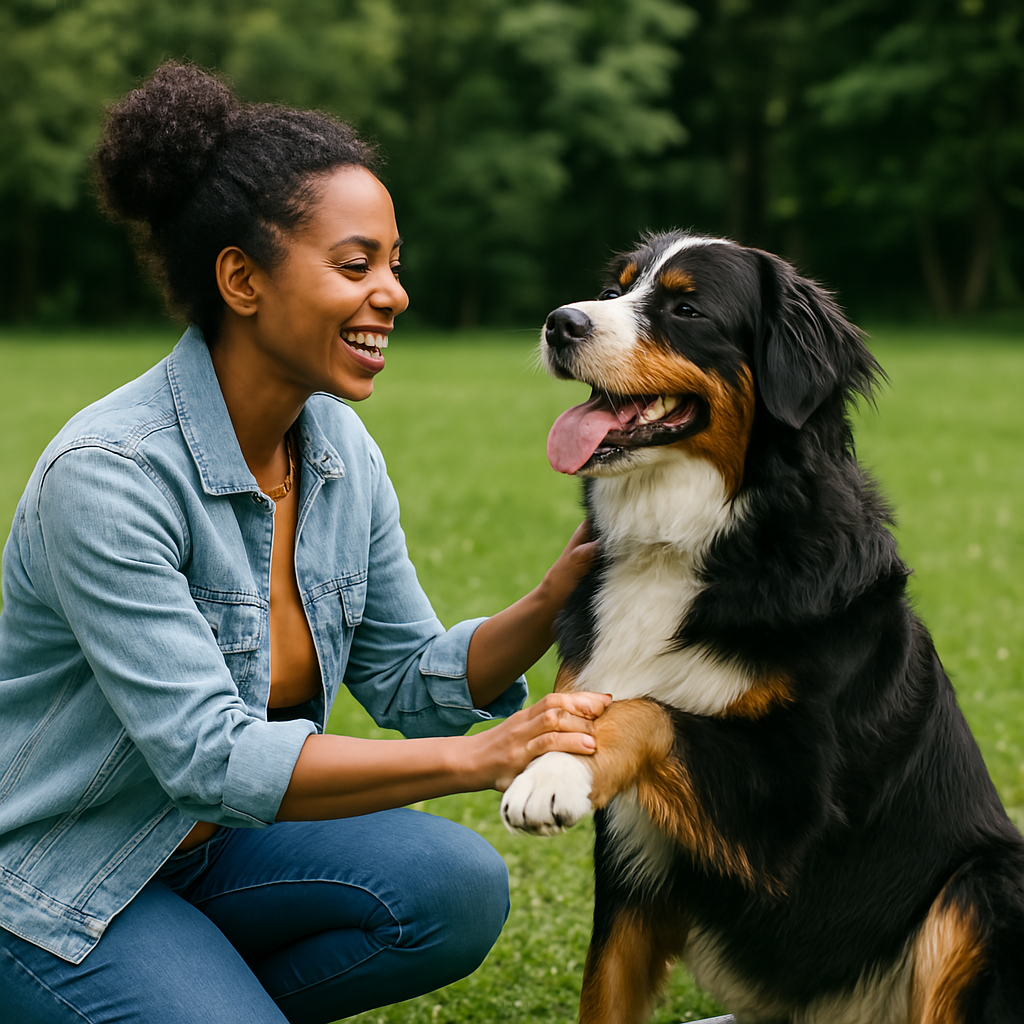
Positive education is based on a simple principle: we reinforce good behaviors instead of punishing bad ones. This method, founded on neuroscience and ethology, uses motivation, reward, and respect for the dog’s needs. It bans coercive methods (hits, shouting, choke collars) and relies on observation, consistency, and regularity. A well-educated dog does not obey out of fear, but for the pleasure of interacting. You must be patient, clear, and know how to reward.
🧠 Basic exercises
Here are the first commands to teach:
- Sit: a natural posture easy to obtain by holding a treat above the head
- Stay still: essential for safety (street, open door)
- Recall: one of the most crucial, to be worked on first with a long line
Each exercise must be taught in a calm environment, with progression and positive reinforcement. Repeat, praise, adapt to your dog. Do not seek perfection, but cooperation.
❗ Common problems and solutions
- Excessive barking: identify the cause (frustration, alert, loneliness) and redirect the energy
- Nipping: common in puppies, to be channeled with chew toys and redirection
- Jumping on guests: ignore, divert, reinforce four paws on the ground
In all cases, avoid shouting. Stay consistent. Every behavior has a cause: look for it rather than “correcting” blindly.
🎒 Equipment and rewards
A good trainer is well equipped. Here is the essentials:
- Long leash or line for recall
- Clicker to precisely mark a good behavior
- Treat pouch always ready
- Interactive or favorite dog toys
- Comfortable harness
As for rewards: food, of course (natural treats, pieces of meat, special kibble), but also toys, games, petting, or freedom. Observe what your dog prefers.
🚀 Advanced training and canine sports
Once the basics are mastered, why not go further? Advanced training enriches the bond, intellectually and physically stimulates your dog. This can include:
- Agility: obstacle course at speed
- Canicross: running while attached to your human
- Obedience: chaining commands with precision
- Mantrailing or tracking: following human scents
These disciplines strengthen mutual trust, develop the dog’s natural skills, and channel its energy positively.
📚 FAQ
At what age should training start?
As soon as the puppy arrives! Early learning is the most effective. But it is never “too late.” Even an adult dog can learn at any age.
What if my dog doesn’t respond to treats?
Find a more motivating reward: toy, petting, access to something. Some dogs prefer a tug toy over a kibble.
How long does it take for a command to be learned?
It depends on the dog and consistency. On average, expect 50 to 100 repetitions over several days. Be patient and consistent.
🗣️ Testimonial
“My labrador used to pull on the leash like crazy. Thanks to positive training, in a few weeks he looked at me, calmed down, and became pleasant to walk. I learned to observe him, to adapt my behavior… and he followed.” — Léo, 40 years old
📊 Progress chart
| Command | Goal | Learning status |
|---|---|---|
| Sit | Response within 3 seconds | ✔️ Learned |
| Stay | 10 seconds of stillness | 🔄 In progress |
| Recall | Quick return despite distraction | 🔄 Improving |
| Heel | No pulling, off leash | 🕓 To work on |
🛑 Common mistakes
- Giving the command multiple times (the dog learns to ignore it)
- Using punishment or intimidation (opposite effect)
- Inconsistency among household members
- Working too long without breaks
🔚 Conclusion
Training is a communication tool, not domination. It allows harmonious living, understanding your dog, and strengthening the bond daily. With kind methods, a bit of patience, and lots of consistency, any dog can learn… and love to learn. 🐶🧠
🧠 Understanding canine psychology
To educate well, you need to understand how a dog thinks. It is not a miniature human: it perceives the world differently, with its highly developed sense of smell, social instincts, need for routine and clarity. A dog needs to understand what is expected of it and to feel that it is understood. It learns better in a relaxed environment, where it is rewarded for good choices. It reads our body language, tone, and attitude more than our words. Hence the importance of being consistent, patient, and fair. Yelling or punishing unpredictably only confuses the messages. Clear and kind communication, adapted to its way of perceiving the world, is the key to successful training and a balanced relationship.
📆 Example of a training routine over one week
- Monday: recall training on a long line in the park
- Tuesday: “stay still” exercise at home
- Wednesday: short session on “sit” + fun tricks
- Thursday: free walk with recall + controlled freedom
- Friday: review leash walking, clicker training in the city
- Saturday: free play + self-control exercise (leave it on the ground)
- Sunday: rest or pleasure walk without commands
🔁 Concrete examples of learning
- “Leave it!”: place a treat on the ground, block it with your hand, as soon as the dog looks away → click + different treat
- “Come”: start at 1 meter distance, without distractions, with a joyful voice and high-value reward
- “Walk”: move forward only when the leash is loose. Stop as soon as it pulls. Resume when it comes back to you.
🐕 Influence of breed on training
Every dog is unique, but certain breed tendencies influence learning. Herding dogs (border collie, malinois, Australian shepherd) are very responsive, intelligent, and motivated, but need guidance. Primitive breeds (akita, shiba, husky) are often more independent: they learn but choose whether to obey. Companion dogs (cavalier king charles, bichon) are often very sensitive to humans. This does not mean some dogs are “good students” and others “stubborn,” but simply that the method must be adapted to their profile. The important thing is to respect the pace, motivations, and sensitivity of each dog. A tailored approach, adjusted to its breed, temperament, and history, always yields better results than a one-size-fits-all method.
⏱️ Average learning time per exercise
| Command | Ease | Average learning time |
|---|---|---|
| Sit | Easy | 1 to 2 days |
| Recall | Medium | 2 to 4 weeks |
| Stay still | Difficult | 3 to 6 weeks |
| Heel | Difficult | 4 to 8 weeks |
| Leave it! | Variable | 1 to 3 weeks |