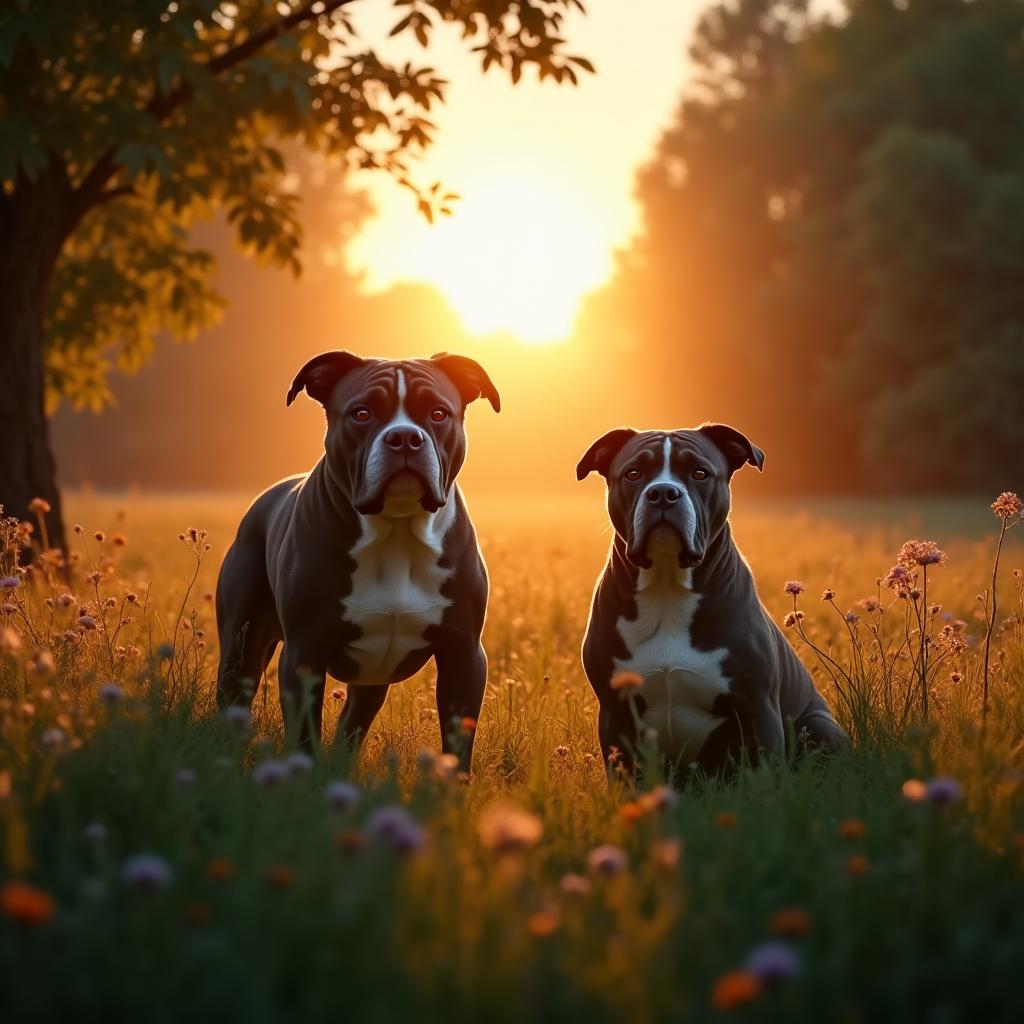

They often have the same massive build and muscular look: hard to tell them apart at first glance. Yet, the American Bully and the American Staffordshire Terrier (Amstaff) are two distinct breeds. In this article, we review their history, morphology, temperament, activity needs, health predispositions, and the criteria to consider when choosing one or the other according to your lifestyle.
1. Origins and History
1.1 Common Roots
Both breeds originate from the same lineage of fighting molossers introduced to America in the 19th century. Breeders crossed British terriers (Bull and Terrier) with various bulldog breeds to obtain dogs that were both robust, courageous, and affectionate.
1.2 Birth of the Amstaff
The American Staffordshire Terrier was standardized as early as the 1930s by the American Kennel Club (AKC). It was then a versatile working dog: guard, rat hunter, farm dog, and faithful companion. The standard emphasizes an agile and athletic appearance, capable of moving with ease.
1.3 Creation of the American Bully
The American Bully appeared in the 1980s–1990s, the result of targeted crossings between Amstaff, American Pit Bull Terrier, and other bulldogs to accentuate musculature and size. Breeders sought to obtain a wider head, a more developed chest, and a “blocky” look, while reinforcing a sociable character.
2. Morphology and Appearance

| Characteristic | American Bully | American Staffordshire Terrier |
|---|---|---|
| Height | 38–45 cm (depending on the variety) | 45–48 cm |
| Weight | 15–45 kg (from pocket to XL sizes) | 25–35 kg |
| Build | Wide trunk, compact, short legs | Athletic build, more slender |
| Head | Very wide, marked stop | Moderately wide, muzzle a bit longer |
| Coat | Many colors, solid or patched | Varied colors but more subdued |
3. Temperament and Behavior
If you are looking for an affectionate companion, both breeds will respond. However, beware of the nuances:
- Amstaff: livelier, energetic, and sometimes stubborn. He loves to play, run, and enjoys mental stimulation.
- American Bully: generally calmer, more “laid-back.” He places great importance on human presence and does not tolerate solitude well.
Regarding sociability, both dogs can coexist with other animals if early socialization is arranged. However, the American Bully often shows more tolerance with children and is more “cool” in family environments.
4. Exercise and Activity Needs
4.1 Daily Exercise
The Amstaff requires about 1 to 1.5 hours of physical activity each day. Dynamic walks, jogging, agility, or fetch games are ideal to channel his energy.
4.2 Activities for the American Bully
For the American Bully, 45 minutes to 1 hour of exercise is generally sufficient. He equally enjoys calm walks and short play sessions in the garden.
4.3 Mental Stimulation
For either breed, obedience activities, food puzzles, or hide-and-seek games work wonders to prevent boredom and destructive behaviors.
5. Health and Longevity
- Life expectancy: similar for both breeds, between 10 and 14 years.
- Predispositions:
- Hip dislocations (dysplasia)
- Heart malformations (subaortic stenosis)
- Dermatological problems (atopy)
- Pocket Bully: beware of overly trolley subjects, often prone to obesity and joint disorders.
Regular follow-up with osteopathy or physiotherapy can help preserve the mobility of these stocky dogs.
6. Maintenance and Grooming
Their short coat is very easy to maintain:
- Weekly brushing to remove dead hair.
- Occasional baths (every 2–3 months) with a mild shampoo.
- Regular checks of ears and teeth.
Their thick skin may require a specific moisturizing cream if it becomes dry or irritated.
7. Legislation and Family Life
In France, neither the American Bully nor the Amstaff are listed as dangerous dogs (category 1 or 2) in the Rural Code. However, some town halls or condominiums may restrict their acceptance. Consider:
- Declaring your dog at the town hall if necessary.
- Taking out specific civil liability insurance.
- Respecting the rules of possession (muzzle, leash) in transport or public places.
8. How to Choose?
To better guide your choice, ask yourself these questions:
- Do you have a very active lifestyle or rather a calm one? The Amstaff will suit the first profile, the American Bully the second.
- What is your environment? An urban studio limits the size. Opt then for a standard type Bully or a young and well-socialized Amstaff.
- Are you ready to invest in osteopathy or physiotherapy? Both breeds can suffer from dysplasia or arthritis.
“Every dog deserves to have the time taken to understand its personality before bringing it into the home.”
9. FAQ
- Are both breeds suitable for children?
- Yes, but under supervision. The American Bully often shows more patience, the Amstaff more playful.
- Can they be left alone all day?
- Better to avoid; maximum 4 hours of absence to limit separation anxiety.
- What monthly budget should be planned?
- Considering food (premium kibble), veterinary fees, and activities, about €80–120 per month.
- Can they live in an apartment?
- Yes, if you compensate with frequent outings. The indoor space is not enough for a dog of this build.
With this comparison in hand, you can now decide with full knowledge and offer your future companion an environment adapted to their needs. 🐾
In conclusion, Amstaff and American Bully share a common heritage and an affectionate character, but differ morphologically and in energy level. Choose the profile that best fits your daily life, and above all, give them all the necessary attention so they can thrive fully.