
When we talk about dogs and children, we often think of complicity, laughter, tenderness. But this magical relationship doesn’t happen by itself: it is built, framed, and learned. When well managed, it becomes a fabulous lever for the flourishing of both — but if poorly handled, it can also generate stress, fear, or accidents. In this article, we guide you step by step so that this beautiful adventure is lived in serenity and trust. 🐾
🌟 The benefits of the dog-child relationship
Growing up with a dog is like having a life school at home. The dog teaches the child patience, responsibility, empathy. It is a silent confidant, an tireless play partner, a comforting presence. Studies show that children living with a dog develop greater emotional intelligence, emotional stability, and social skills. For the shy child, the dog is a support. For the lively child, it is a landmark. And for all, it is a faithful companion who accompanies the major stages of childhood. This unique relationship builds unforgettable memories and shapes adults who are more attentive, more caring, and better connected to the living world.
📏 Golden rules of coexistence

For everything to go well, a few rules are essential:
- Never leave a child alone with a dog, even a “gentle” one
- Learn to read canine language signals (tail, ears, growl)
- Respect the dog’s rest times
- Do not disturb the dog while it is eating or in its bed
- Do not treat the dog like a stuffed animal (pulling fur, climbing on it…)
A well-supervised dog and a well-educated child make the best teams in the world.
🧠 What the child must learn
Mutual respect is learned very early. The child must understand that the dog feels emotions, that it can be tired, stressed, or scared. The child must learn to greet it calmly, not to bother it when it sleeps or eats, to speak to it softly. We can also teach some basic rules like “never run towards an unknown dog,” or “let the dog come to you.” These lessons are opportunities to teach empathy, listening, and patience.
🚨 Stress signs to know
- Repeated yawning
- Turning the head away, avoiding eye contact
- Ears pinned back, tail between the legs
- The dog licks its lips for no reason
- It moves away, growls, freezes
These signals are warnings. They must be spotted in time to prevent discomfort from escalating. By respecting them, we show the dog that it is heard.
🎲 Activities to share according to age
| Child’s age | Recommended activities |
|---|---|
| 2-4 years | Observe, give a treat with adult help, brush the dog |
| 5-7 years | Hide and seek with the dog, search games, participation in care |
| 8-10 years | Small training exercises (sit, turn), mini-agility, leash walks |
| 11 years and up | More complex games, light cani-cross, tricks, shared educational responsibility |
🐶 Breeds to favor or avoid with children
| To favor (with supervision) | To avoid (except exceptional cases) |
|---|---|
| Golden Retriever, Labrador, Cavalier King Charles | Chow-chow, Akita Inu, Husky |
| Bichon, Collie, Newfoundland | Nervous hunting dogs (Weimaraner, Setter) without work |
| Poodle, French Bulldog, Beagle | Very protective dogs poorly supervised |
Each dog is an individual, but certain breed tendencies exist. The most important remains education, adult supervision, and the dog’s ability to tolerate the presence of children without stress.
🛑 Common mistakes
- Thinking that “the dog will adapt on its own”
- Leaving the child alone with the dog, even for 2 minutes
- Reassuring or praising the dog after a growl without analyzing why
- Forcing closeness: attachment cannot be commanded
🗣️ Testimonial
“We adopted a little female dog when our daughter was 3 years old. Thanks to a trainer, we learned to supervise play, respect quiet moments… Today, they are inseparable. My daughter has developed great gentleness, and our dog surprises us every day with her patience.” — Sophie, 36 years old
❓ FAQ
What is the minimum age to adopt a dog with a baby?
There is no fixed rule. Ideally, you should already have solid educational basics or be accompanied. The child should not be at an age to “endure” the dog’s learning process.
Can a dog become jealous of a baby?
It can feel stress related to the change in attention. So it is necessary to anticipate: maintain rituals, include the dog in routines, avoid sudden exclusion.
My dog sometimes growls when my child approaches. What should I do?
A growl is a signal, not an attack. You need to analyze the situation, secure without punishing, and consult if it repeats.
🔚 Conclusion
The relationship between a child and a dog can be one of the most beautiful stories of their lives. But like any beautiful thing, it is cultivated with respect, vigilance, and love. A dog is neither a nanny nor a toy, but a sensitive, loyal, and profound being. When integrated properly into family life, it becomes an ally, a confidant, a teacher of gentleness. 👨👩👧👦🐾
👶 Preparing your dog for the arrival of a baby
Welcoming a baby means disrupting daily life… and not just for humans. The dog, sensitive to changes in smell, rhythm, and attention, can be unsettled. A few weeks before the birth, start gently modifying routines: simulate baby noises, leave objects and scents around (clothes, furniture). Teach the dog not to follow everywhere, to stay calm in another room. And above all, do not suddenly reduce moments of attention once the newborn arrives. Maintain bonding rituals, even brief ones, so the dog does not experience this period as exclusion. By gradually preparing the ground, you facilitate a peaceful coexistence between your dog and the new family member, while strengthening the bond of trust.
🎯 Calm and educational games to play with a child
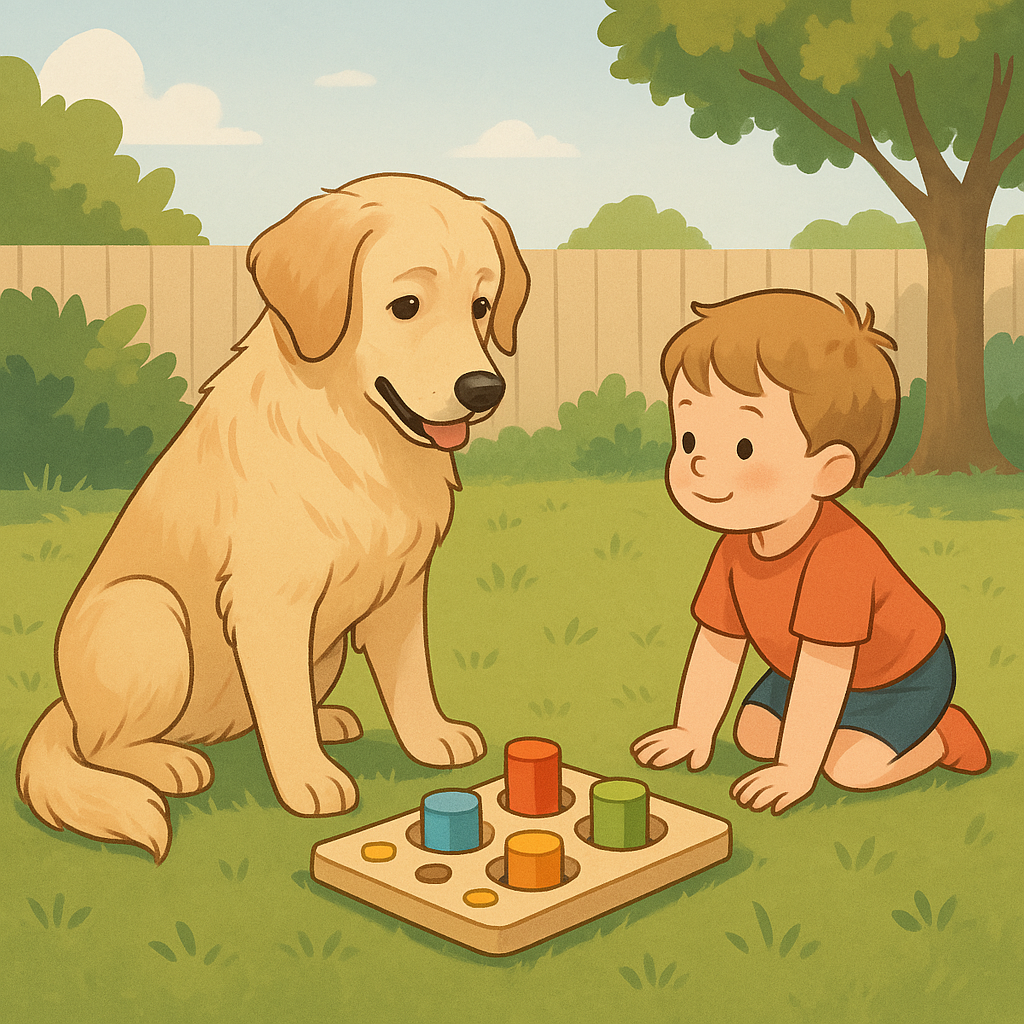
- The “find-the-kibble” game: the child hides a treat while the dog waits (control + scent)
- The basket throw: the child learns to gauge and guide the dog (precision + patience)
- The “stop/go”: on command, the dog stops or goes (recall + self-control)
- The “target”: the dog touches the hand or a designated object (focus, gentleness, bonding)
These games develop the relationship, but also calmness, concentration, and confidence on both sides.
🪞 The dog, emotional mirror of the child
The dog does not judge, does not correct, does not scold. It feels. This is what makes it so precious for children. An anxious child often finds in the gaze of their dog an anchor, a soothing presence. A too lively child learns, thanks to the dog’s reaction, to modulate their energy. This emotional mirror helps the child become aware of themselves, to refocus, to adjust their gestures. For children with special needs (autism, attention disorders…), the presence of a calm and stable dog can offer a reference point, emotional security, and even facilitate certain social interactions. This relationship, based on trust and gentleness, contributes to the child’s emotional development while strengthening family cohesion.
This very special bond builds lasting emotional skills in the child, far more powerful than a simple game or decorative presence.