

## Welcoming a Second Dog Without Creating Jealousy: Complete Guide
You dream of expanding your canine family, but one question nags you: how to prevent your first dog from having a hard time with this arrival? Cohabitation between dogs is not a smooth sailing. Between territorial conflicts and competition for your attention, the pitfalls are numerous. Yet, with careful preparation and the right strategies, you can create lasting harmony.
In Brief
🐾 **Age and sex matter**: Favor a male/female pair and avoid a too large age gap (18-24 months ideal) to limit hierarchical tensions.
🛋️ **Prepare the territory**: Create individual spaces with **separate beds**, distant bowls, and identical toys for each dog before the newcomer arrives.
🤝 **The first meeting is crucial**: Organize it on **neutral ground** (park, forest) during a parallel walk, without forced contact or excessive excitement.
⚖️ **Manage key resources**: Food, human attention, and access to resting places must be distributed fairly to avoid possessive behaviors.
Assessing Compatibility Before Adoption
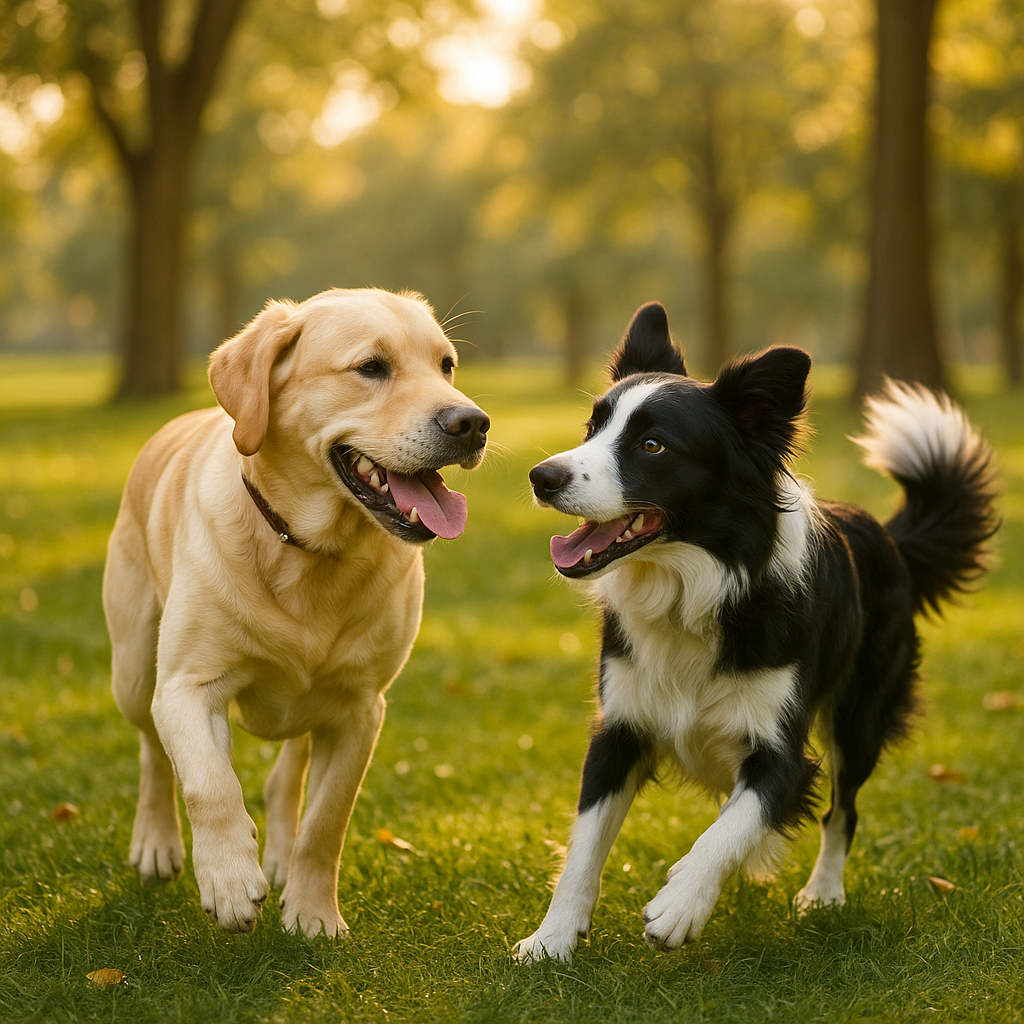
No rushing in headfirst. Will your 10-year-old golden retriever tolerate a hyperactive 6-month-old Australian shepherd? Probably not. Observe three crucial parameters:
The Age Factor
A too large gap generates frustrations. Seniors poorly tolerate the boundless energy of puppies, while two adolescents risk behavioral escalation. The ideal window? 18 months to 2 years maximum difference.
The Question of Sex
Male/female pairs present fewer risks of conflict than two males or two females. Fights between female dogs are often more violent and lasting according to ethologists.
Temperament and Energy
Pairing a shy dog with an outgoing one may seem balanced but risks stressing the former. Two similar profiles facilitate interactions. Use this comparative table:
| First Dog’s Profile | Compatible With | To Avoid |
|---|---|---|
| Dominant | Submissive dog +2 years older | Another dominant |
| Anxious | Calm and reassuring dog | Hyperactive dog |
| Hunter | Low-reactive dog | Dog with strong prey drive |
Preparing for the Newcomer’s Arrival

Setting up your space determines 50% of the success. Here are the essentials:
- Duplicate resources: Two distant resting places, two water bowls, identical toys. One dog must never “steal” access from the other.
- Create buffer zones: A room where your first dog can retreat without being followed, equipped with their bed and favorite toys.
- Reorganize rituals: Move the bowl or resting place if needed, to prevent your dog from associating changes with the rival.
“Dogs perceive space as a map of resources. Modifying this map before the arrival avoids exacerbated territorial defense” – Dr. Charlotte Duranton, ethologist
D-Day: Ideal Scenario for the First Meeting
Forget introductions in your living room. Here is the proven protocol:
- Choose a **neutral ground** (quiet park, forest path)
- Have them walk **in parallel at 10 meters apart** with two different people
- Gradually bring them closer without direct contact for 20 minutes
- Allow **short mutual sniffing** (3-5 seconds max)
- Immediately stop any growling or stiff posture
The classic mistake? Letting the dogs “settle their scores.” In reality, without human intervention, misunderstandings escalate into entrenched conflicts.
Managing the adaptation period (1 to 3 months)
This delicate phase requires constant vigilance on three fronts:
Distribution of attention
Your first dog must receive **as much if not more** petting and playtime as before. Schedule exclusive moments with each:
- Individual walks 2-3 times/week
- Preferred games alternated
- Random order of petting
Feeding rituals
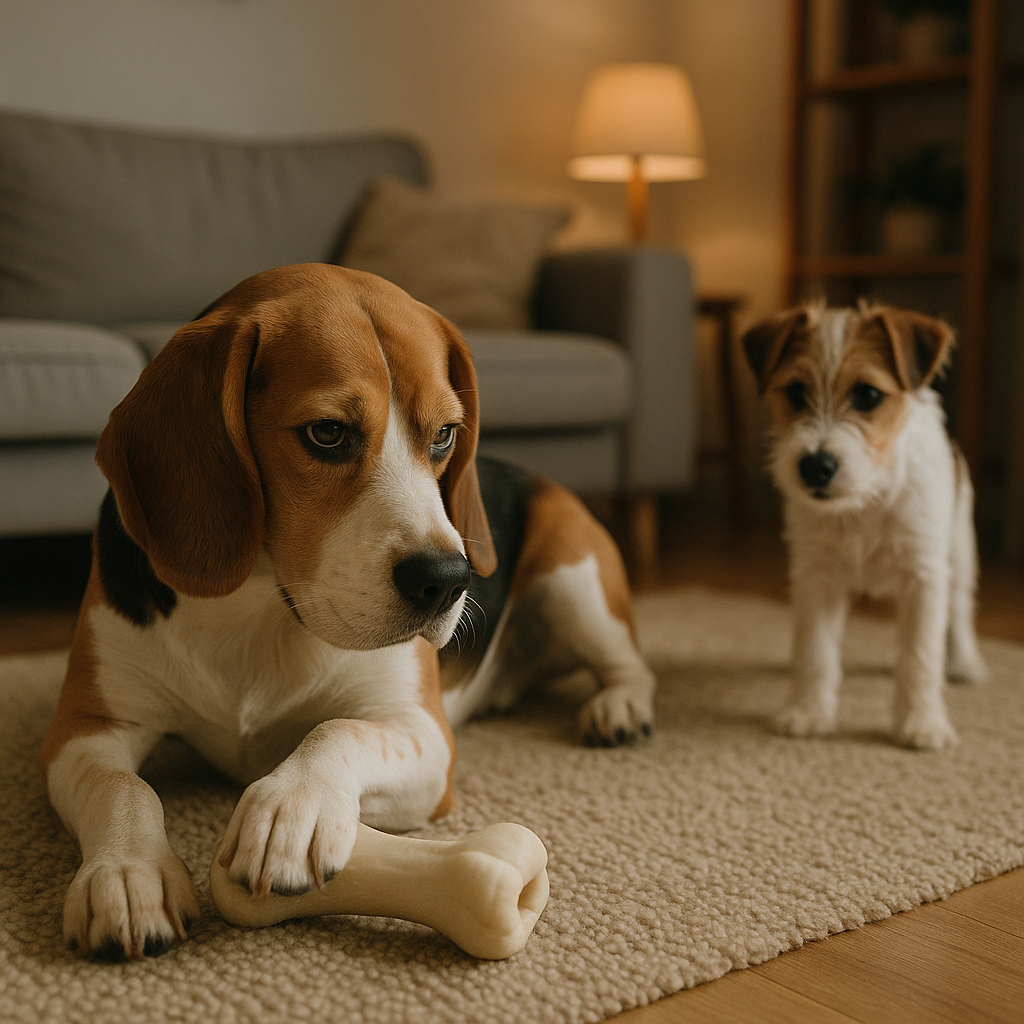
Always feed them separately, ideally in different rooms. If impossible, use a physical barrier and only remove the bowls after the dogs have been separated. A simple threatening glance during the meal can trigger lasting aversion.
Conflict management
Spot the warning signals:
- Intense staring
- Compulsive lip licking
- Stiff body and high tail
Intervene with distraction (noise, known command) before escalation. Never use physical punishment as it worsens anxiety.
Signs of pathological jealousy and solutions
Certain behaviors reveal suffering requiring intervention:
| Symptom | Immediate solution | Long-term approach |
|---|---|---|
| Destruction of objects | Increase mental exercise | Individual tracking games |
| Regressive cleanliness | Return to basic recall training | Soothing pheromones |
| Passive aggression | Temporary separation | Cooperation exercises |
Cooperation exercises work remarkably well: ask the dogs to sit side by side for a treat, or hold a rope toy together. They thus learn to associate the other’s presence with rewards.
When to consult a professional?
Despite your efforts, some situations justify external help:
- Repeated fights with bites
- Refusal to eat for 48 hours
- Self-destructive behaviors (excessive licking, self-mutilation)
A canine behaviorist trainer costs on average €50-70/session, but three sessions are often enough to defuse tensions. Prefer positive methods based on reinforcement.
Frequently Asked Questions
How long does the adaptation period last?
Count on 1 to 3 months depending on the dogs. Positive signs: sleeping in the same room without tension, playing briefly together, ignoring each other during meals.
Should I favor a puppy or an adult?
A puppy is generally better accepted but requires more work. A calm adult can integrate more quickly if temperaments are compatible.
My first dog growls when the new one approaches me, what should I do?
Do not punish him. Gently move the new dog away and reward the first as soon as he calms down. Work on gradual desensitization over several days.
Should I intervene during rough play?
Only if a dog shows signs of stress (whining, trying to escape). Growling during play is normal as long as it remains brief and without body stiffness.
Can I leave my dogs alone together from the very beginning?
Absolutely not. Start with physical separations (baby gate, different rooms) during your absences. Move to free cohabitation only after 2 weeks without incident.



