

| Key Points | Details to Remember |
|---|---|
| 🐶 Definition | Understand the difference between dog boarding, kennel, and family boarding |
| 📋 Services | Identify the services: individual box, walks, care, dog accommodation |
| 🩺 Requirements | Check vaccinations, health record, and admission conditions |
| ⚖️ Regulations | Learn about authorizations, health standards, and liability insurance |
| 💸 Pricing | Compare according to level: cheap kennel to high-end dog boarding |
| 🧭 Choice | Test through visits, adaptation days, and reading dog boarding reviews |

Are you looking for dog boarding in Montpellier and want to know where to entrust your companion during the holidays? Don’t worry: between municipal kennels, family boarding, and high-end facilities, there are very different options. This guide explains how these establishments work, what services they offer, what health and regulatory obligations apply, and especially how to choose the best solution for your dog — without getting lost in the pages of ads.
How Dog Boarding and Kennels Work
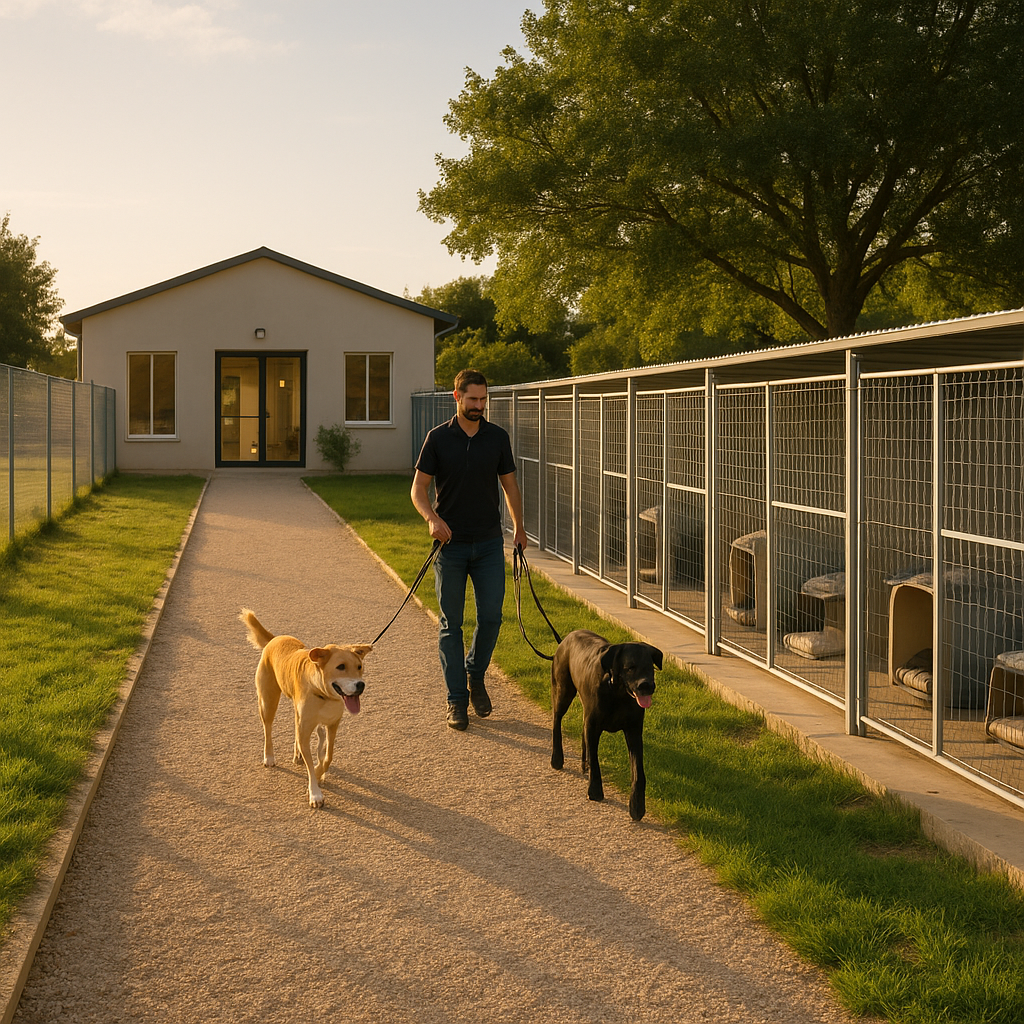
A dog boarding facility is a temporary dog accommodation where your pet spends the night and receives daily care. The term “kennel” often refers to the physical infrastructure (boxes, enclosures) while “dog boarding” refers to an activity organized around hosting and caring for dogs. Family dog boarding offers a more domestic welcome: the animal lives in a house with regular outings and more sustained human interaction. The chosen model directly affects the animal’s comfort and the dog boarding price.
Daily Organization
The typical day at a boarding facility includes feeding, walks or outings in a closed area, cleaning of boxes, and social interactions if the facility allows it. Some boarding facilities offer group play sessions, others maintain an individual box to avoid stress or conflicts between dogs. For owners, the organization involves arrival and departure times, a form to fill out, and often a recommended adaptation day.
Types of Accommodation
There are three main categories: traditional kennels with individual boxes, family boarding, and high-end establishments (dog spa, large outdoor space, additional services). Cheap kennels focus on the essentials: box, basic food, and walks. In contrast, a high-end dog boarding multiplies services: individual box with premium bedding, activity programs, grooming, and enhanced supervision.
Offered Services and Common Options
Services vary greatly and influence comfort and price. Here are the most common services and those that can make a difference depending on your expectations.
- Individual kennel: most boarding facilities offer an individual kennel, appreciated for its tranquility.
- Walks and outings: daily walks, group or individual outings depending on the dog’s behavior.
- Medical care and medication administration: some boarding facilities accept treatments, others do not; ask for written confirmation.
- Grooming: shampooing, brushing, trimming; often offered as an option.
- Specialized feeding: food brought by the owner or provided by the facility (specify your dog’s dietary habits).
- Cameras and monitoring: useful for owners’ peace of mind, especially in high-end dog boarding facilities.
- Transport: pick-up from your home as an option.
Health Requirements and Admission Conditions
Before any drop-off, most boarding facilities require an up-to-date health record: mandatory vaccinations (such as rabies depending on regulations and destination), booster dates, recent antiparasitic treatments. Some facilities require a behavioral visit or a trial day to assess the dog’s sociability.
Vaccinations, Treatments, and Documents
Frequently requested documents include: vaccination record, proof of antiparasitic treatment, rabies vaccination certificate if necessary, copy of liability insurance. For sensitive dogs or those under treatment, written authorization for medication administration must be anticipated.
Profile and Compatibility
Family-run dog boarding facilities better accommodate anxious animals or small dogs accustomed to home life. Kennels with individual boxes are more suitable for unsociable or large dogs. Be sure to report any history (aggressiveness, escape attempts, health problems) so the facility can adapt the care accordingly.
Regulations and Responsibilities
Animal boarding facilities, like any activity involving domestic animals, are subject to health and administrative obligations. They must comply with animal welfare standards, have compliant premises, and, depending on the country, be registered with the competent authorities. Professional liability insurance is recommended to cover damages caused or suffered by animals in care.
Inspections and Standards
Veterinary inspections, hygiene rules, and compliance with minimum space per animal are among the control points. A reputable establishment willingly displays its certificates and staff qualifications. During the preliminary visit, check cleanliness, ventilation, play area, and clear separation between clean and dirty zones.
Rates: How to Interpret Them (Without Specific Figures)
Boarding rates vary according to the level of service, kennel size, included services, and season. Instead of giving figures that can quickly become outdated, here is how to read a rate chart and compare offers reliably:
- Check if the rate includes food or if it is extra.
- Verify the cost of options: medication administration, grooming, transport.
- Compare prices taking into account the dog’s size: some facilities charge according to weight or category.
- Ask for sample invoices for a typical period (e.g., one week in July) to avoid surprises.
If you want a precise range of prices practiced in Montpellier, I can research it and cite it from verifiable sources (official pages, local directories, establishment websites). Without real-time research, providing exact figures could be inaccurate; it is better to compare several establishments using the methods above.
Practical directory: method to create a reliable list in Montpellier
I do not provide an automated local directory without real-time verification. However, here is a step-by-step method to obtain an accurate and sourced directory of dog boarding facilities in Montpellier:
- Consult official directories and reliable platforms (PagesJaunes, city hall website, local veterinarians); note the name, address, and website.
- Verify the SIRET and the legal existence of the structure via public registers to confirm the activity.
- Call the establishment to confirm hours, health policy, and request detailed rates.
- Check dog boarding reviews on several platforms (Google, Facebook, specialized forums) and compare feedback.
- Request to see the premises during a prior visit and ask for a contractual sheet specifying included services.
To make your task easier, here is a template to fill out for each establishment:
| Field | Example / Remark |
|---|---|
| Name | Official name of the boarding facility |
| Address | Street, postal code, Montpellier or neighboring town |
| Phone | Number validated by call |
| Website | URL if available |
| Specificities | Family-run boarding, individual box, walks, care |
| Indicative prices | Rate confirmed by phone or website |
| Reviews / Rating | Link to reviews and calculated average |
Compare: family boarding vs traditional kennel vs high-end
| Type | Advantages | To check |
|---|---|---|
| Family boarding | Homely atmosphere, individualized attention | Compatibility with other animals, number of dogs hosted |
| Traditional kennel | Well-established structure, security and individual boxes | Cleanliness, walking space, staff/animal ratio |
| High-end | Extensive services, monitoring and comfort | Price, availability in high season |
Tips for choosing the best boarding for your dog
- Make an unannounced visit to observe daily life and hygiene.
- Prefer a facility that requires an adaptation period and offers a trial before holidays.
- Read several dog boarding reviews and ask for local references.
- Check insurance and liability terms in case of incident.
- Request an emergency contact and the policy in case of veterinary clinic admission.
Checklist before entrusting your animal
- Up-to-date health record and vaccination certificates
- Usual food and feeding instructions
- Clearly identified medications and written instructions
- Familiar object (blanket, toy) to reduce stress
- Emergency contact and usual veterinarian’s number
FAQ — Frequently asked questions about dog care
What should be brought on the day of drop-off?
Bring the health booklet, the usual food in sufficient quantity for the duration of the stay, a leash, and any medication with precise instructions. A scented object from home often helps anxious dogs.
How to choose between an animal boarding facility and home care?
Home care (pet-sitting) avoids travel and the stress related to moving, but it depends on the reliability of the caregiver. An animal boarding facility guarantees professional care, fixed hours, and trained staff. The choice depends on your dog’s temperament and your priorities (socialization vs. home comfort).
Do boarding facilities accept dogs with medical needs?
Some boarding facilities accept and administer treatments, but this must be clearly indicated at booking and a written confirmation obtained. Other establishments prefer to refuse complex cases and direct them to specialized structures.
Can the boarding facility be visited before booking?
Yes. A preparatory visit is strongly recommended: it allows you to assess cleanliness, space, interactions with staff, and to observe any behaviors that might make you uncomfortable.
How to obtain reliable reviews about a boarding facility?
Cross-check reviews on several platforms (Google, Facebook, dog lovers’ forums). Prefer detailed reviews that mention concrete elements (cleanliness, emergency management, communication). Do not hesitate to ask for local references.