
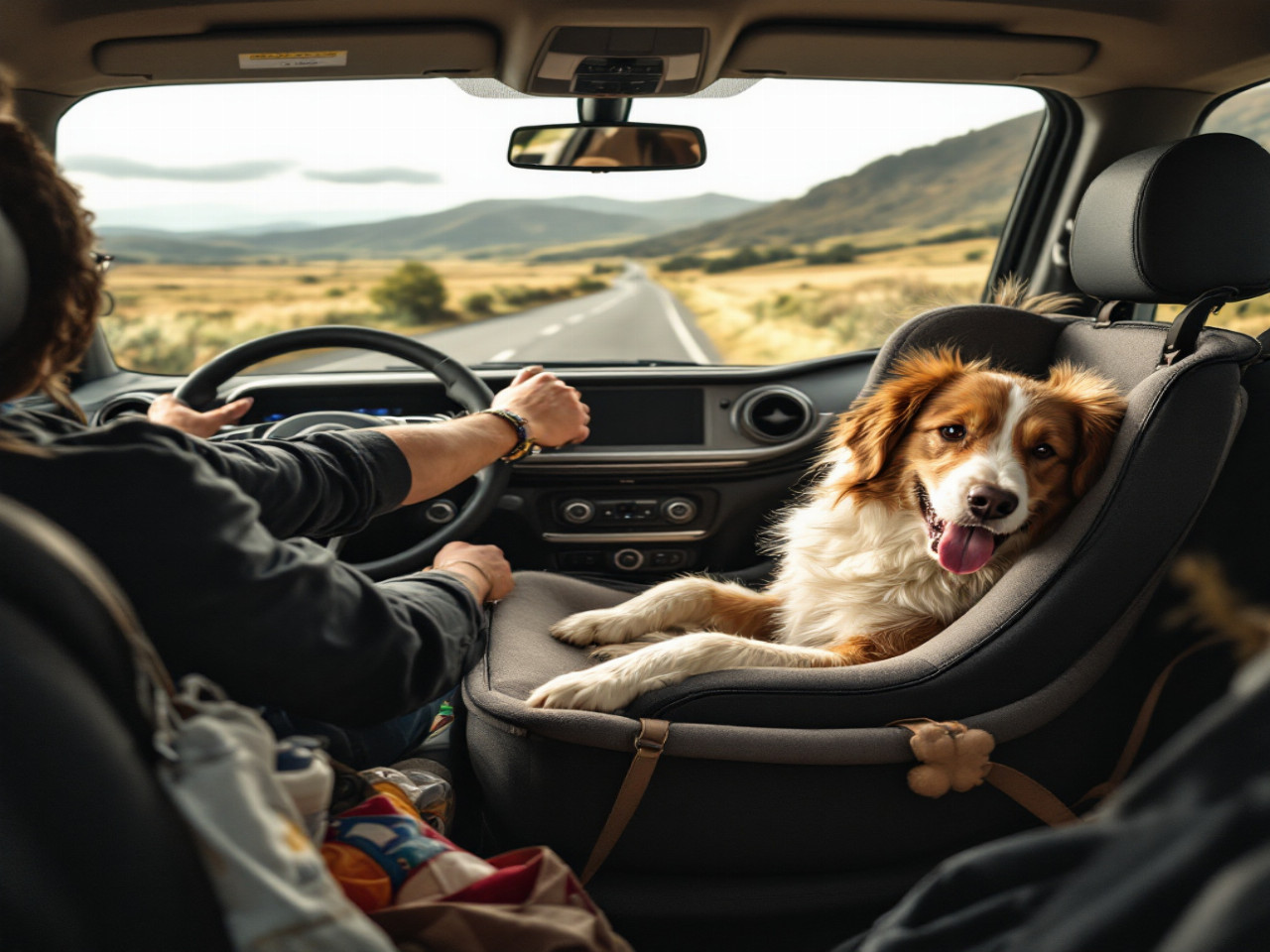

Do you dream of a stress-free road trip without incessant meowing or barking? Traveling by car with your dog is above all a matter of preparation and attention to your four-legged companion’s needs. From organizing the trunk to an anti-anxiety playlist, including regular breaks, here are ten proven tips to turn your trip into an enjoyable experience for both your dog and yourself. Ready to start? 😊
1. Set up a dedicated travel space
Imagine a small, cozy, and secure cocoon specially designed for your dog: this is the foundation of a peaceful trip. Whether it’s a harness attached to the seatbelt, a sturdy transport crate, or a partition net, the idea is to limit jolts and offer a zone where he can rest in complete tranquility. By placing a soft cushion, some toys, and a blanket with his scent, you create a familiar environment that reduces anxiety. My labrador Buddy, for example, loves his basket: as soon as he senses it, he snuggles in and closes his eyes.
2. Gradually accustom your dog to the car

You wouldn’t throw a ring novice straight into a championship, would you? The same goes for your dog and the car. Start with short trips around your neighborhood, reward him with a treat upon arrival, and gradually extend the duration. After a few five-minute rides, move to fifteen, then thirty. You can even simulate a trip by putting the car in neutral and letting the engine run, so he can feel the vibrations and sounds without moving. Little by little, the association “car = good experience” will become automatic.
3. Control temperature and ventilation
The car can become a real oven in the middle of summer, while your dog poorly tolerates excessive heat. Slightly open the windows, install sunshades on the rear windows, and consider a portable USB fan. In winter, think about an extra blanket or a suitable coat if your dog is sensitive to cold. Absolutely avoid leaving your dog unattended in a parked car, even for five minutes, without air conditioning: the risks of heatstroke are real. A dashboard thermometer or a smartphone app can alert you in case of a heat spike.
4. Plan regular and active breaks
The road wears you out… even for dogs. After an hour, take a 10 to 15-minute break so he can stretch, move around, relieve himself, and hydrate. Not to mention that a break often means a little ball game or a mini walk: an excellent way to burn off accumulated energy. To organize your stops, here is a quick table indicating the ideal frequency depending on the trip duration:
| Trip duration | Recommended break | Suggested activity |
|---|---|---|
| 1 hour | 10 minutes | Stretching + short walk |
| 2 to 3 hours | 15–20 minutes | Fetch games + hydration |
| More than 4 hours | 20–30 minutes | Longer walk + mini snack |
5. Bring a canine first aid kit
You can never be too careful, especially in the countryside or on isolated roads. Your kit should contain:
- Sterile compresses, bandages, and antiseptic for small cuts.
- Digital thermometer and saline solution.
- Nail clippers, tick remover, and an appropriate repellent.
- List of veterinary emergency numbers along your route.
- Prescribed medications and a copy of his health record.
In case of an incident, you save precious time, and your dog faces reduced risk.
6. Care for hydration and feeding
A dehydrated dog is a dog in danger. Always bring a flexible water bottle and a collapsible bowl, and offer him water every 30 minutes, especially in hot weather. Regarding food, favor a light meal 2 to 3 hours before departure to avoid nausea. On the road, avoid fatty kibble: frozen treats or apple bites do the trick while refreshing.
7. Focus on Safety and Securing
It’s not just a matter of regulations, it’s a matter of survival. An unrestrained dog can become a projectile in the event of sudden braking. Several solutions are available to you:
- The seatbelt harness, easy to install.
- The transport crate made of metal or thick plastic, secured in the trunk.
- The divider net if your trunk is spacious and your dog is calm.
Test the system before the big trip: a moderate-speed braking test is enough to ensure it stays securely in place.
8. Distract with Toys and Soothing Sounds
A bored dog can become restless, bark, or even chew the seat upholstery. So bring along some sturdy chew toys (Kong, knotted rope…), and play a playlist specially designed to calm animals: sounds of water, slow classical music, or recordings of heartbeat sounds. Essential oil diffusers (orange blossom, lavender) in spray form can also help soothe the atmosphere.
9. Teach Basic Commands Before Departure
“Sit,” “lie down,” “stay”: mastering these commands before the trip greatly facilitates life on board. Take advantage of the week before your departure to reinforce each command with short and frequent sessions. Favor treats as rewards, then gradually reduce them to rely on the satisfaction of a well-executed command. A dog that knows how to stay calm at a rest stop more easily resumes its place as soon as you fold up the folding chair.
10. Organize Arrival and Accommodation
The stress of travel doesn’t always end when you get out of the car. Book in advance a “dog-friendly” hotel or guesthouse equipped with an outdoor space, a bowl, and ideally, a small park. Use apps like DogFriendly or BringFido to locate dog-accepting addresses, authorized beaches, and dog parks. By planning this way, you avoid last-minute rush and offer your dog an environment where it can relax upon arrival.
FAQ
Does my dog always vomit in the car?
Nausea, especially in young puppies, is common. This is called motion sickness. Gradually accustom your dog, favor a light meal before the trip, and offer breaks for fresh air. If symptoms persist, a veterinarian can prescribe an appropriate anti-nausea medication.
Can I leave my dog alone in the car for a few minutes?
Absolutely not, even if the temperature seems mild. In a few minutes, the cabin reaches dangerous levels, putting your dog at risk of hyperthermia or hypothermia. Prefer a dog-accessible rest area or ask a passenger to stay on board.
How to manage separation stress if my dog doesn’t stay calm as soon as I start driving?
Associate trips with positive experiences: give your dog a toy stuffed with dog pâté just before starting. Repeat several times, gradually increasing the duration up to 30 minutes of calm. Praise and reward at each return.
How much water should I provide for a 4-hour trip?
Count about 10 to 15% of your dog’s weight in water per day. For a 20 kg dog, plan 2.5 to 3 liters for 24 hours. Over 4 hours, offer 500 ml divided into small sips at each break.