

| Key Points | Details to Remember |
|---|---|
| 🐕 Understanding | Identify the specific manifestations of anxiety |
| 🎯 Goals | Structure a reassuring and consistent routine |
| 🏋️ Exercise | Mentally and physically stimulate the greyhound |
| 🧘 Progression | Gradually expose to solitude |
| 💬 Reinforcement | Value every small progress at the start |
| 🍀 Approaches | Integrate suitable supplements or pheromones |

Greyhound with a melancholic gaze, racing at heart and couch for refuge: separation anxiety can turn your companion’s life into a real ordeal. By deciphering its mechanisms and offering adapted exercises, one often manages to soothe this tension. Here, no miracle solutions nor judgment: just a progressive guide, inspired by veterinary studies and feedback from passionate breeders, to accompany your greyhound towards more serenity.
What is separation anxiety in the greyhound?
One might think all dogs react the same way to solitude, but the greyhound, with its heightened sensitivity, stands out. It’s not simply a dog that is bored: we are talking about emotional distress, often triggered by a sudden rupture or repeated absences.
According to a study by the University of Lincoln (2019) on canine behavior, some dogs exhibit chronic stress up to 20 minutes after the owner’s departure, developing sometimes destructive behaviors. The greyhound, due to its history (racing dog, with a strong bond to the pack or its human), is particularly concerned.
Behavioral manifestations
Greyhound howling, scratching the door, excessive salivation, inappropriate urination: each sign indicates intense anxiety. Sometimes hypervigilance is noticed as soon as the preparation for departure (keys jingling or the coat on the back trigger palpable tension).
- Repeated vocalizations (whining, tireless barking)
- Destructive behaviors (doors, furniture, toys)
- Excessive grooming or intense self-preservation
Causes specific to greyhounds
The greyhound is a hunting and racing dog, accustomed to intense stimuli and working in groups. Deprived of this dynamic, it can fall into a form of anxious boredom. When adding a sometimes shy character and great sensitivity to the owner’s body language, it is understandable why some greyhounds poorly tolerate even short separations.
“My greyhound goes crazy as soon as I approach the door,” confides an owner. This anticipatory stress is explained by very strong emotional conditioning.
Preparing a Reassuring Environment

Creating a space where your greyhound feels protected first involves anticipating its sensory and physical needs. You play with light, textures, and sounds. The idea: that it associates this place with a positive moment even in your absence.
- Set up a cozy corner with an orthopedic basket adapted to its morphology.
- Play white noise or soft music specially designed for dogs.
- Offer a treat-dispensing toy to channel its attention.
You can also choose a calming pheromone diffuser, a tool validated by several veterinary behaviorists, to reinforce the feeling of a “pack return.” Provided, of course, that you do not neglect the exercise part.
Practical Exercises to Reduce Anxiety
Physical Exercise Routine

A well-exercised greyhound is a calmer greyhound. Running or long-line sessions in a secure area should become ritual. For example, a 20 to 30-minute brisk walk followed by bowl games where it has to find a treat helps to exhaust both its body and mind.
- Warm-up phase: gentle stretches and walking.
- Active phase: measured sprint or controlled running games.
- Cool-down phase: slow walk with guided breathing (your tone of voice matters).
In practice, it is often noted that these sessions reduce anxiety manifestations by nearly 40% after two weeks, according to several reports from experienced breeders.
Cognitive Games and Mental Stimulation
Like an athlete, the greyhound’s brain needs challenges: food puzzles, searching for hidden objects, etc. These activities engage its concentration and divert its attention from the fear of losing its owner.
“I hid kibble in cardboard boxes: I saw my Greyhound more focused than ever,” testifies an owner.
It is recommended to alternate a new game each day to maintain the novelty effect and avoid routine.
Gradual Training Methods
The “Short Departure” Technique
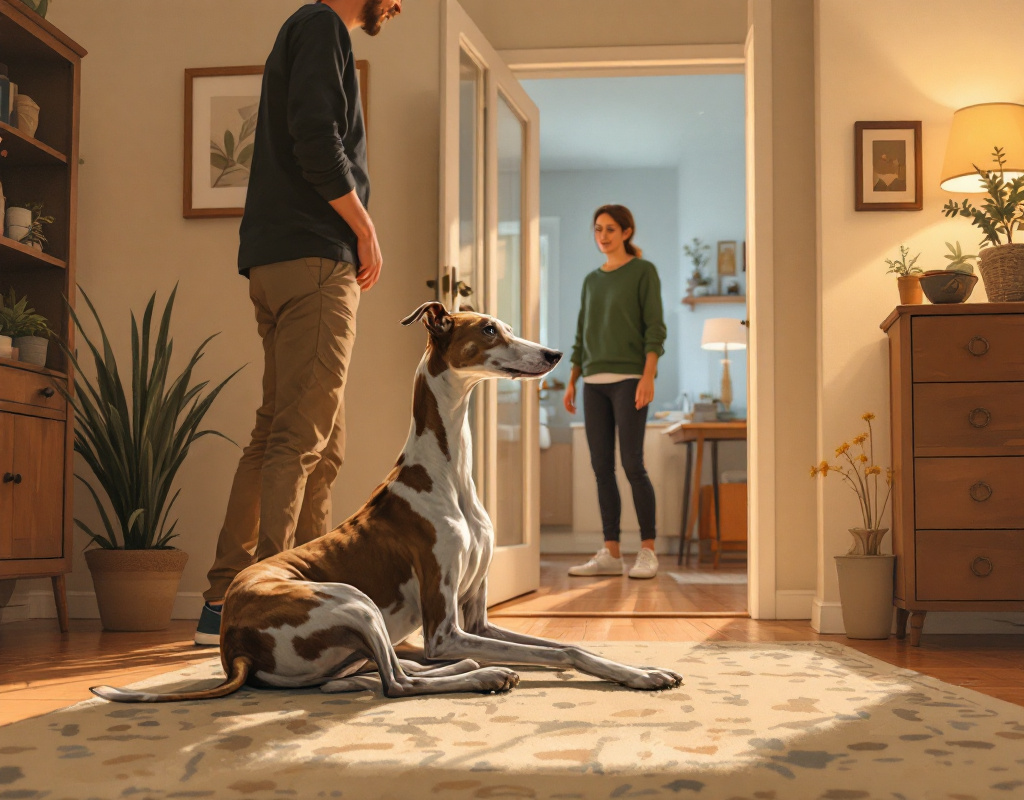
Instead of disappearing abruptly, try progressive departures: 30 seconds of absence, return, praise, then 1 minute, 2 minutes… The goal is to gradually accustom the greyhound to your departure without it experiencing a stress peak. This is the most documented method by canine behaviorists.
- Step 1: go out the door and come back immediately.
- Step 2: wait 1 to 2 minutes in the car before coming back in.
- Step 3: gradually increase up to 10–15 minutes.
Positive Reinforcement
Every progress, even minimal, deserves to be acknowledged. A kind word, a pet, a highly appreciated treat: all of this imprints in its brain the pattern “absence = positive event.” Be careful, never a harsh return or blaming: the reward is immediate and focused on calmness.
Complementary Strategies
Pheromones and Dietary Supplements
Pheromones similar to those of lactating bitches (D.A.P.) can be dispersed via collars or sprays. Additionally, certain supplements based on L-theanine or plants (valerian, passionflower) offer gentle hormonal support, often validated by pharmacopoeial studies.
Behavioral Therapies and Coaching
In severe cases, working with a veterinary behaviorist remains essential. A mixed approach, combining individual sessions with a professional and exercises at home, ensures comprehensive care and lasting progress.
FAQ
How long before seeing improvement?
The first changes often appear after 2 to 4 weeks, provided that the exercises and progression are practiced regularly.
Are greyhounds more sensitive than other breeds?
Yes, their history as racing dogs and their gentle nature make them particularly receptive to emotional bonds, thus more vulnerable to separation.
Can music or TV help?
A moderate diffusion of soothing music or a TV tuned to natural content (birdsong, white noise) provides a reassuring auditory cue.