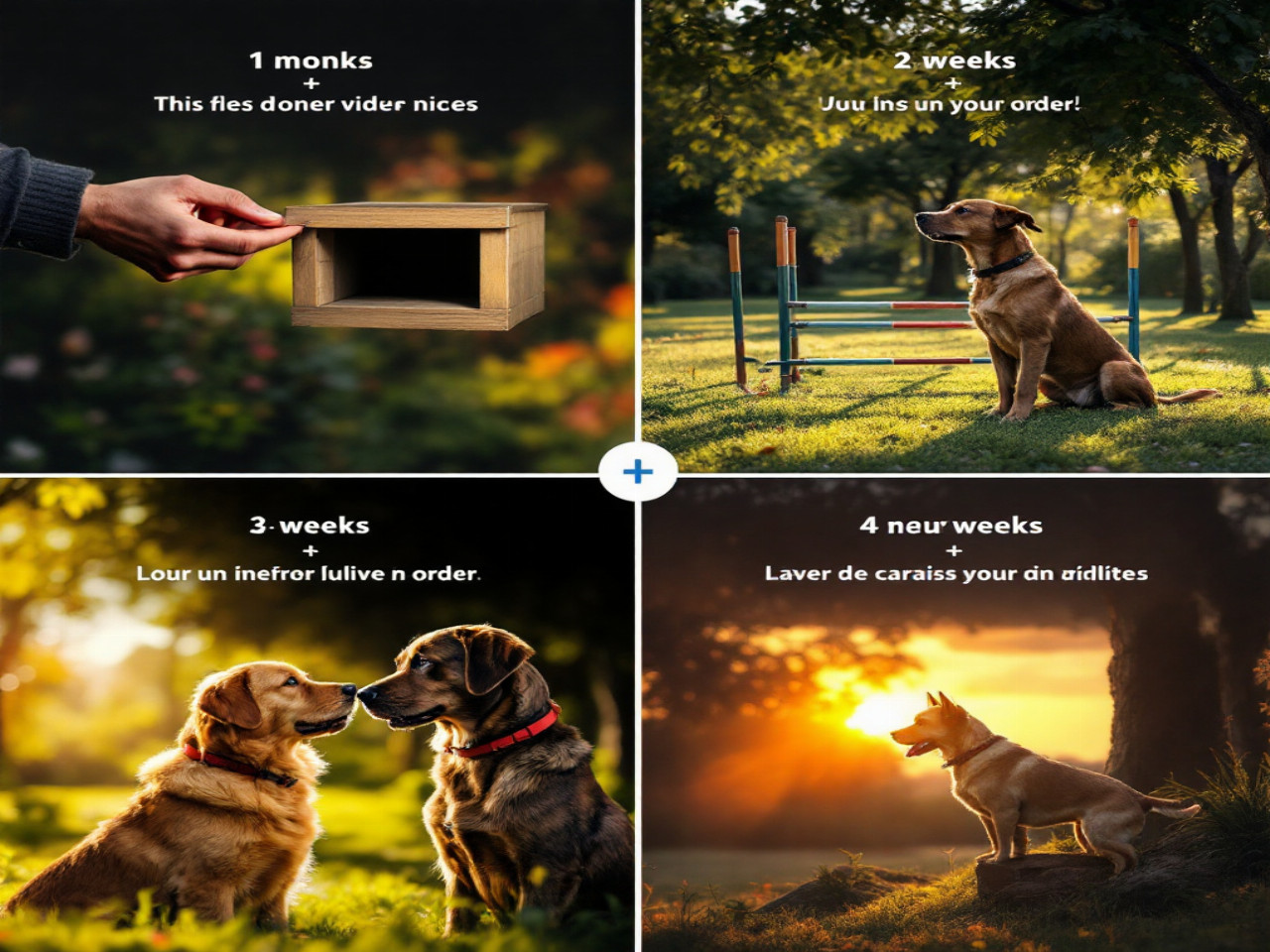

Do you dream of a dog that listens and is reliable? Without going through a dog club, you can lay the foundations of obedience in one month, at home or outdoors. This detailed guide accompanies you day by day: choice of exercises, minimal equipment, tips to avoid blockages and make each session fun. Ready with your clicks and treats, let’s start! 😊
Why a 4-week obedience program?
In reality, a learning process that is too long demotivates everyone; a structured plan over four weeks offers a steady pace, quick rewards, and visible skill improvement. Four weeks is enough to anchor three or four essential commands without losing the enthusiasm of the owner or the dog. And besides, aren’t we happier when we see concrete progress every week?
Prerequisites before starting

Before jumping in, take a few minutes to prepare the environment and get equipped:
- Treat target: small bites easy to chew.
- Collar or harness: comfortable, without excessive tension.
- Light leash: 1.5 to 2 m to maintain control and offer some freedom.
- Varied treats: vary to maintain motivation.
- Phone or stopwatch: to measure session durations.
Settle in a quiet corner, avoid meal times and strong external distractions. The simplest would even be to have a defined space, like a small park or a living room where nothing is lying around.
Your 4-week schedule
| Week | Key objectives | Session duration |
|---|---|---|
| 1 | Sit and recall | 5-8 min, twice a day |
| 2 | Down and stay | 8-10 min, twice a day |
| 3 | Walking without pulling | 10-12 min, 1 to 2 times a day |
| 4 | Generalization & reinforcement | 5-15 min, depending on context |
Week 1: Mastering sit and recall
Gently establishing the sit
At the start, aim for simplicity: show the treat at the level of the muzzle, then slowly move it towards the back of the dog’s head. The head follows, the rear naturally lowers. As soon as the buttocks touch the ground, click, distribute. Three to five repetitions per set, two sets per session, morning and evening. The first sessions feel like magic tricks, take advantage to create a positive association.
Recall: from a few steps to the beach
Start in a room without obstacles, at a short distance. “Come” must remain constant, whatever the tone of your voice. When he arrives, it’s a celebration: petting, sweet words, treats. Then gradually increase the distance, add obstacles (furniture, tree) to simulate a real environment. Keep the atmosphere joyful, avoid any harsh tone. Recall is vital: it will save your dog from a dangerous situation later.
Week 2: Adding down and “stay”
Transitioning from sit to down
With a dog already comfortable sitting, pass your hand to the ground, slide the treat along the floor between the front paws. His head follows, his rear too. You can gently help the neck to facilitate the position. Once acquired, repeat without visible treat, guiding only with the gesture. Three sets per session, varying the location: rug, grass, tile…
“Stay”: the secret of self-control
“Stay” or “reste” is often feared because it requires the dog to resist the urge to move. Start at a distance of one step, place your hand like a stop sign, clearly say “stay.” Return to him, praise or gently correct depending on the attitude. Gradually increase duration and distance. Always keep an encouraging tone; it’s an exercise in patience as much as obedience.
Week 3: Walking on a leash without pulling
Relearning the walk
What we’ve all experienced: the dog pulling, you tiring your wrist. In practice, establish the reward at heel: as soon as he walks by your side, a little click and a treat. As soon as he moves with tension, stop immediately. Patience and consistency make the difference. Change direction without warning, to teach him to keep attention on you rather than tracking a scent.
Variants and distractions
You can throw a ball and then resume walking. Nothing better to show him that following the human also means fun. Gradually introduce busier contexts: market, park, neighborhood. Always monitor the success rate: if the distractions are too strong, return to a simpler environment and rebuild confidence.
Week 4: strengthen and generalize
Changing locations and surfaces
For learning to be lasting, it must be transferred: sidewalk, undergrowth, balcony, car… Each new setting requires concentration. Take advantage of this month to vary the times of day: train in the morning, during the day, in the evening. The idea is to get the dog used to obeying everywhere, not just in your living room.
Intermittent recalls and partial reinforcement
Once the commands are well established, move on to variable reinforcement: sometimes it’s a treat, sometimes a kind word, or simply a game. This method makes the dog more motivated than systematic reinforcement because he never knows what bonus awaits. Alternate rewards to create a kind of joyful “quest.”
Tips to sustain achievements
- Incorporate daily mini-sessions of 2 to 3 minutes.
- Use commands in everyday life: before getting out of the car, ask for a “sit.”
- Remember that each dog learns at his own pace: adjust the difficulty.
- Develop the exercises: add jumps, detours, or a creative “trick.”
- Stay patient and celebrate every progress, even small.
FAQ
What is the ideal frequency for sessions?
Twice a day is a good pace, but if you lack time, a single 10-minute session is enough to maintain achievements.
My dog is bored, how to rekindle interest?
Vary toys, mix soft and crunchy treats, introduce a new command or a playful course between two commands.
Can an adult dog be trained the same way?
Absolutely. Canines remain very receptive throughout their lives; sometimes more patience is needed, but the method remains the same.
I lack specialized equipment, is that a barrier?
Not at all. Treats, a standard leash, and a bit of creativity are enough to start. You can add a clicker or a non-slip mat along the way.
How long before seeing results?
Within a few days, the first basic commands appear. After two weeks, most dogs perform “sit” and “down” without hesitation when the exercise is repeated daily.