

| Key Points | Details to Remember |
|---|---|
| 🔑 Definition of the method | Concise explanation of the positive approach |
| 🎯 Main objective | Acquire key commands for safety |
| 🏠 Ideal setting | Calm environment without distractions |
| 🍖 Reinforcement | Systematic use of rewards |
| ⏱️ Learning duration | Short and regular sessions |

Teaching basic commands to your Swiss Shepherd relies on consistency, patience, and immediate reward. By working daily for a few minutes, you will lay the foundation for a harmonious and secure relationship.
Why train a Swiss Shepherd?
The Swiss Shepherd stands out for its intelligence and energy. Without a clear framework, it can quickly lose focus and get bored. By setting rules from an early age, you harness its cognitive potential and reduce canine stress.
- Awakened nature: it learns quickly but also gets bored just as fast.
- Need for mental activity: obedience channels its energy.
- Enhanced safety: a dog that responds to “Heel” or “Come” remains under control in any situation.
A well-trained Swiss Shepherd becomes a balanced companion, capable of managing external stimuli without excessive nervousness.
Preparing training sessions

Before starting, gather the materials and choose a suitable location. A few simple guidelines ensure quick progress:
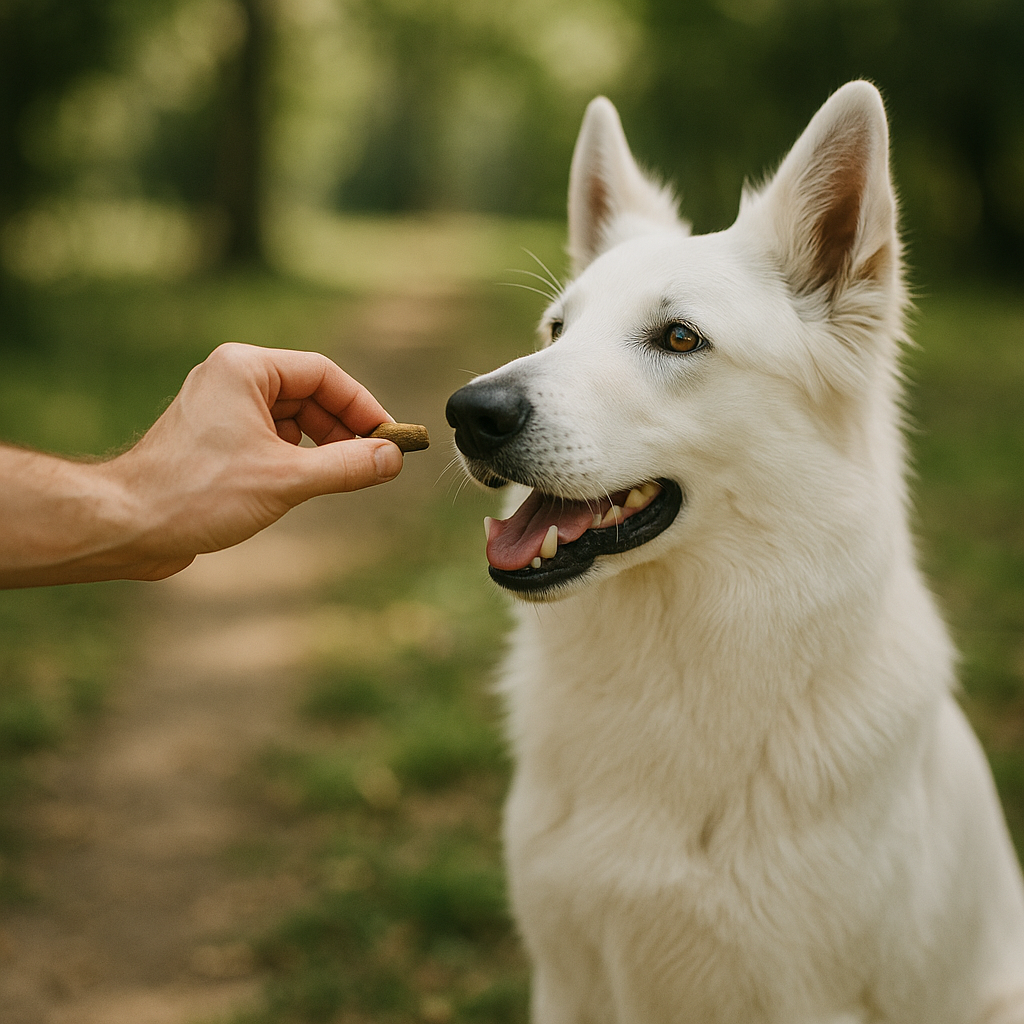
- Soft treats cut into small pieces.
- Clicker or small silent toy to mark the precise moment of learning.
- Clear area, free of stimuli (other animals, noises, crowds).

Each session should not exceed 10 minutes: shorter is more effective.
The essential: a consistent environment avoids distractions and strengthens the dog’s attention.
Basic commands and their learning
Here is an overview of the five fundamental commands, each accompanied by a step-by-step method.
1. Sit
To initiate the “Sit” command:
- Hold a treat above the nose, then slowly move it backward. The dog naturally shifts onto its hindquarters.
- As soon as it sits, mark the moment with the clicker or a keyword (“Yes!”) and give the treat.
- Repeat the exercise while adding the word “Sit” just before the hand gesture.

Vary locations to generalize the response: living room, garden, park.
2. Down
To move from “Sit” to “Down”:
- Place a treat on the ground in front of the front paws, then slowly move it away.
- The Swiss Shepherd lies down to follow the treat; reward the lying down posture.
- Associate the word “Down” with the gesture, then gradually shorten the treat until you get the posture on command alone.
3. Come
The command “Come” strengthens the bond:
- Attract attention with a visible treat and step back a few paces.
- When the dog approaches, warmly praise and offer the treat.
- Carefully increase the distance and make sure you are always more attractive than the outside environment.
4. Heel
“Heel” means the dog walks without pulling beside you:
- Position the dog at your side and give the treat to reward staying close.
- Move forward slowly: as soon as he moves away, stop and call him back to your side.
- Reinforce the command by saying “Heel” and reward at each successful step.
5. Stay
To secure immobility:
- Ask for “Sit” or “Down,” then slowly step back one or two steps.
- If the dog stays in place for three seconds, return and reward.
- Extend the interval until you achieve 30 seconds of immobility.
The key: gradual progress allows immobility to be established without stress.
Tips to Maintain Motivation
A motivated shepherd learns with pleasure: here are some tips to keep up his enthusiasm.
- Vary rewards: small treat, petting, quick game.
- Alternate known exercises and new challenges.
- Always end on a success, even a minor one.
Common Mistakes to Avoid
To avoid hindering progress:
- Punishing failures: this blocks the desire to try.
- Overloading with commands at the same time.
- Forgetting to reward immediately after execution.
FAQ
- At what age should I start training my Swiss Shepherd?
- You can start the first obedience games from 8 weeks old, in short and playful sessions.
- How long before my dog masters a command?
- On average, expect 1 to 2 weeks of daily training for a simple command like “Sit”.
- Is a clicker essential?
- No, a clear keyword works just as well provided it is consistent.
- What should I do if my Swiss Shepherd no longer obeys in a new place?
- Return to a calm environment, reward generously, then gradually reintroduce distractions.
- Is it necessary to consult a professional?
- In case of persistent difficulties, a dog trainer will provide tailored and personalized support.