


/* Css En-Bref */
.en-bref {
max-width: 640px;
margin: 2em auto;
padding: 1.5em 1.8em;
background: #f7f9f9;
border: 1px solid #10b58b;
border-left: 6px solid #10b58b;
border-radius: 12px;
box-shadow: 0 8px 24px rgba(251, 191, 36, 0.15);
font-family: ‘Inter’, ‘Segoe UI’, sans-serif;
color: #3a2d0d;
text-align: left;
}
.en-bref .enbref-header {
font-size: 1.15em;
font-weight: 700;
color: #d97706;
margin-bottom: 0.6em;
display: flex;
align-items: center;
gap: 0.5em;
}
.en-bref p {
font-size: 1em;
line-height: 1.65;
margin: 10px;
}
.en-bref strong {
color: #1c1917;
}
| Key Points | Details to Remember |
|---|---|
| 🐕 Definition | Miniature sighthound with an elegant and refined appearance |
| 📏 Size | 25–38 cm at the withers with a weight of 3–5 kg |
| ❤️ Temperament | Affectionate, playful and sensitive to emotions |
| 🏡 Habitat | Suitable for apartment living with regular outings |
| 🩺 Health | Prone to joint and dental fragilities |
| 🎯 Adoption | Recommended for calm and attentive households |
One might think that the Italian Greyhound is reduced to a frail and fragile silhouette, yet this breed reveals a lively temperament. Of ancient origin, this small Italian sighthound combines grace and energy. In this article, we delve into its history, needs, and unique character to better understand why it so captivates lovers of delicate companions.
Origins and History of the Italian Greyhound
The journey of the Italian Greyhound dates back several millennia, with representations in ancient Egypt and ancient Rome. From that time, these miniature sighthounds accompanied the nobility, not only as companion dogs but also as symbols of refinement. In the Middle Ages, it appears in European illuminations, where it is shown alongside aristocrats. Despite its small size, it sometimes traveled long distances to hunt small prey, highlighting its surprising speed.
Physical Characteristics
Size and Silhouette
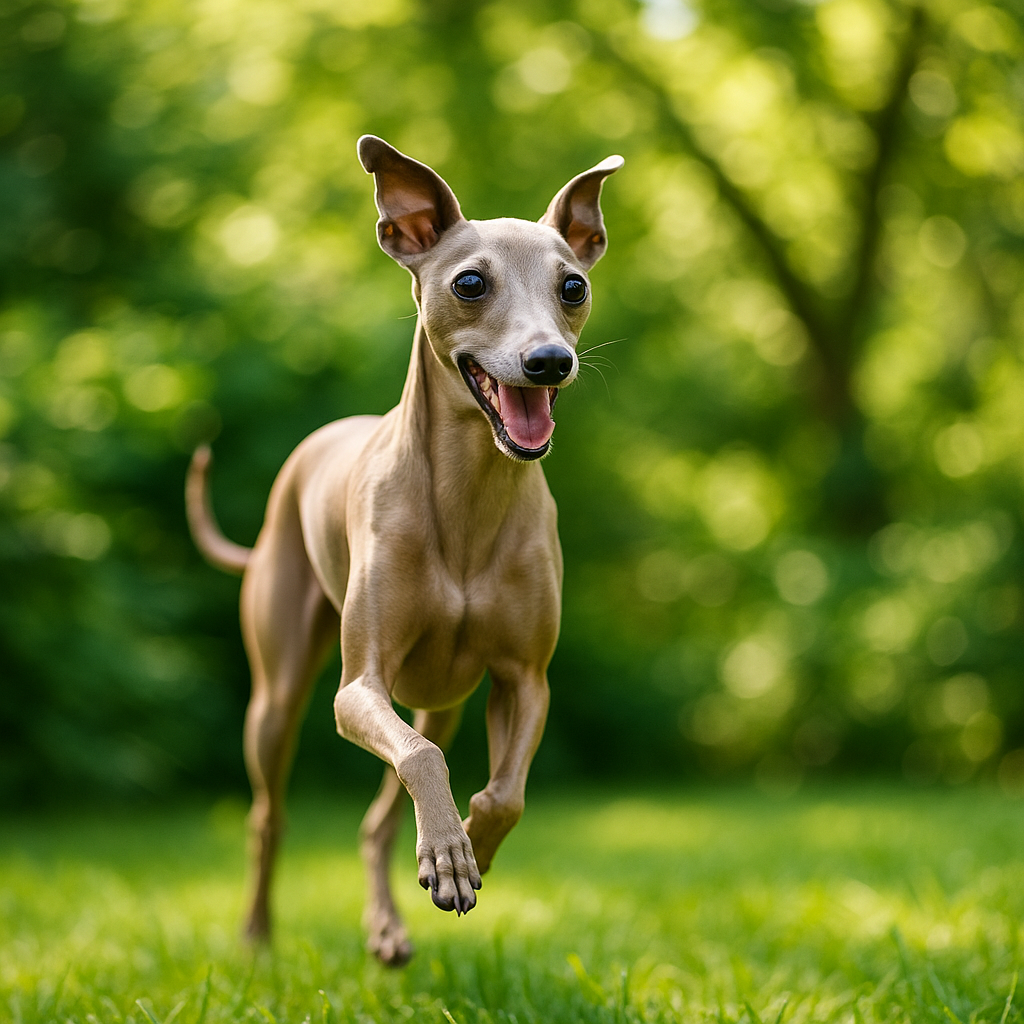
The Italian Greyhound displays a slender and muscular body while maintaining remarkable lightness. Generally measuring between 25 and 38 cm at the withers, it rarely weighs more than 5 kg. This fine build is accompanied by slender limbs, a narrow chest, and a slightly arched back. Despite its apparent fragility, its bones are strong, adapted to sudden bursts of speed reminiscent of its past as a hunting sighthound.

Coat and Colors
The Italian Greyhound’s coat is short, smooth, almost shiny under the light. Colors range from slate gray to fawn, including black, cream, and brindle. Some specimens feature a fine facial mask or a small white star on the chest. This minimalist coat highlights every curve of the body, enhancing the impression of aesthetic purity that many find fascinating.
Temperament and Behavior
Affection and Human Bond
This miniature sighthound often shows a close bond with its owners. Its need for human warmth is expressed by a constant desire to snuggle and share moments of calm. It exhibits great sensitivity: it senses moods and reacts with empathy. Its gentle demeanor makes it particularly suitable for people who want an attentive companion, almost ready to understand a mood word before it is even spoken.
Activity and Games
Despite its sofa-like color, the Italian Greyhound loves to expend energy. Fast runs and chase games are essential to channel its energy. On a leash, it can reach 40 km/h when it gives its all. Short and intense sessions are better suited than long monotonous walks. A few interactive toys and a secure space are enough to prevent its liveliness from turning into excessive restlessness.
Health and Specific Care
Its delicacy is not just an illusion: the fine bones can be prone to fractures if one is not careful. Low temperatures affect it quickly, hence the almost permanent use of coats outdoors. Indoors, a soft bedding protects its joints. Its fast metabolism also makes it fragile in terms of digestion, so the diet must be high quality, divided into portions, and adapted to its size to avoid gastrointestinal disorders.
Dental Prevention
The fine jaws can present dental crowding, leading to tartar and periodontal diseases. Regular brushing with a suitable canine toothpaste proves crucial. Chew toys can also help reduce the buildup of deposits on the teeth, while respecting the fragility of the enamel.
Veterinary Visits
Beyond the usual vaccinations, it is recommended to monitor blood pressure and to screen early for any dysplasia or stomach torsion. Some lines may also show a mild form of retinal atrophy, for which carriers should be tested before breeding to limit genetic transmission.
Indoor and Outdoor Life
In an apartment, the Italian Greyhound thrives as long as it benefits from emotional anchors and regular outings. The absence of a dense coat requires a comfortable ambient temperature, between 20 and 24 °C. Fifteen minutes of free running in a fenced garden, followed by a nap on a padded cushion, constitutes the ideal routine.
Adopting an Italian Greyhound: Practical Advice
- Check the breeder: transparency about the health status of the parents and DNA tests.
- Provide appropriate accessories: coat, light collars, non-slip bowls.
- Anticipate socialization through gradual meetings with other dogs and children.
- Establish a care schedule: light grooming and weekly dental maintenance.
- Enroll your companion in positive reinforcement sessions to strengthen mutual trust.
FAQ about the Italian Greyhound
- What is the average lifespan?
- Generally between 12 and 15 years, with good care and an adapted diet.
- Can it live with children?
- Yes, provided that interactions are calm and respectful, to protect its delicate frame.
- Should a dedicated space be created for it in an apartment?
- A cozy corner, heated in winter, where it can feel safe is strongly recommended.
- What type of diet should be favored?
- Premium kibble for small dogs, enriched with omega-3 and controlled carbohydrates.
- How to manage its need for warmth?
- Suitable clothing, soft heated blankets, and access to comfortable areas depending on the season.