
| Key Points | Details to Remember |
|---|---|
| 🎨 Appearance | Muscular silhouette, expressive head, coat often tricolor or orange and white |
| 🏛️ History | Ancient origins linked to Northern Italy and game hunting |
| 🧠 Temperament | Balanced: gentle with family, motivated in the field |
| 🛠️ Maintenance | Minimal grooming, needs regular exercise and consistent guidance |
| 🎯 Use | Efficient pointing dog, also adapts to active family life |
The Bracco Italiano exudes an elegance that goes beyond appearance: it carries a history, a character, and a lifestyle. It is noticed for its expressive head, its almost sculptural carriage, and its calm but assertive manners. Understanding this dog means accepting to look beyond the simple cliché of the “pointing dog” to perceive the sensitive companion, sometimes theatrical, capable of accompanying both a day of hunting and a well-organized urban life. Here is a comprehensive dossier for those who want to know, adopt, or simply appreciate this uncommon breed outside Italy.
Origins and evolution: Italian roots, European journey
The earliest depictions of a dog resembling the Bracco date back to Antiquity and the Middle Ages in the Italian peninsula. Paintings and engravings show dogs with a similar carriage, adapted to hunting in plains and hills. What distinguishes the Bracco is the balance between power and finesse: designed to locate and point game, it also had to be resilient and enduring on varied terrain. The modern standard stabilized in Italy in the 19th century, then the breed gradually spread to the rest of Europe after the first half of the 20th century.
A dog shaped by hunting and local selection
Italian hunters favored lines capable of obeying the master’s commands, advancing methodically without haste, and pointing game without frightening it. Unlike some hunting dogs hyper-selected for speed, the Bracco maintains a more composed, almost choreographed way of working. It is this “artist’s” gait in its attitude that often earns it flattering descriptions: it observes, waits, then executes with precision.
Appearance and Standard: Between Sculpture and Functionality
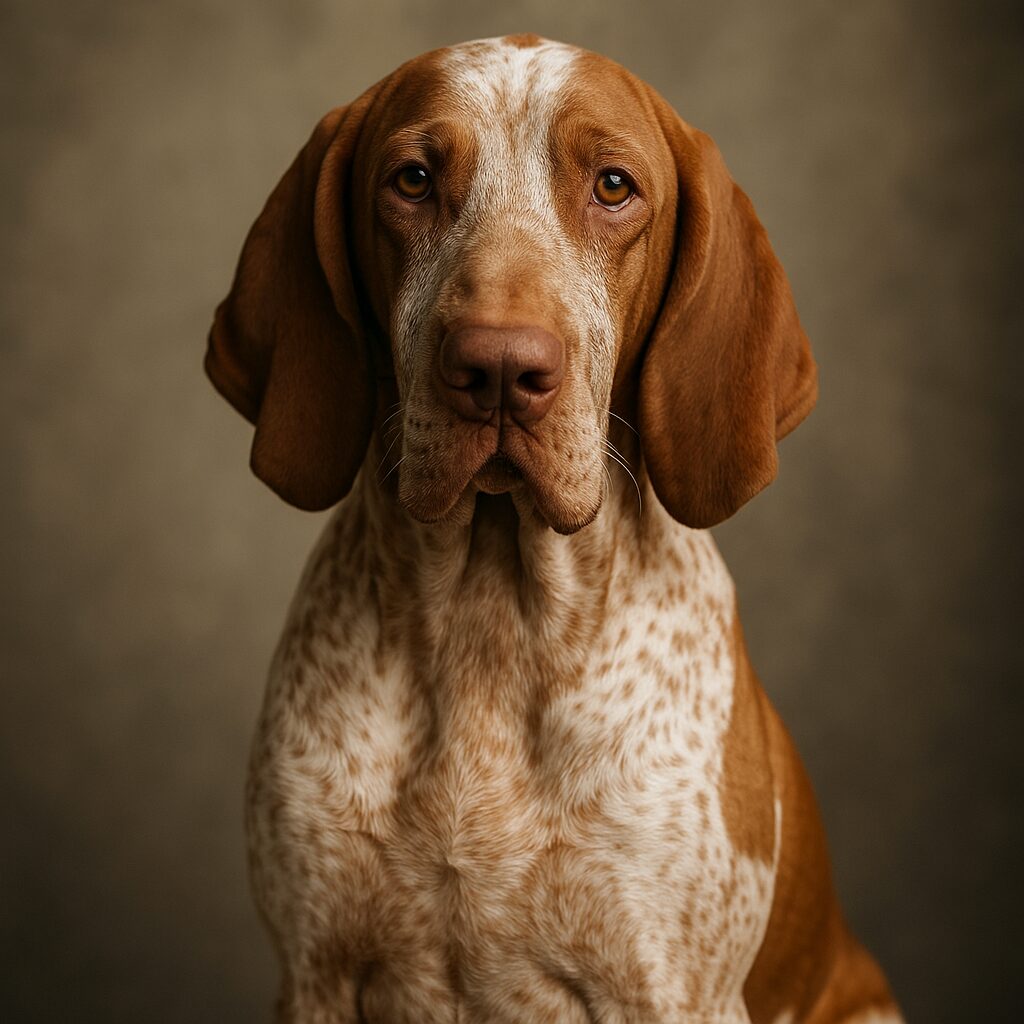
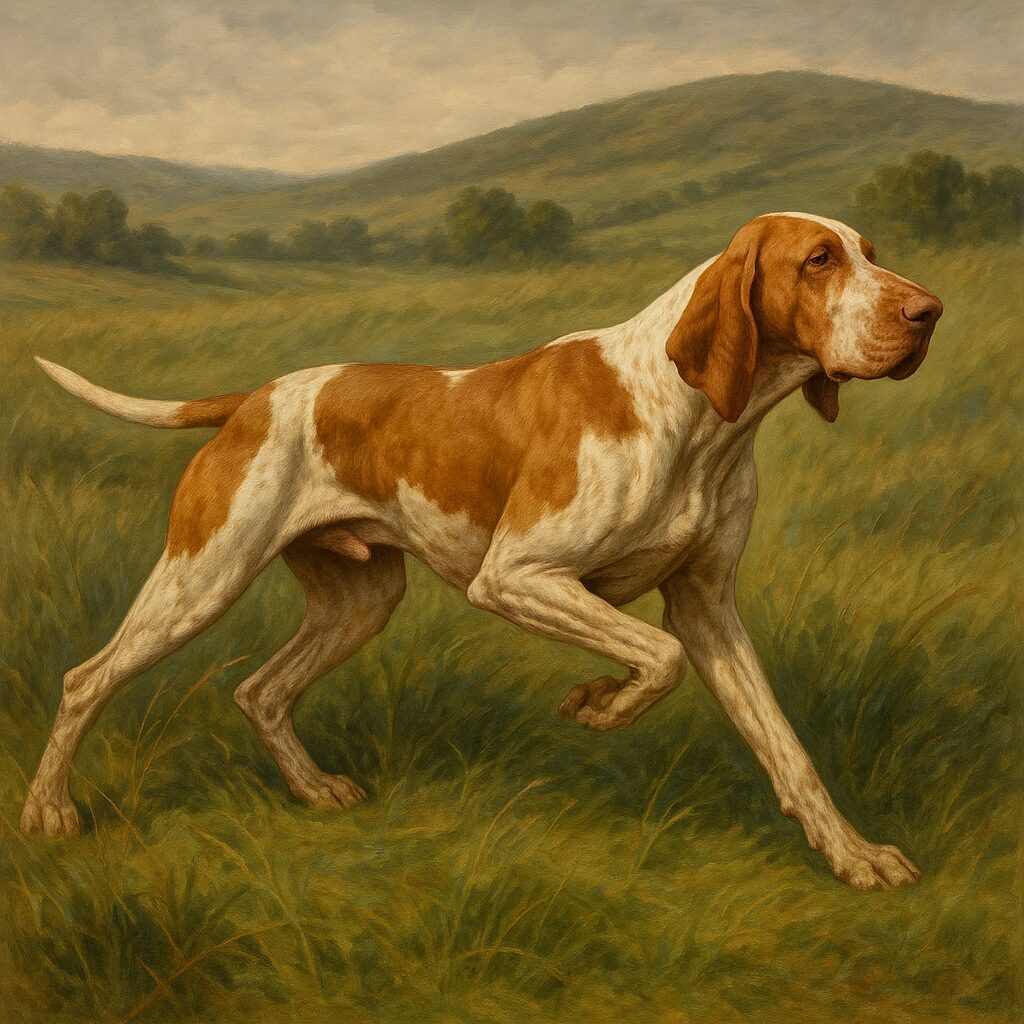
The Bracco has a robust silhouette without heaviness. The head is broad but refined, the stop pronounced, the drooping lips give a melancholic and focused expression. The drooping ears, the moderate tail set, and the deep chest contribute to its unique style. The coat can be orange and white, brown and white, or tricolor with fine black markings; the hair is short and dense, easy to maintain.
| Characteristic | Measurement / Remark |
|---|---|
| Height (male) | 55–67 cm at the withers |
| Height (female) | 53–62 cm at the withers |
| Weight | About 25–35 kg depending on build |
| Coat | Short, dense, shiny |
Aesthetics Serving Function
Every part of the body corresponds to a hunting function: solid limbs to cover ground, broad paws for endurance, powerful nose to detect scents. Yet, the whole maintains an artistic look: a broad but measured gait, a noble head carriage. Judges at shows appreciate both the overall balance and the personality that shines through in the individual.
Character and Human Relationship: Complicity, Intelligence, and Gentleness
The Italian Bracco stands out by a mix of seriousness and affection. It is not a dog with impulsive reactions: it observes, analyzes, then acts. In the family, it is often close to children, patient and protective without being overprotective. With strangers, it can be reserved but never aggressive; early socialization facilitates relaxed interactions.
Education: Firmness, Consistency, and Motor Skills
Training the Bracco requires a firm but kind hand. Methods based on fear or coercion produce distrust; it responds much better to rewards, play, and consistency. Like all pointing dogs, it benefits from exercises that engage the nose, memory, and cooperation: leash work, repeated recall, learning the “point,” and training in retrieving objects. Without sufficient mental stimulation, it can become bored and develop troublesome behaviors.
- Socialization: early exposure to noises, people, and animals.
- Motivation: use toys and rewards rather than punishments.
- Routines: short and regular sessions to strengthen concentration.
Health and Care: Relative Robustness and Preventive Measures to Know
The Bracco generally enjoys good health, but some conditions deserve attention: hip dysplasia, eye problems, and sometimes skin disorders or ear infections related to the drooping ears. Regular veterinary check-ups, hip x-rays for breeding dogs, and eye monitoring are guarantees of longevity.
Grooming and Hygiene
The short coat limits the need for intensive brushing: weekly brushing is usually enough to remove dead hair and stimulate the skin. Attention to the ears: moisture and debris promote ear infections, hence periodic checks and cleanings. Finally, physical activity requires an appropriate diet; obesity severely harms the joints in a dog of this size.
Activities and Lifestyle: Where Does the Bracco Italiano Excel?
In the field, it is remarkable for its scenting ability and its capacity to hold point. It responds well to hunting activities, but it also surprises in modern disciplines: tracking, utility search, modified agility, and even hiking. It would like a family that includes it in regular outings. An urban apartment without sufficient outings will quickly frustrate it.
Family Compatibility and Environment
With children, it can be a calm play partner; with other dogs, it often coexists without problems if socialization is done early. For owners living in urban areas, the key remains availability: long walks, scent outings, and structured games. The Bracco seeks human contact; it does not thrive solely in the company of another dog without human interaction.
Choosing a Bracco: Breeding, Adoption, and Criteria to Observe
Before adopting, define the expected use: hunting companion, activity partner, or family dog. A serious breeder will provide health certificates (hips, eyes) and a gradual meeting with the parents. Refuse professionals unable to show documents or speak openly about the temperament of the lines. Adoption remains an excellent option: sometimes Braccos needing a stable environment are found after life changes.
| Criterion | Why It Is Important |
|---|---|
| Health certificates | Reduce the risk of inheritable diseases |
| Meeting with the parents | Allows evaluation of the average temperament of the lines |
| Breeding contract | Clarity on guarantees, transfer, and responsibilities |
Frequently Asked Questions (FAQ)
Is the Bracco suitable for a first-time owner?
Yes, if the owner is ready to learn and commit: the Bracco is not extremely difficult but requires consistency, patience, and regular activities. The presence of a dog club or a trainer facilitates implementation.
How much exercise per day?
At least one to two hours of sustained activity, ideally spread out in outings and scent games. Without this, the dog will lose concentration and zest for life.
Is the Bracco adapted to apartment living?
It is possible only if you compensate with frequent and varied outings; otherwise, it will thrive better in an environment with access to a secure outdoor area.
At what age does hunting training begin?
Gradually from adolescence, around 8–12 months, with gentle and adapted methods. Basic exercises (obedience, recall) must be well established before introducing more specific hunting stimuli.
Practical Summary for Future Owners
- Invest in socialization and positive education.
- Plan regular and varied outings to satisfy its need for scenting.
- Monitor health: orthopedic and eye checks recommended for breeders.
- Choose a transparent breeder or consider adoption from a shelter.
“The Bracco is not just a hunting tool; it is a companion with temperament, capable of great emotional subtlety.”