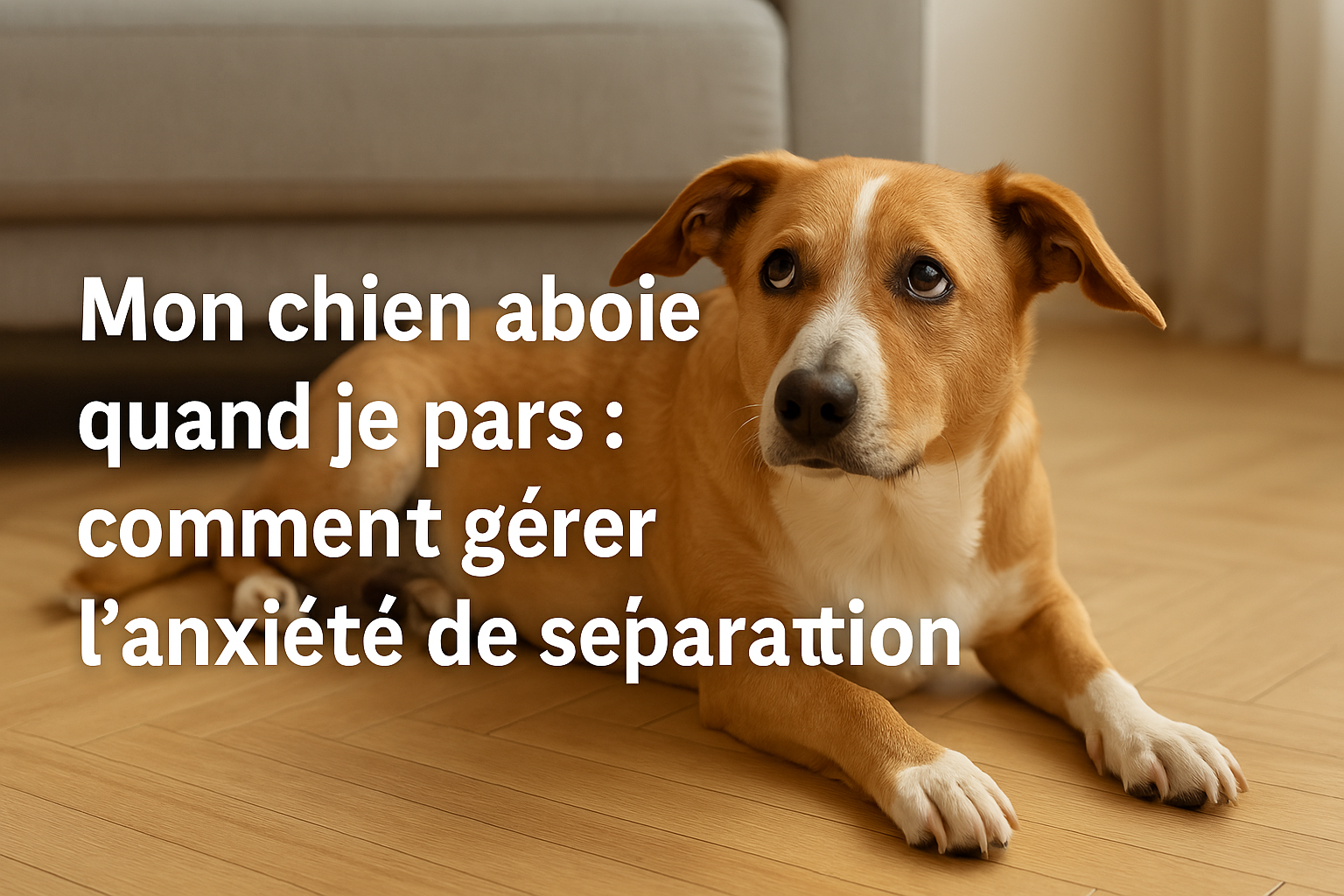

You close the door, and behind it… there’s the concert. Barking, howling, scratching at the door, sometimes even destruction. Separation anxiety is a real distress for our companions. And a true source of stress for us humans. The good news? We can take action. By understanding the signs, the causes, and especially by adopting gentle and gradual methods. Follow the guide to experience calmer departures (and returns).
🔍 Symptoms of separation anxiety
Separation anxiety manifests in several ways. Some dogs bark or howl as soon as you close the door. Others destroy, scratch, urinate… or remain withdrawn until your return. It’s not “to get revenge”: it’s a real distress. We often observe:
- Prolonged barking, sometimes for hours
- Targeted destruction (door frames, cushions, toys, etc.)
- Trembling, panting, whining
- Refusal to eat in your absence
- Hyper-attachment in your presence (following you everywhere)
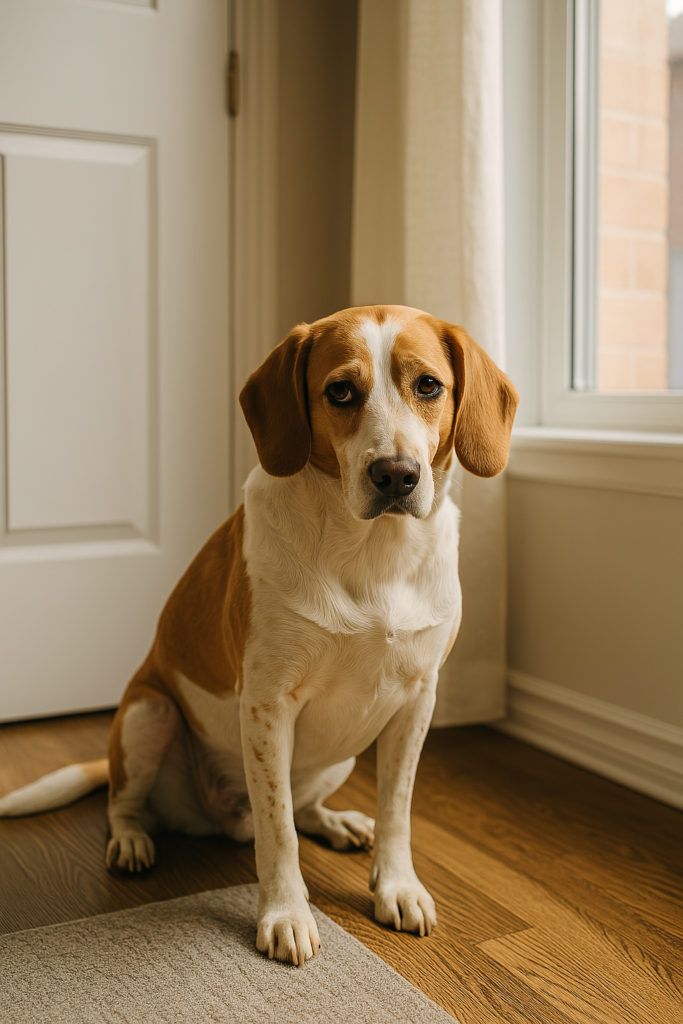
The dog is not “spoiled”: it is in panic. Understanding this is the first step towards a solution.
📚 Why does my dog react like this?

Several factors can explain separation anxiety:
- Puppies or young dogs who have never learned solitude
- Adopted dogs who have experienced abandonment
- Recent changes (moving, divorce, new routine)
- Hyper-attachment (the dog lives through your presence)
- Lack of mental or physical activities
Most often, it’s not “a single cause,” but a mix. And good news: whatever the dog’s past, it is always possible to improve the situation.
✅ Concrete solutions and effective methods
- Work on false departures : put on your shoes, take your keys, then… stay. Repeat, again and again, until you defuse the association “signs = abandonment.”
- Very short departures : go out for 1 minute, return calmly. Then 2 minutes, then 5. Without ceremony or excitement.
- Create a safe zone : mat, basket, toys… a place where he feels good.
- Reassuring objects : old t-shirt, blanket with your scent.
- Use occupation rituals : licking mats, frozen kong, scent games… he must associate your absences with something pleasant.
There is no magic wand. But a consistent, repeated, and positive routine yields excellent results. Some dogs improve in 2 weeks, others in 2 months. The important thing is consistency.
🧰 Useful tools and practical tips
| Tool | Usefulness | To know |
|---|---|---|
| Connected camera | Observe its real behavior in your absence | Allows adapting the method |
| Licking mat | Occupies, soothes, mentally tires | To be given only during your absences |
| Frozen filled Kong | Stimulates + lasts long | Use only with your departures |
| Soothing playlist (calm dog) | Certain sounds calm anxious dogs | Test what works with yours |
| Pheromone diffusers (Adaptil) | Mimic the mother’s scent → reassuring effect | Works well alongside behavioral work |
❓ FAQ
Is my dog unhappy with me?
No. It is simply too emotionally dependent. This is not a failure, it is a starting point to strengthen its autonomy.
What if nothing works?
Call on a behavioral trainer. An outside eye can make all the difference. Sometimes, a few sessions are enough to unlock a situation.
🗣️ Testimonial
“My female dog destroyed the curtains as soon as I left. I started by filming her reactions, then I set up a routine with Kongs and gradual departures. Today, she falls asleep as soon as the door is closed. It changes everything.” — Julien, 29 years old
🔚 Conclusion
A dog that barks when you leave is not trying to punish you. It is telling you, in its own way, that it needs help. And this help, you can offer it with simple gestures, time, and a lot of patience. In return? Stress-free departures. Calm reunions. And a strengthened bond. 🐾
🔍 Separation anxiety or simple boredom?
It is sometimes difficult to distinguish real separation anxiety from a dog’s behavior… when it is bored. A dog that destroys, scratches, or barks may do so because it is in emotional distress, but also because it simply has too much unspent energy. The key? Observe the context. If the dog is regularly stimulated (walks, mental games, social interactions), and still shows signs of panic as soon as you leave, anxiety is likely. Conversely, if your dog shows signs of frustration when left alone after periods of inactivity or boredom, it is more likely suffering from a lack of stimulation. The important thing is to assess the dog’s needs, reinforce physical and mental activities, and adopt appropriate solutions (toys, soothing routines).
🤝 The role of the return: how to properly greet your dog
We often talk about the departure, but the return is just as strategic. Many dogs associate your arrival with a moment of intense excitement — and sometimes, relief. To avoid reinforcing this tension, it is important to manage reunions neutrally. Ignore the dog for a few minutes, let it calm down. Then, greet it calmly, gently. You thus show that your return is not a dramatic event, but a normal continuation of the day. This helps the dog understand that departures and returns are part of the routine, without being a source of anxiety or excessive excitement. It is a way to provide it with more emotional security.
This small detail changes everything. It teaches your dog that your comings and goings are part of the routine. And that reassures it.
⏳ How long can a dog stay alone without stress?
There is no universal answer. A 3-month-old puppy should not be left alone for more than 1 to 2 hours. A well-balanced adult dog can be left alone for between 4 and 6 hours. Some dogs, well trained, tolerate 8 hours — but this is not ideal on a daily basis. More than the duration, it is the quality of the solitude that matters: has he been exercised beforehand? Does he have activities during your absence? Has he been gradually accustomed? A well-prepared dog will tolerate 5 hours of solitude much better than another left to himself from the start. The key is to start with short periods and gradually increase the duration, while ensuring that the dog has something to entertain himself, to rest, and does not suffer from boredom. Respecting his need for stimulation, both physical and mental, is crucial to avoid destructive behaviors and anxiety.
🗣️ Testimony (extended version)
“My female dog, adopted at 1 year old, howled as soon as I passed the door. I thought I was going to have to take her back to the shelter… Then I started filming, observing, understanding. I implemented quick departures, frozen kongs, and above all: I stopped feeling guilty. After 3 weeks of routine, she no longer waited for me at the door. Today, she sleeps peacefully during my absences. It is an immense relief — for her as well as for me.” — Julien, 29 years old
🔚 Conclusion (extended version)
Does your dog bark when you leave? It is not inevitable. It is not a tragedy either. It is a message. A call for help. Separation anxiety can be treated, with gentleness, patience, and consistency. By taking the right steps, by establishing calming routines, you transform panic into trust. And you will experience this evolution together. What you are building here is not just a behavior… it is a stronger, calmer, more connected bond. 🐶💛