


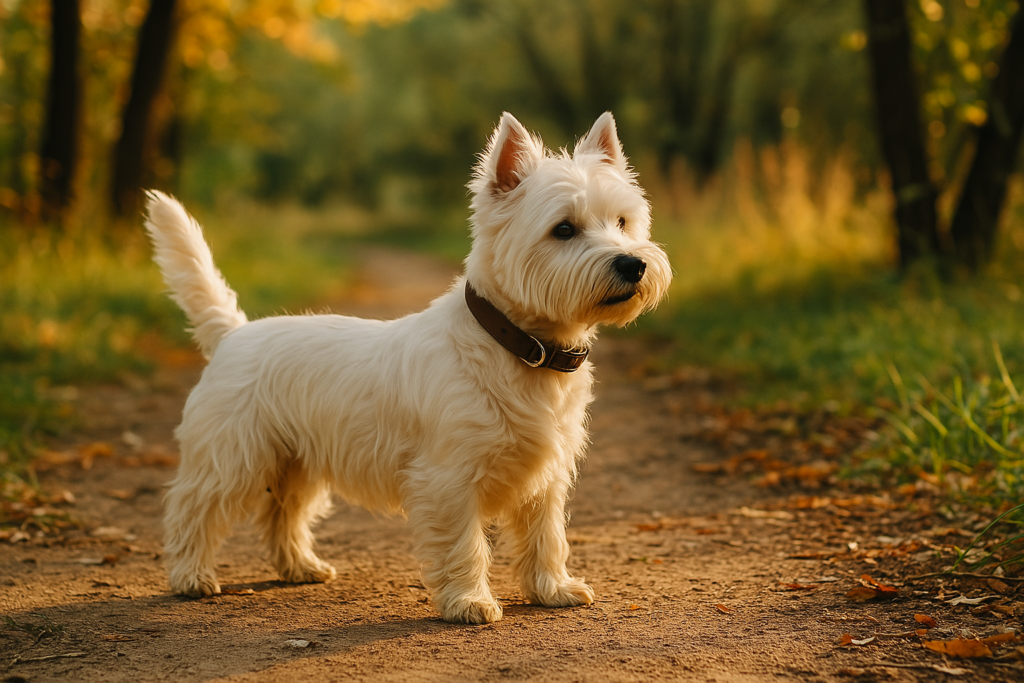
The West Highland White Terrier, more commonly called the “Westie,” is a small Scottish terrier with a pristine white coat. Don’t be fooled by its size: beneath its plush appearance, it hides a lively and courageous temperament, ready to embark on all kinds of adventures. In this article, we explore this charming and determined little terrier!
General Presentation
Originating from the Scottish Highlands, the West Highland White Terrier is a small-sized dog (about 25 to 28 cm at the withers) weighing between 6 and 10 kg. Its coat is always white, which distinguishes it from other Scottish terriers that are often darker. Its fur is double-layered: a soft undercoat and a coarser outer coat, providing protection against the elements.
Originally, it was used for vermin hunting (foxes, rats, etc.) in Scottish lands. Its life expectancy generally ranges between 12 and 15 years, or even longer if its lifestyle and any vulnerabilities are well managed.
Character and Behavior

The Westie, like many terriers, is a lively, brave, and sometimes stubborn dog. It can be very affectionate towards its home but may retain a slight hunting instinct that drives it to chase rodents or other small prey. It loves to explore, sniff around, and participate in family activities.
In social settings, it is often sociable, although it may require good early socialization to avoid conflicts with other dogs. Regarding barking, it is not the quietest, but firm (and kind) training can help moderate its intensity.
Did you know? The Westie’s white coat was reportedly selected by Colonel Malcolm of Poltalloch, who wanted to avoid confusing his dogs with game during hunting trips. Hence the exclusivity of the white coat!
Physical and Mental Needs
Despite its appearance as a small dog, the Westie is a true terrier, with the energy to match:
- Daily walks (2 or 3 times a day), with some active play
- Mental stimulation: mini-agility, scent games, simple commands
- Exploration and sniffing: it enjoys gardens, parks, and places rich in scents
- Social interactions: it’s a little curious dog who likes meeting people and animals
If it doesn’t expend energy, the Westie may bark or nip out of frustration. It’s best to provide a minimum amount of activity to channel its temperament.
Health & Genetic Predispositions
The Westie remains a hardy dog but can be prone to some issues:
| Issue | Symptoms | Prevention |
|---|---|---|
| Dermatitis (e.g., “Westie Armadillo Syndrome”) | Itching, redness, dandruff | Proper diet, veterinary care during flare-ups |
| Patellar luxation | Limping, leg held up | Weight control, avoid excessive jumping |
| Ear infections | Scratching, odor, shaking head | Regular ear cleaning, check for moisture |
His coat and skin can be sensitive, so be vigilant about his diet (choose high-quality kibble) and grooming products (gentle shampoo, etc.).
Recommended Diet
The Westie should eat “small breed” kibble or specific terrier formulas, according to a veterinarian’s recommendations:
- Premium kibble rich in quality proteins
- Suitable for his age (puppy, adult, senior) and activity level
- Avoid table scraps, which can cause overweight or digestive issues
- Divide into 2 meals to limit the risk of overeating
A healthy Westie will generally have a beautiful coat and boundless energy. Watch his weight, as terriers can quickly become “chubby” if given too many treats or not enough exercise.
Coat Care / Grooming
The beautiful white coat of the Westie requires maintenance:
- Brushing 2 to 3 times a week to remove dead hair and prevent tangles
- Possibly stripping or trimming at the groomer to maintain the coat texture
- Bathing every 1 to 2 months, or when particularly dirty (beware of sensitive skin)
- Regular checks of ears and eyes, especially if in a humid or dusty environment
Some owners opt for a shorter cut, which is less demanding but slightly changes the typical “Westie” look.
Favorite Activities
- Exploratory walks: the Westie likes to sniff and dig a little
- Throw-and-fetch games: chasing the ball, tug-of-war with a rope
- Scaled-down agility: he can have fun on an adapted course
- Playful training: learning some tricks, basic commands
Ideal for What Type of Owner?
The Westie is a lively and joyful dog who loves family life and does not need huge spaces, but rather regular activities. He can live in an apartment if you are present to play and take him out, or in a house with a garden if it is well fenced (a terrier remains a terrier!).
He suits active owners who appreciate his playful character and his determined little terrier look. If you are often absent or reluctant to do a bit of grooming, it is better to choose a more independent or less demanding breed.
Recommended Products
To satisfy the Westie and ensure easy maintenance:
- “Small breed” kibble: suited to his activity level and skin sensitivity
- Brush/curry comb: for regular brushing, removing dead hair
- Gentle shampoo for sensitive skin: to avoid irritation and itching
- Durable toys: balls, ropes, as he has the jaw of a little hunter
Note: a harness can sometimes be preferable to a collar, especially if the Westie pulls a bit, to protect his throat.
FAQ & Anecdotes
Is the Westie a big barker?
Like many terriers, it can bark to signal an intruder, a suspicious noise, or simply out of excitement. Proper training and enough physical exercise limit excessive barking.
Does it get along well with cats?
If introduced early, yes. It remains a terrier with a hunting instinct, but if it grows up alongside a cat, cohabitation usually goes well, provided each one’s space is respected.
Marketing anecdote
The Westie has often been featured in advertisements, notably for certain Scottish whisky brands, highlighting its origin and its typically Highland appearance!
In summary, the West Highland White Terrier is a small, energetic, playful, and resourceful dog that brings pep to everyday life. With regular grooming of its white coat, good training (to control its barking and hunting instinct), and enough activities, it proves to be a wonderful life companion, ready to follow you on your outings and enliven your home with its lively presence. Want to adopt a Westie? It’s a choice full of character and Scottish charm!