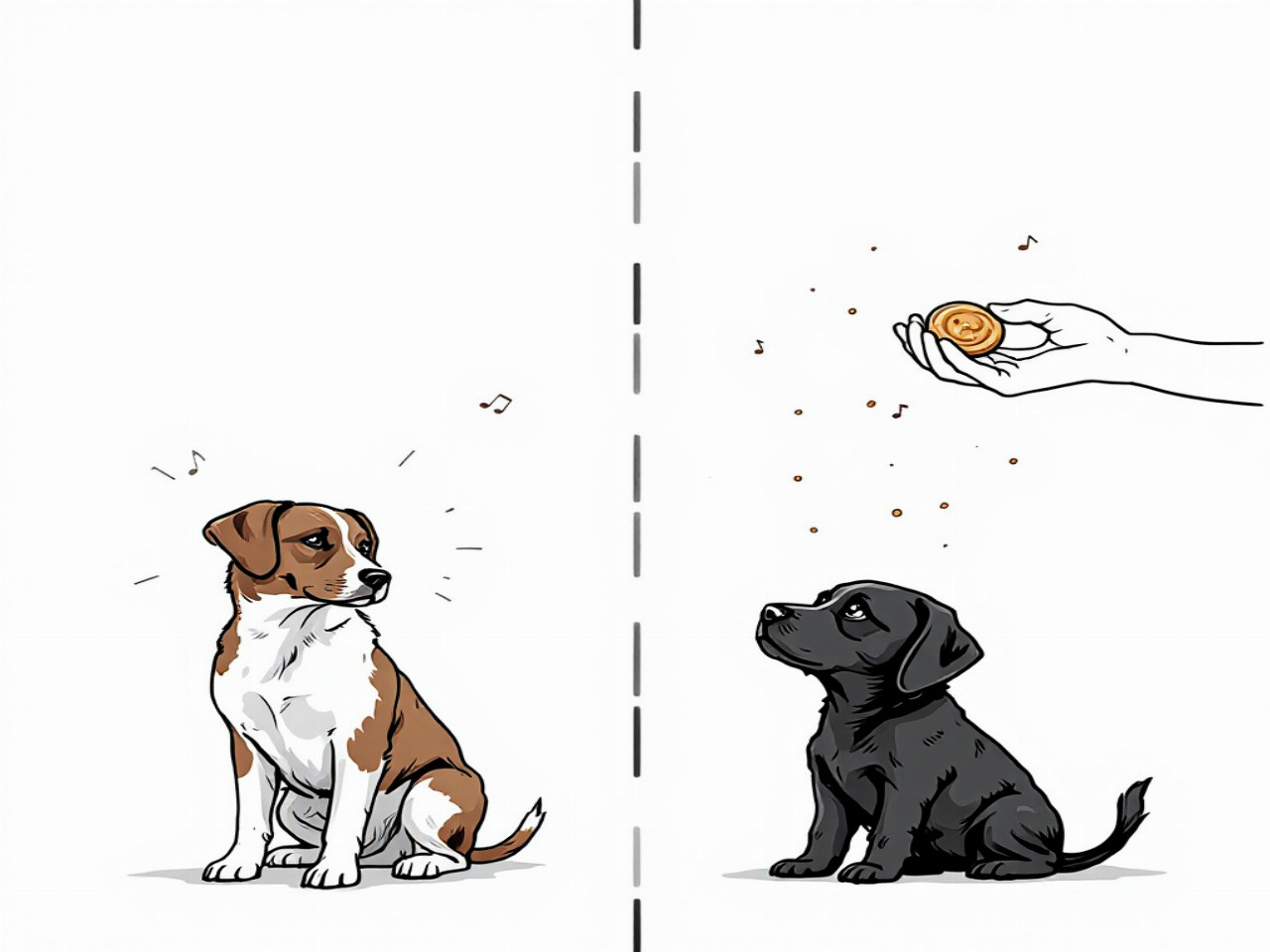

Every dog has its own personality and appetite for treats. For some, a small piece of cheese is worth much more than all the sweet words in the world; for others, the simple sound of the clicker is enough to trigger the desire to obey. This article explores in detail the two main approaches to dog training: clicker training and food rewards. The goal? To help you identify the ideal combination to progress with your four-legged companion.
The mechanisms of canine learning
Before diving into the clicker vs treat duel, it is essential to understand how the dog associates an action with its consequence. Influenced by the work of Pavlov and Skinner, we know that positive reinforcement encourages the repetition of a behavior. Whether the reward is a precise “click” or a small piece of sausage, the idea remains the same: the animal learns by linking a signal to a reward. The challenge is to calibrate this signal so that it becomes a reliable compass in its learning.
Clicker training: how does it work?
A sound bridge to behavior
The clicker is a simple gadget but formidable when handled with tact. Each time the dog performs the desired action, you click, then give the treat. The “click” embodies a sound bridge, or “bridging signal,” which marks the precise moment of the correct action. Speed and consistency of timing are crucial: a click delayed by a few milliseconds can create confusion in the dog’s mind.
Strengths and points of caution
- Surgical precision: you can validate a tiny behavior, then gradually amplify it.
- Neutrality of the signal: the clicker is not emotionally charged like the human voice, which avoids inconsistencies.
- Possibility of shaping: you shape a complex behavior by chaining small steps.
- Risk of dependency: if the clicker remains indefinitely associated with the treat, it becomes difficult to do without it.
First steps with the clicker
Start with classic conditioning of the clicker: click, then offer the treat, 20 to 30 times in a row, until the dog fixes on the sound. Then choose a simple behavior (sit, touch a target…) and click at the right moment. You can experiment now with a very simple exercise, like teaching your dog to give its paw: check out this Tutorial: Teach Your Dog to Give Its Paw in 4 Steps for inspiration.
Food rewards: why do they always work?
The power of greed
Treats embody the ultimate reward: the dog quickly forms an opinion on what is edible, tasty, and motivating. Chicken chips, apple cubes, special kibble… the variety can turn each session into a real treasure hunt. The highly developed sense of smell in our canine friends makes them solid play partners, always ready to negotiate new learning in exchange for a piece of melting cheese.
Strengths and limits
- Accessibility: no gadget needed, a small treat is enough.
- Instant motivation: the dog is focused on the reward, sometimes excessively.
- Risk of satiety: it is necessary to dose to avoid overloading the daily ration.
- Complexity of timing: giving the treat too early or too late can dilute the lesson.
Varying reinforcers
To avoid routine, you can slip in some petting, a rope toy, or a game of fetch between two treats. This diversification prevents the dog from “materializing” learning exclusively in food. Mixing tactile, sound, and visual stimuli strengthens the connection and can even serve as a transition to a 100% abstract clicker, without treats.
Comparison Table of Methods
| Criterion | Clicker Training | Food Rewards |
|---|---|---|
| Precision | Excellent (click at the millisecond) | Good, depends on manual timing |
| Equipment | A clicker and some treats | Only treats |
| Dog’s Engagement | Variable, depending on the conditioning period | Very high, especially if the treat is appetizing |
| Risks | Dependence on the signal, frustration | Satiation, too tactile dependence |
| Versatility | Ideal for complex behaviors | Perfect for starting or reinforcing a simple gesture |
When to Combine the Two Approaches?
The idea is to play on the strengths of each tool: start with the treat to get engagement, then introduce the clicker to refine the gesture. As the dog understands, you can space out the treats and rely on the click as a pre-signal for the reward. This mix allows gradually substituting food with the simple sound of the clicker, until reaching a balance where the animal works as much for pride as for the snack.
Practical Tips for Progress
- Set short sessions (2–5 minutes) to maintain motivation.
- Alternate familiar environments and new places to generalize the behavior.
- Keep a variety of treats: highly appetizing for complex exercises, less rich for recall.
- Note your progress in a notebook: date, exercise, success, points to work on.
- Be patient: every dog has its own pace and preferences.
FAQ
- Is the clicker enough without treats?
- It is possible, especially if the dog has acquired the value of the click. At first, the association Click→Treat is reinforced; after 20–30 repetitions, the sound of the click becomes a reward in itself. To ensure transfer, you can occasionally slip a treat in every 3rd click.
- What type of treat should be preferred?
- Choose bites that are easy to chew and digest, such as liver cubes or dedicated kibble. The goal is not to interrupt the session so the dog maintains its mental energy.
- My dog gets upset if he doesn’t get the treat!
- You need to defuse frustration by alternating play moments and calm periods. Sometimes, simple physical contact or a gentle word is enough to reassure the animal between two treat sessions.
- Can the clicker be replaced by a keyword?
- Some trainers use a specified “good dog.” However, the human voice is more subject to intonation variations, which can confuse the dog. The clicker remains a neutral signal, easy to standardize.
- How to know if my dog prefers one method over the other?
- Observe their level of engagement and speed of execution. If they seem stressed with the clicker or saturated with treats, adjust your strategy. The important thing: test and keep a close eye on their body language.