


Getting a puppy to come back when called, even when focused on a scent, a toy, or simply the wind in the trees, can be challenging. The “invisible thread” method uses a thin and strong long line to gently guide the dog, without excessive pulling. We will explore together why this protocol, far from being magical, nevertheless offers a reassuring framework to build a reliable recall in a curious young companion.
🧶 Invisible thread method: a suitable long line is discreetly installed, allowing the dog freedom of movement while subtly intervening if the recall falters.
📍 Progressive steps: from empty recall in a confined space to exercise in a more distracting environment, each phase allows the puppy to understand the command without frustration.
💡 Confidence gain: by avoiding harsh pulling, the dog’s well-being is preserved and a positive listening relationship is established.
🔤 Simple adjustments: length of the long line, voice intensity, motivating reward – each parameter is adjusted to fit the specific temperament of your young dog.
Understanding the invisible thread method
Origins and basic principles
At the heart of the invisible thread is the idea of combining safety and autonomy. Rather than a choke collar, a nylon or cotton long line of about ten meters is chosen, light enough not to bother the puppy. The trainer, often standing, keeps the thread discreet, laid on the ground or wrapped around the hand. As soon as the dog moves too far away, a slight contact recalls its attention without startling it.
Why this approach?
One might think that simple training without attachment is enough, but the reality is quite different: a young dog, distracted by an unpredictable action, risks slacking off. With the invisible thread, the owner retains some leeway and intervenes before the puppy gets used to refusing the recall. It is a physical and psychological safety net.
Advantages and limits
- Increased safety: the puppy does not stray out of reach, preventing unexpected escapes.
- Positive reinforcement: the presence of the thread is associated with a reward rather than a constraint.
- Progressive transition: once the recall is acquired, the long line is shortened until the equipment is completely dispensed with.
- Limit: this method requires vigilance and open space to lay the long line without tangling.
Equipment and preparation
Choosing the right long line
Prefer a long line of 8 to 12 m, made of braided nylon or cord, neither too thin (to avoid causing pain) nor too thick (to remain discreet). Opt for a sturdy carabiner and an easy-to-handle attachment system. Test several lengths if possible: a flat terrain versus a forest clearing do not require the same range.
Training location: from intimacy to distraction
Start in a fenced garden or a quiet space without foot traffic. Then progress to a quiet park before offering a livelier environment (other dogs, joggers). The idea is to gradually increase external stimuli so that obedience becomes automatic, even in the presence of an attractive trash can or a passing cat.
Dog’s State of Mind
An enthusiastic young dog is an asset, but beware of fatigue or excessive excitement. Favor a short session (5 to 10 minutes), several times a day. If your puppy yawns, lies down, or whines, it is a sign that a break is needed. It is better to end on a success and a treat than to push to the point of saturation.
Detailed Learning Steps
1. Recall without leash indoors
Without a long line, in a room without distractions, initiate the command word (for example “Come”). Reward the dog as soon as it places two paws on you. Repeat until it comes spontaneously three times in a row.
2. Introducing the long line
Attach the long line to the collar, let the dog explore with the long line dragging on the ground. Do not call for recall immediately: the goal is to get the animal used to the presence of the rope.
3. Recall in semi-freedom
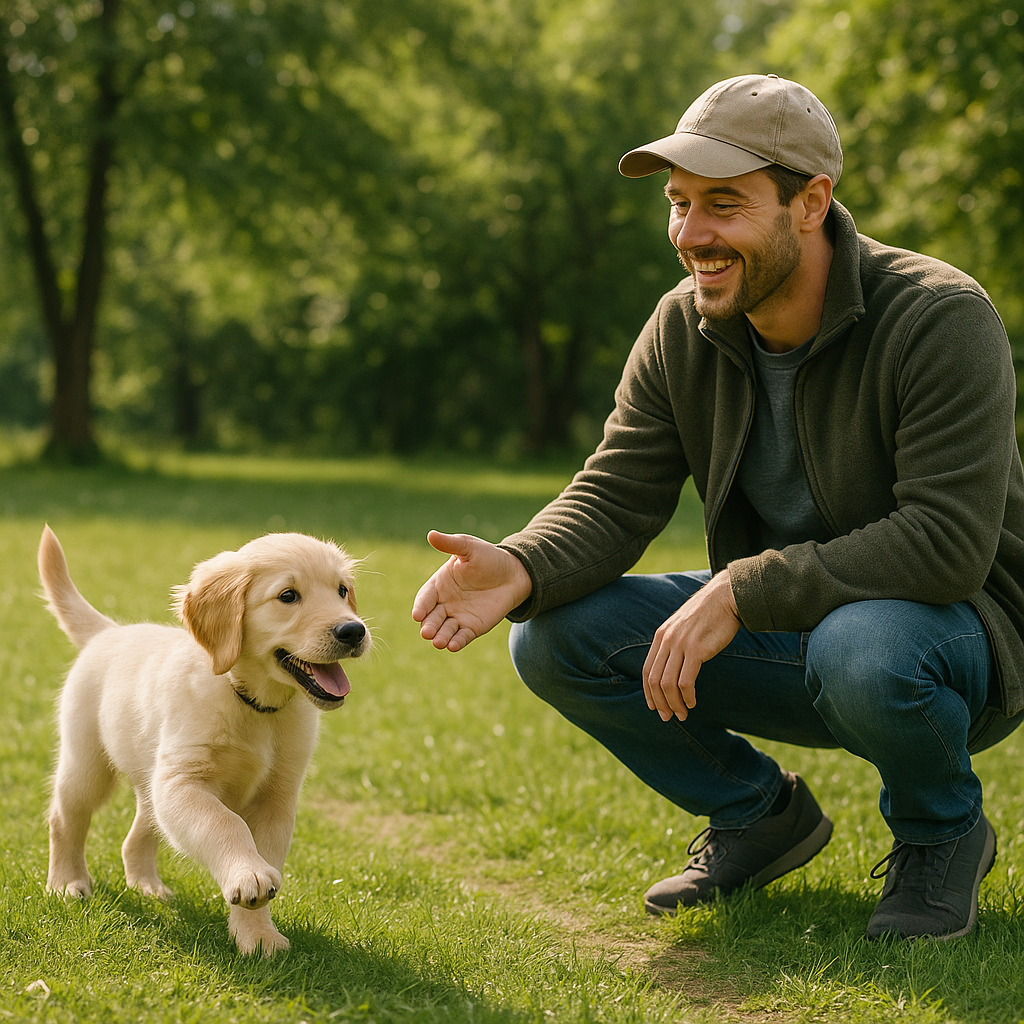
Move forward a few meters, gently slip the long line behind you. Give the command “Come”, apply a small guiding gesture (slight pull), and rejoice as soon as it arrives. Vary the tone, posture, and reward (treat, petting, little game).
4. Increasing the range
Gradually increase the free length. When the dog starts to ignore the call, gently block the long line to remind it of the command, then release as soon as it returns. Pull only with a finger of tension, the essential being the pause time which strengthens listening.
5. Variations of situations
Test different contexts: paved ground, grass, slight slope. Introduce distractions: a toy placed, another person nearby. With each new element, repeat the exercise keeping the same sequence “call – slight tension – return – reward”. It is repetition in diversity that builds reliability.
6. Transition to free recall
You have shortened the long line to a few meters? It is time to move to recall without the line. Repeat indoors, then outdoors. If the dog hesitates, put the line back on for a session or two, to remind the positive habit. When it comes without hesitation, praise it warmly and conclude the method.
Practical Tips and Adjustments
- Vary the rewards: a quality treat, a toy, or a wild run, depending on the puppy’s character.
- Maintain a joyful tone: recall must remain a positive experience, not a disguised punishment.
- Observe canine body language: ears back, tail high or low, yawns indicate you need to adjust the intensity or duration.
- Do not multiply commands: use a single word for recall, synchronized with a constant body gesture.
4-Week Progression Table
| Week | Environment | Distance | Goal |
|---|---|---|---|
| 1 | Calm indoors | 0–3 m | Understanding the word “Come” |
| 2 | Enclosed garden | 3–6 m | Getting used to the long line |
| 3 | Quiet park | 6–10 m | Managing small distractions |
| 4 | Open spaces | 10–12 m | Reliable recall without solicitation |
Common Mistakes and Solutions
« My puppy gets used to coming only when he sees a treat! »
Solution: alternate between visible rewards and hidden rewards. Sometimes, a toy or a sincere petting is enough to stimulate motivation. If the only reassuring variable becomes food, refusal is likely in its absence.
« I pull too hard when he drags… »
Solution: focus on the stop signal rather than the pulling. A slight blocking of the leash, combined with the command, works better than continuous pulling which can create anxiety.
FAQ
Which leash to choose for a small breed puppy?
For a light dog, a 6 m cotton leash, with a diameter of 4 to 6 mm, is ideal. It respects the joints and does not impose excessive weight.
Can a harness be used instead of a collar?
Yes, a front harness distributes tension without stressing the neck. Prefer an ergonomic model, closed on the chest, to avoid slipping.
How many sessions per week?
Two to three short daily sessions (5–10 min) guarantee rapid progress without exhausting the puppy. The secret lies more in frequency than duration.
My dog bites the leash, is it a problem?
It is often exploratory behavior. Offer him a chew toy before each session and remove the leash as soon as he shows too much interest in it to avoid premature wear.