

/* Css En-Bref */
.en-bref {
max-width: 640px;
margin: 2em auto;
padding: 1.5em 1.8em;
background: #f7f9f9;
border: 1px solid #10b58b;
border-left: 6px solid #10b58b;
border-radius: 12px;
box-shadow: 0 8px 24px rgba(251, 191, 36, 0.15);
font-family: ‘Inter’, ‘Segoe UI’, sans-serif;
color: #3a2d0d;
text-align: left;
}
.en-bref .enbref-header {
font-size: 1.15em;
font-weight: 700;
color: #d97706;
margin-bottom: 0.6em;
display: flex;
align-items: center;
gap: 0.5em;
}
.en-bref p {
font-size: 1em;
line-height: 1.65;
margin: 10px;
}
.en-bref strong {
color: #1c1917;
}
Offering a moment of relaxation to your four-legged companion is possible with a homemade licking mat. Made from food-grade silicone, it invites the dog to explore textures and flavors while helping to channel its energy. Here, you will find a detailed guide to make this soothing toy, from selecting raw materials to final customization.
In brief
😀 Accessible materials: A few packets of food-grade silicone powder, a suitable mold, and water are enough to create a durable and safe mat for your dog’s health.
🚀 Simple process: In less than 1 active hour, you mix, pour, and unmold your mat before the first use.
🌟 Mental stimulation: The varied relief develops the search instinct and slows down food intake, ideal for greedy or anxious dogs.
Why a licking mat for dogs?
The licking mat is based on a playful and sensory principle: the dog uses its tongue to retrieve treats slipped into the mat’s recesses. Unlike classic toys, it combines intellectual challenge and physical relaxation. In anxious or hyperactive dogs, the repeated action of licking secretes endorphins, inducing a calming effect comparable to a massage.
Behavioral benefits
- Reduction of stress and boredom
- Slowing down of food intake
- Strengthening of concentration and patience
Necessary materials
Before starting, gather all the essential elements. The quality of the silicone and the accuracy of the measurements will determine the final strength and safety of the mat.
| Item | Quantity / Type | Tip |
|---|---|---|
| Food-grade silicone powder | 500 g | Choose a food-grade (FDA or equivalent) |
| Catalyst agent (peroxide, amino) | according to instructions | Respect the exact proportion to avoid incomplete curing |
| Silicone mold | 30×30 cm | Prefer flat molds with low edges |
| Precision scale | 1 g | Allows reliable dosing |
| Customizations (colorant, particles) | optional | Phthalate-free and heavy metal-free |
Choosing the right food-grade silicone
The market offers different types of silicone: platinum or peroxide. Platinum silicone, a bit more expensive, offers better elasticity and less catalyst residue. On the other hand, peroxide silicone can be suitable for single use and is cheaper. Whatever your choice, always check compliance with food standards to avoid any risk of poisoning.
Quick comparison
Platinum silicone: better durability, odorless.
Peroxide silicone: economical, easy to mix.
Manufacturing steps
1. Preparation of the workspace
Set up a clean area, covered with parchment paper or an old mat. Wear disposable gloves to avoid skin fatigue from catalyst residues. Make sure the mold placed on a flat surface does not move during pouring.
2. Measuring and mixing
- Weigh 500 g of silicone powder on the scale.
- Add the catalyst according to the manufacturer’s recommendations (generally 1 to 2% of the silicone weight).
- Mix vigorously for 2 to 3 minutes, scraping the edges of the bowl to fully homogenize the preparation.
3. Pouring into the mold
Pour the mixture slowly to limit air bubbles. Gently tap the bottom of the mold or softly drop it from a low height onto the work surface to bring air pockets to the surface.
4. Demolding and drying
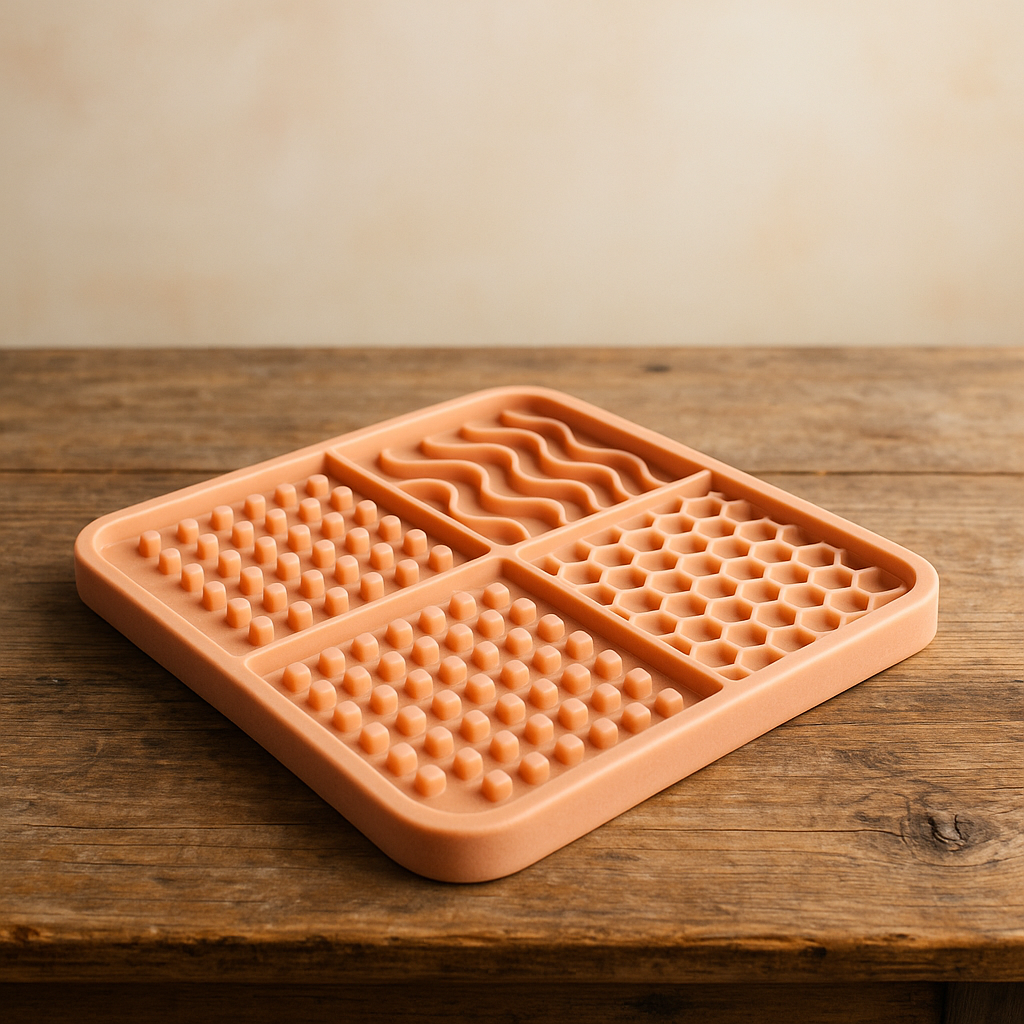
Let the silicone set at room temperature for at least 30 minutes. Depending on the catalyst, it may take up to 2 hours. Once firm to the touch and non-sticky, gently turn the mold over and unmold the mat. Trim irregular edges with a cutter if necessary.
Tips to personalize your mat
To add a unique touch, you can incorporate safe glitter or natural dyes (turmeric, spirulina). If you have a circle or a pattern, place it in the mold before pouring for a recessed or raised effect.
- Vary the shapes: stars, hearts, or silhouettes.
- Layer two different colored layers.
- Create alveoli of various sizes to diversify the challenge.
Care and safety
After each use, clean the mat with warm soapy water. Food-grade silicone is dishwasher safe, but prefer a short and gentle cycle to extend its lifespan. Regularly inspect the mat’s condition: cracks or overly worn areas can trap bacteria.
Alternatives and complementary accessories
If you want to vary the pleasures, discover licking brushes (brushed silicone) that simultaneously stimulate gum massage. For outdoor use, some suction cup mats attach to the terrace or glass door, offering a new playground.
FAQ
Can the licking mat stay outside for several hours?
Yes, provided it is in the shade and full of water or a damp bottle to avoid rapid drying. In direct sunlight, UV treatment can accelerate the degradation of the silicone.
What is the average lifespan?
A mat used daily can retain its properties for 6 to 12 months. It all depends on the intensity of chewing and repeated cleanings.
My dog licks too hard, will he tear the silicone?
Food-grade silicone is resistant but not indestructible. For a chewing dog, choose a thick model (5 mm or more) and monitor the mat’s condition to replace it as soon as small cracks appear.