
| Key Points | Details to Remember |
|---|---|
| 🐾 Origin | The Komondor is a Hungarian shepherd dog that appeared in the 14th century |
| 🐕 Morphology | Powerful body, medium size and impressive appearance |
| 🛡️ Function | Protection of herds against predators |
| 🧬 Coat | Natural dreadlocks that insulate and camouflage |
| ⚖️ Character | Independent, vigilant and loyal |
| 🏡 Care | Regular brushing and adapted care |

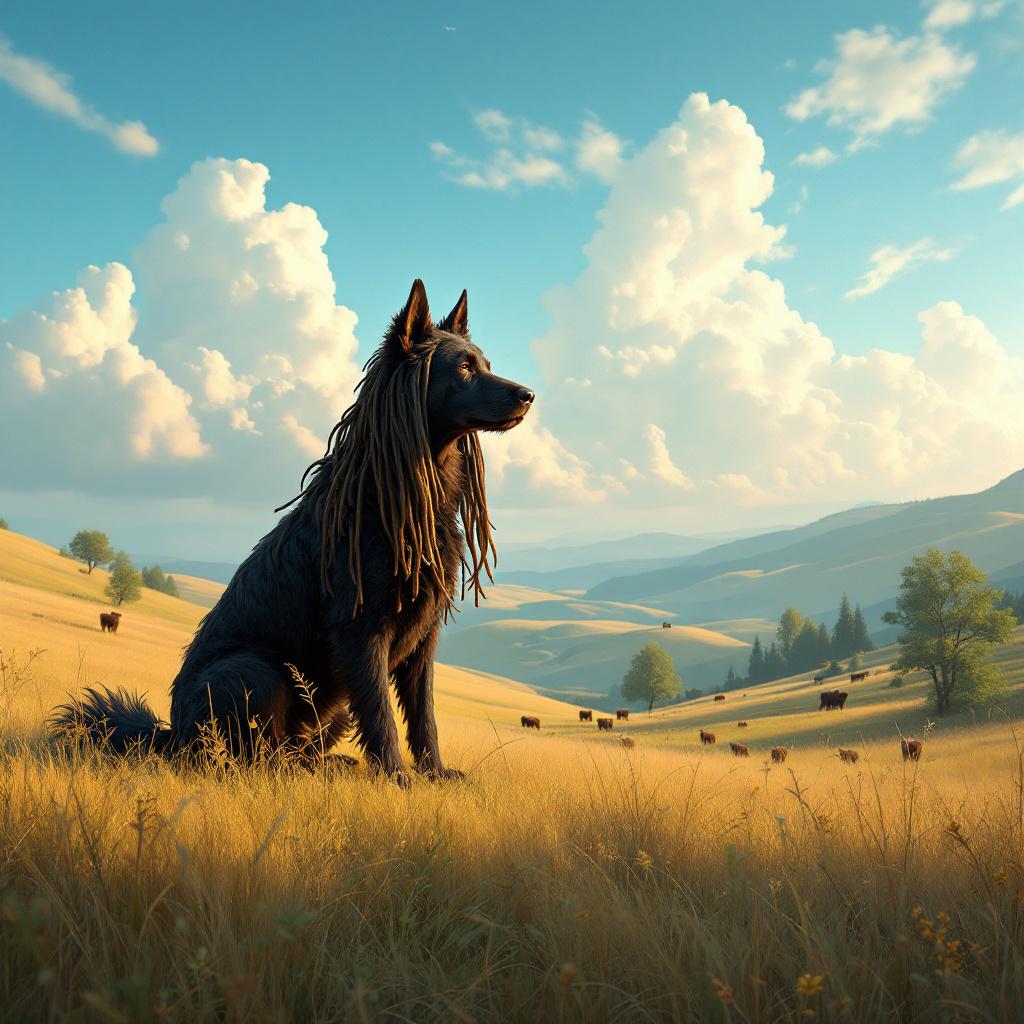
The striking image of a dog entirely covered with long dreadlock-like strands may surprise at first glance, yet this is indeed the natural coat of the Komondor. Born to guard and protect herds in the Hungarian plains, this shepherd dog stands out primarily by its tightly corded coat which acts as thermal and defensive armor. Let’s explore together how this unique fleece forms, what benefits it brings to the sheep, and what is needed to care for it in a modern context.
Origins and History
The lineage of the Komondor dates back to the heart of medieval Hungary, when Magyar shepherds imported their large dogs into Central Europe. These dogs had to live outdoors, exposed to the elements, while keeping wolves and foxes at bay. The harsh climate, thorny vegetation, and the need to deter predators forged a robust dog with dense fur. It was between the 14th and 15th centuries that the Komondor began to standardize its characteristic cords, likely inherited from crosses with other cattle dogs from Western Asia.
Over the centuries, this shepherd’s companion contributed to the prosperity of Magyar sheep farms. The natural insulation of its coat allowed it to stay afloat in snow and endure hours spent close to the sheep, even in rain. In Eastern Europe, the reputation of this herding dog spread to France and England in the 20th century, arousing curiosity and admiration among dog enthusiasts.
Morphology and Coat

A powerful silhouette
The Komondor displays an impressive stature: 65 to 80 cm at the withers with a weight ranging between 35 and 60 kg. Its solid musculature is visible beneath the coat, providing essential stability to contain the movements of a herd. The voluminous head, broad skull, and slight stop reinforce its balanced appearance. Despite its massive look, the Komondor performs its tasks with agility, capable of maneuvering among sheep without tiring.
The protective dreadlocks
At shedding time, the Komondor’s hair naturally twists to form cords: this is the “dreadlock” effect that defines it. These cords consist of a mix of dense undercoat and guard hairs, which intertwine through the dog’s repeated movements. Besides insulating against cold, they cushion bites or claw strikes from predators, acting as an organic armor. When a wolf approaches too closely, the dreadlocks disperse the impact, and the shepherd, alerted, can intervene before the Komondor suffers serious injuries.
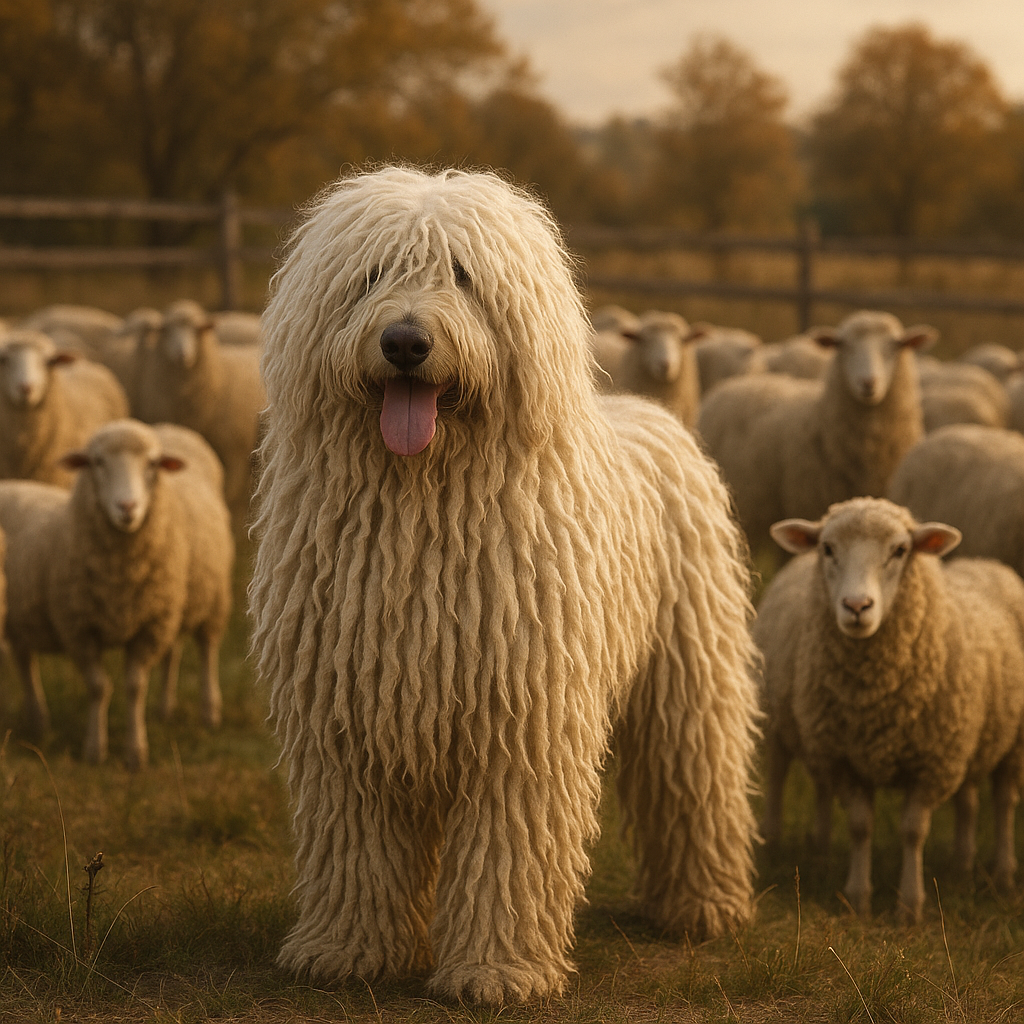
There is also a surprising camouflage effect. In the white woolly flocks of sheep, the Komondor almost completely blends in, surprising the observer and discreetly deterring any intruder. This involuntary disguise is not a trick: it is the direct consequence of the evolution of its coat to fulfill several roles simultaneously.
Temperament and Role in Breeding
Independent and thoughtful, the Komondor is not a showy affectionate dog. It favors silent surveillance, circling the herd without a sound. When a threat becomes clear, it barks continuously to warn its master.
- Silent defender: its discreet approach makes it an ideal watch dog.
- Pack reflex: despite its independence, it coordinates with other dogs to encircle and isolate a potential prey.
- Close bond: it bonds more with animals than with humans, except for a few authority figures it respects.
In an extensive breeding context, the Komondor can remain several days without close supervision. Its instinct drives it to stay outside, and its natural endurance allows it to cover several kilometers each day to check that everyone is there.
Care and Modern Breeding
The myth says this dog is impossible to groom, but this is a misunderstanding: it simply requires different maintenance than short-haired breeds. The cords are not washed too frequently, in order to preserve the natural greasy barrier, but an annual or biennial bath, followed by thorough drying, is generally sufficient.
| Action | Frequency |
|---|---|
| Hand separation of cords | Once a week |
| Full bath with mild shampoo | 1 to 2 times per year |
| Inspection of paw pads and nails | Once a month |
| Auditory and dental check | Every six months |
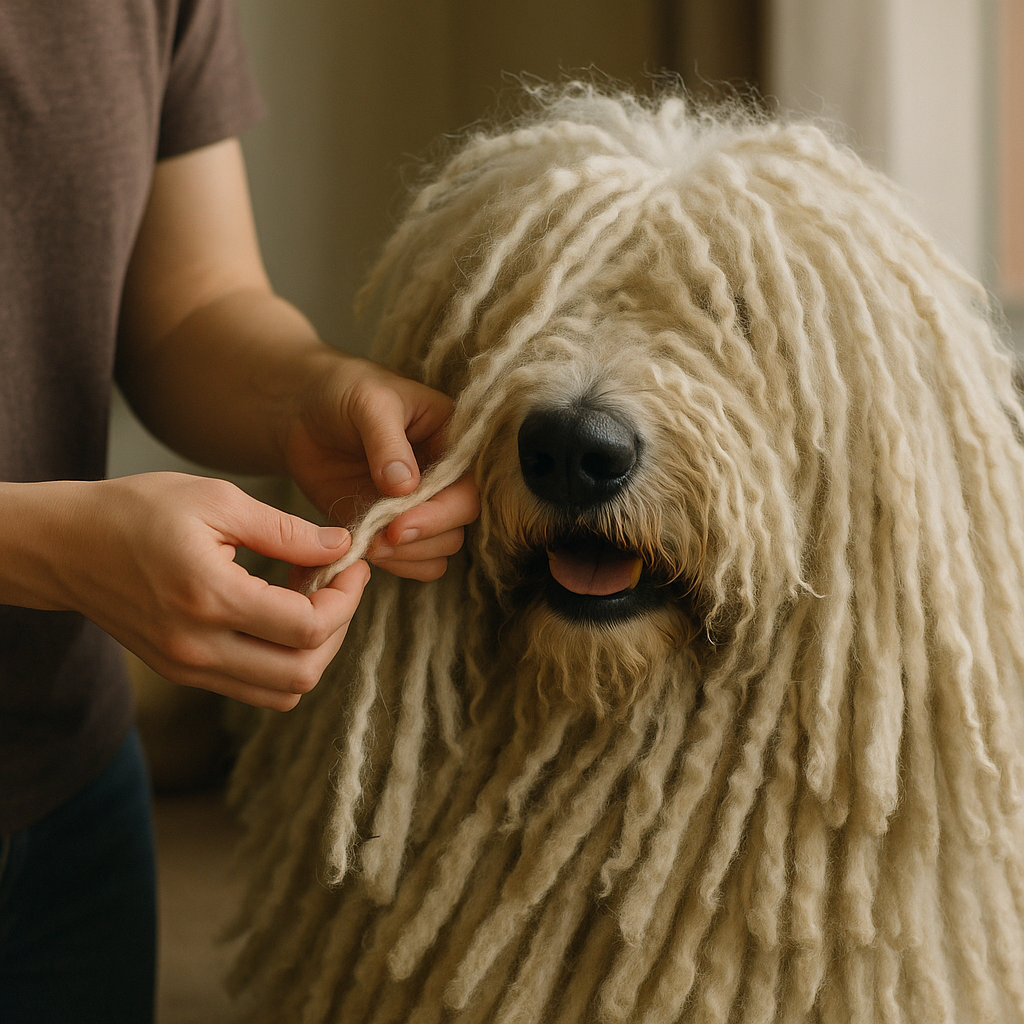
Caring for a Komondor means adopting a slower pace of life: you must accept to dedicate time to detangle each cord, palpation after palpation. But this activity quickly becomes a meditative ritual, almost a moment of silent complicity where you learn to know the texture and relief of the coat. And if you consider participating in dog shows, more frequent maintenance is necessary so that the cords keep their natural coiffure and do not become compacted.
FAQ
Does the Komondor tolerate apartment living?
Unless you have a substantial outdoor space for it to patrol, an apartment is not suitable for this dog designed to roam wide expanses. It quickly develops anxiety if confined.
How long does it take for the cords to form?
It takes between 12 and 18 months for the young Komondor to form its first solid cords. The first two years are therefore crucial to encourage the natural separation of the strands.
Does this coat attract more parasites?
In reality, the density of the dreadlocks limits direct access of fleas and ticks to the skin. Regular visual checks are enough to detect and remove any possible intruder.
Is the Komondor easy to train?
Its independence can complicate basic obedience, but with a firm and consistent method, reinforced by rewards, it can acquire the essential commands for the safety of the herd.