

| Key Points | Details to Remember |
|---|---|
| 🐾 Definition of the Miniature Pinscher | Lively and compact dog of German origin. |
| 📜 History | Selective breeding in the 18th century to hunt rodents. |
| ⚖️ Size and weight | 30 to 35 cm at the withers, 4 to 6 kg. |
| 🧠 Temperament | Affectionate, protective and very energetic. |
| 🛁 Care | Minimal grooming, regular exercise needed. |
| ❤️ Health | Life expectancy of 12 to 16 years, joint precautions. |

Are you looking for a companion who is both elegant and full of energy? The Miniature Pinscher, often nicknamed “the miniature king,” leaves no one indifferent. Behind its appearance as a small princely dog lies a bubbling temperament, both affectionate and determined. It’s impossible to get bored by its side, as it exudes overflowing energy and a strong presence. In this guide, I will take you to explore its origins, physical characteristics, health, training, and all the advice for living harmoniously with this unique little dog.
Origins and History of the Miniature Pinscher
One might think that the Miniature Pinscher is simply a smaller version of the Doberman, but this is not the case. Its history dates back to the 18th century in Germany, where farmers were looking for a farm dog capable of eradicating mice and rats. Through crosses between dogs like the Terreur de Crêtz, Dachshund, and various local pinschers, this tireless little hunter was born. Rather than serving as a shadow to the Doberman, it carved out its own identity. Its arrival in the United States in the early 1900s contributed to its international fame, solidifying its status as the “aristocratic puppy” with a quick step.
Physical Characteristics

Size, Weight, and Silhouette
The Standard defines the Miniature Pinscher between 30 and 35 cm at the withers for 4 to 6 kg, with a fine bone structure and lean musculature. You will immediately notice its proud head carriage, its V-shaped ears often cropped or natural, and its tail sometimes docked in a stand-up style. Every movement is marked by an almost mechanical precision: it moves with smooth strides, like a little hunting horse.
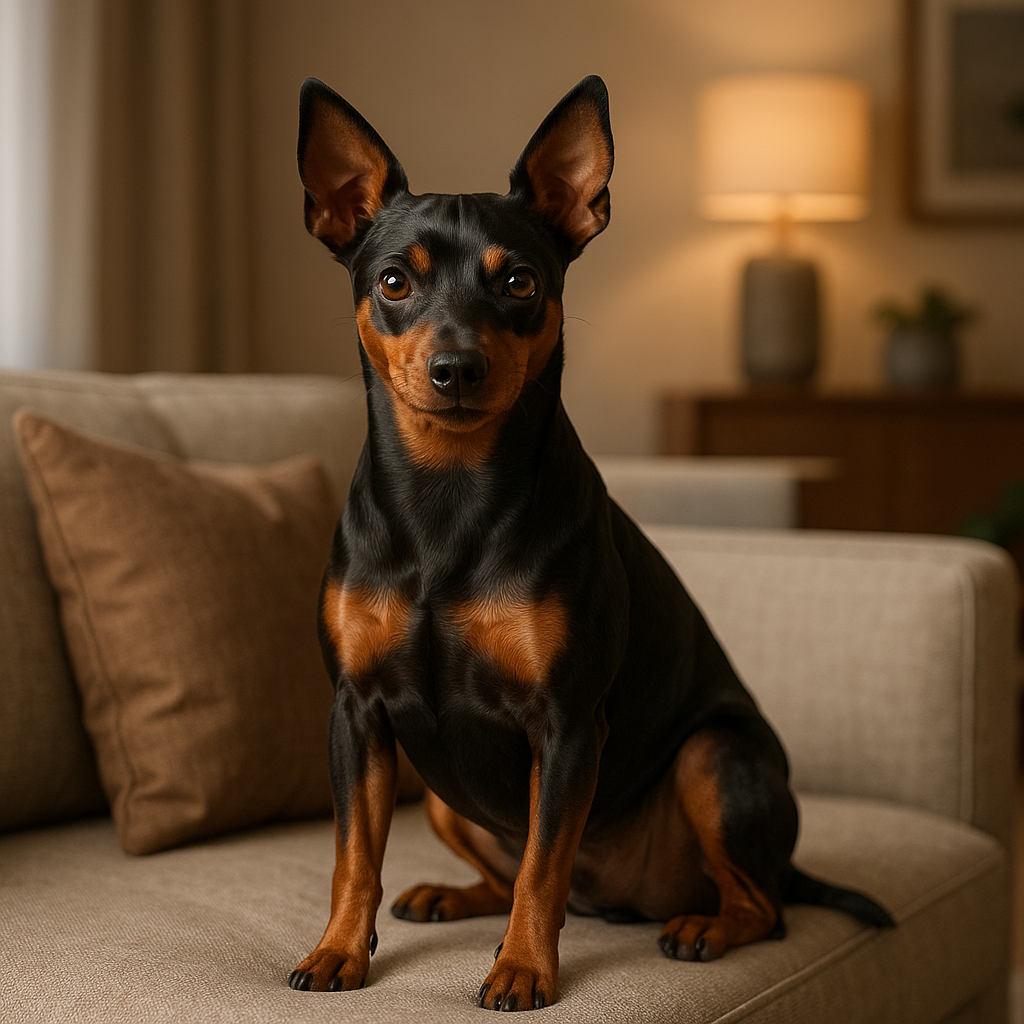
The Miniature Pinscher doesn’t just walk: it “dances” on its paws, always ready to leap.
Coat and Grooming
Its smooth and shiny coat comes in several colors: black and tan, chocolate, blue and tan, or even mahogany red. Ideal for those who fear hair sticking everywhere, this dog only requires weekly brushing to remove dead hair and maintain its shine. However, during shedding periods, a rubber glove can prove your best ally to limit tufts scattered around the house.
Temperament and Behavior
Rarely do you encounter such a strong personality in such a light frame. The Miniature Pinscher alternates between fearless courage and a need for tenderness. As soon as it spots you, it demands your caresses and rests its head on your lap for a cuddle. However, beware of intruders: it will immediately alert you to any unknown presence with sharp and determined barking.
Socialization and Family Life
Within the family, it bonds quickly with adults and responsible children. Its hunter temperament may drive it to chase small animals, so it is important to socialize it well from a young age to avoid any scares. Outdoor games, canine meetings, and mental stimulation are essential to channel its energy and prevent destructive boredom.
Activity and Exercise Needs
Don’t be mistaken: despite its size, this dog is not made for a sedentary life. It requires at least half an hour of brisk walking, combined with intense play sessions every day. Running, home agility courses, ball games, or intelligence games suit it perfectly. Without this, it may develop hyperactive behaviors and excessive barking.

Training and Socialization
Training the Miniature Pinscher requires as much rigor as kindness.
His sharp intelligence quickly grasps the first commands, but his independent character may lead him to “test” your authority. Start with short and frequent sessions focused on positive reinforcement: treats, praise, and reward games will work wonders. Consistency is your best asset: every family member must apply the same rules to avoid confusion.
- Establish clear routines for feeding and walks
- Gradually introduce noises and new people
- Encourage calm and controlled behaviors
- Politely ignore judgmental or excessive barking attitudes
Health and Care
The Miniature Pinscher shows robust health, but some vulnerabilities deserve your attention. Patellar luxations, common in small dogs, need to be monitored: limping or stiffness justify a visit to the veterinarian. There is also a predisposition to dental problems; regular tooth brushing from a young age prevents tartar buildup.
Feeding and Prevention
A quality diet, adapted to his age and activity, limits deficiencies and excess weight, which causes joint strain. Favor premium kibble with high digestibility, dividing the daily ration into two meals to avoid hypoglycemia, more common in small breeds.
Coat and Skin Care
Thanks to his short coat, grooming remains minimal. A gentle shampoo two to three times a year is sufficient, complemented by cleaning facial folds and ears. His skin can be sensitive to harsh products, hence the importance of choosing hypoallergenic and fragrance-free materials.
Adoption, Budget, and Prospects
Are you thinking of adopting this “small big dog”? The price of a purebred puppy ranges between €1,000 and €1,500, depending on the lineage and the breeder’s reputation. You must also consider veterinary costs (vaccinations, sterilization), equipment (crate, toys, leashes), and food. In the long term, you will enjoy his longevity, often exceeding 12 years, to build a strong and close relationship.
FAQ about the Miniature Pinscher
Is the Miniature Pinscher suitable for beginners?
With firm training and regular commitment to exercise and socialization, a novice can definitely succeed. However, his liveliness will require motivation.
Is he compatible with other animals?
Well socialized from a young age, he can live with larger dogs and even cats, provided introductions are gradual and supervised.
What is his barking level?
Rather alert, he signals any trouble with sharp barks. Obedience training helps modulate this trait and avoid excess.
How to combat hyperactivity?
By combining dynamic walks, cognitive games, and structured rest periods, you will provide the balance necessary for his well-being.
What is his life expectancy?
On average, it ranges between 12 and 16 years. A suitable diet and annual veterinary check-ups maximize his chances of longevity.