
| Key Points | Details to Remember |
|---|---|
| 🐶 Definition | Understanding the term “trisomic dog” and its erroneous uses. |
| 🧬 Myths | Untangling popular rumors and scientifically established facts. |
| 🧪 Genetic Tests | Identifying true chromosomal abnormalities in dogs. |
| 🐕 Behavior | Observing a sick dog without resorting to abusive labels. |
| 🏥 Care | Adapting care and socialization according to real needs. |
| 📈 Perspectives | Illuminating veterinary research for future advances. |

Sometimes on social media, photos of “trisomic” dogs appear, accompanied by touching or alarming testimonies. However, unlike humans, Down syndrome has never been described in dogs. Behind this label often lies a confusion between certain malformations, behavioral disorders, and hasty diagnoses. The aim of this article is to revisit the origins of these false claims, to present the reality of canine genetics, and to propose ways to distinguish a true chromosomal disorder from a simple sign of illness or stress.
Origin of the rumors around the “trisomic dog”
The term emerged on forums as a shortcut to designate an animal with an unusual face: almond-shaped eyes, short muzzle, or atypical posture. Quickly, a “crazy dog” with erratic behavior was associated with this supposed trisomy, without genetic proof or veterinary study to support it. The shared photos were often limited to a single angle of view, without a complete assessment or contextualization of the animal’s lifestyle.
The characteristics that cause confusion
Several brachycephalic breeds, such as the bulldog or pug, have a flattened face and heavy eyelids. Sometimes respiratory or ocular disorders add to this, reinforcing the idea of a global anomaly. Not to mention natural genetic variations, notably visible in certain specific Cane Corso lineages where the morphology may seem unusual. These peculiarities, far from being markers of trisomy, simply result from human selection or a lack of care.
The genetic basis of trisomy in dogs

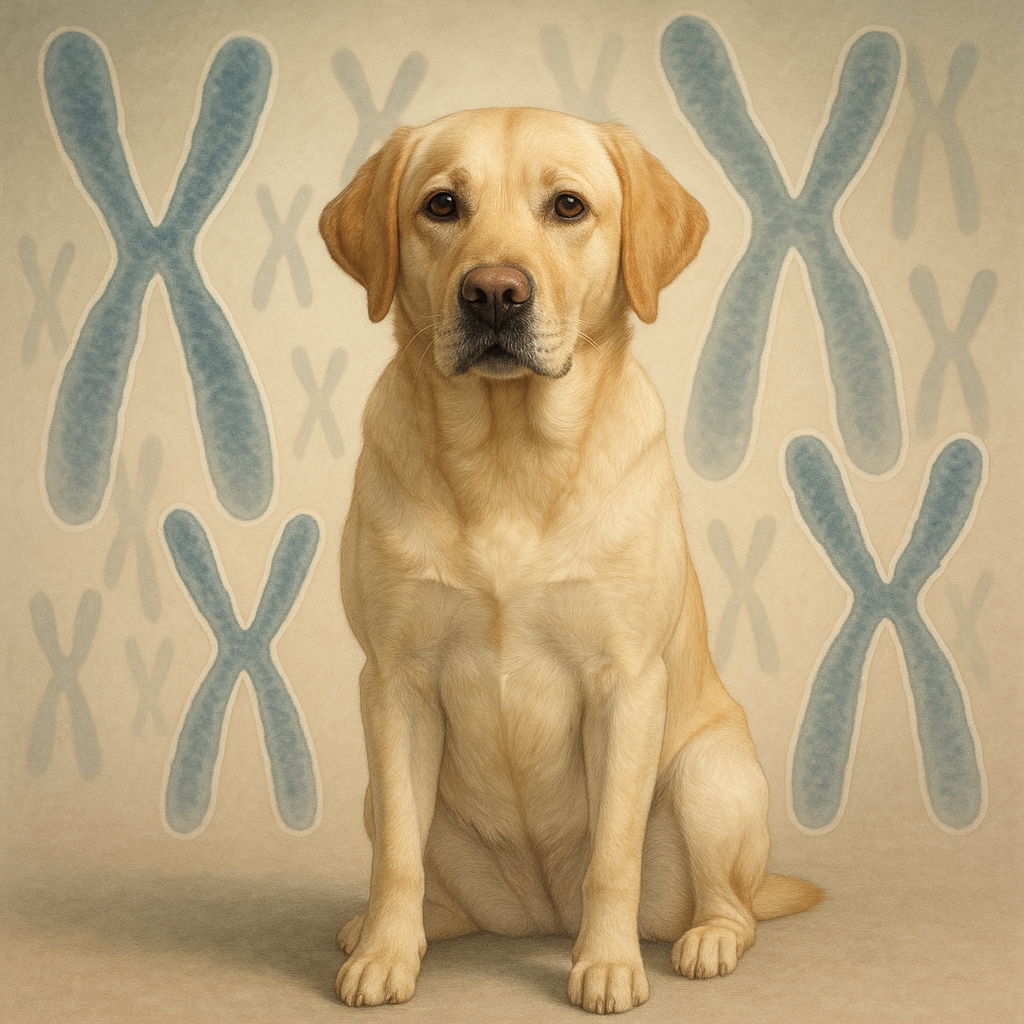
An adult dog normally has 78 chromosomes, arranged in 39 pairs. Down syndrome in humans results from a nondisjunction of pair 21; in the canine species, no study reports the spontaneous appearance of an equivalent triplication. However, in rare cases, anomalies such as translocations or chromosomal mosaics can be observed, but they do not cause a syndrome comparable to human Down syndrome.

Different Types of Chromosomal Abnormalities
In veterinary medicine, we distinguish:
- Translocations: exchange of segments between two chromosomes, often balanced and without visible symptoms.
- Mosaics: some cells carry an extra chromosome, the clinical impact depends on the proportion of affected cells.
- Polyploidies: multiplication of the entire set of chromosomes, generally lethal before birth in mammals.
In all cases, a simple chromosomal assay in the laboratory can clarify the presence or absence of a major abnormality.
How to Distinguish a Sick Dog from a “Trisomic Dog”
Often, a dog considered “abnormal” is actually suffering from an underlying pathology: metabolic, endocrine, neurological, or infectious. Before considering a genetic cause, the overall health status must always be checked.
- Disruption of hormonal balance (e.g., hypothyroidism).
- Chronic infection or inflammation (e.g., otitis: head tilt).
- Nutritional deficiency (e.g., vitamin deficiencies).
- Stress or anxiety (may manifest as “crazy dog” behavior).
The approach remains holistic: clinical examination, blood tests, imaging, and possibly genetic testing. Any serious veterinarian will not be satisfied with a simple visual observation.
The Role of Behavior and Environment
The way a dog is walked or stimulated directly influences its attitude. Too intense activity without recovery time can cause agitation episodes often mistakenly called “madness.” In urban environments, positive reinforcement, socialization, and adherence to the new rules of off-leash walking provide a calming framework and limit the appearance of extreme behaviors.
What to Do About These Rumors? Advice and Resources
“Before making a definitive label, consult a specialized veterinarian and opt for genetic testing if necessary.”
— Dr. Marine Dupont, veterinary geneticist
Rather than sharing a sensational photo or post, it is better to:
- Get information from a professional and demand a complete diagnosis.
- Avoid unmoderated forums and favor recognized veterinary websites.
- Support research by sharing documented and non-anecdotal cases.
Veterinary medicine is progressing rapidly: teams are working to better understand canine chromosomal abnormalities to offer more precise screening tools.
FAQ
Can a dog really have trisomy 21 like a human?
No. Dogs do not have an equivalent of chromosome 21. The few observed chromosomal abnormalities do not cause a syndrome comparable to human Down syndrome.
How should I react if I see a dog in poor condition presented as “trisomic”?
Report the post, contact a veterinarian for a professional opinion, and share reliable information rather than unverified images.
Are there genetic tests to detect abnormalities in dogs?
Yes. Veterinary laboratories offer chromosomal maps and mutation panels, especially for at-risk breeds, to identify translocations and mosaics.