
| Key Points | Details to Remember |
|---|---|
| 🐾 Definition | Celtic origin and historical role |
| 🛡️ Legends | Irish tales and symbolism of courage |
| 📏 Size | Average height of 80–90 cm at the withers |
| ❤️ Temperament | Patience with children and gentle nature |
| ⚕️ Care | Grooming and regular veterinary visits |
| 🏡 Home life | Adaptation to a large space and moderate exercise |
| 💰 Budget | Plan for food and veterinary costs |

Who does not remain admiring the slender and majestic silhouette of the Irish Wolfhound? It looks like a giant with a soft coat, a companion carved for the epic tales of ancient druids. Yet, behind this presence hides a surprisingly harmonious temperament, capable of adapting to a busy family life. This article dives into the heart of Celtic legend to illuminate every aspect of this remarkable breed: its history, physique, character, and the essential care for its well-being.
Origins and Celtic Legends
Breed Genesis
It all begins along the fast rivers and misty moors of Ireland, where the first large dogs already rubbed shoulders with Celtic warriors. These dogs served both in wolf hunting and clan protection. Archaeologists have found stone engravings depicting powerful canines, testifying to an ancient relationship between humans and these extraordinary dogs. Over the centuries, these lineages were crossed to refine size and strengthen musculature, while preserving a loyal and vigilant spirit. In reality, the Irish Wolfhound not only owes its name to its ability to track wolves but also to its crucial role in military strategies.
Legends Imbued with Mythology
In Irish tradition, this dog is associated with heroic figures: it is said that a king crossed the sea with a pack of Irish Wolfhounds to reclaim his kingdom. These stories, told by the fireside, portray the dog as a symbol of protection and unwavering loyalty. Some bards describe its rough coat as a heather cloak, capable of resisting the elements and reflecting the light of a campfire. The idea may seem poetic, but it highlights a physiological reality: the thick hair protects this outdoor athlete, helping it fight against the cold and dampness of the Highlands.
Physical Traits of the Irish Giant
Impressive Appearance and Stature
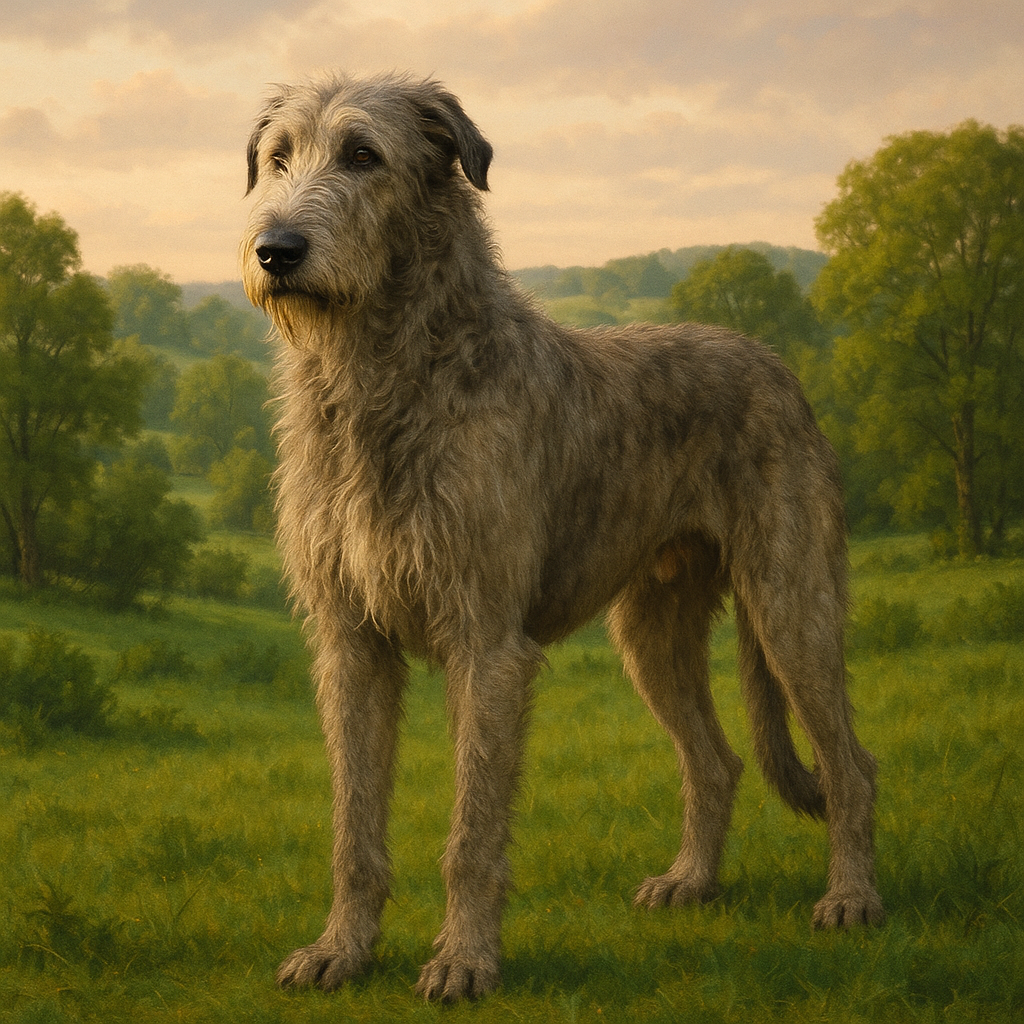
Imagine a dog easily measuring 80 to 90 cm at the withers, often weighing more than 50 kg: one immediately perceives that it is not built for a cramped apartment. Its build evokes a balance between power and lightness; its long, strong legs ensure a supple, almost airy gait when it runs. Muscles are defined beneath the coat, never giving the impression of a heavy mass. This particular silhouette earned it the title of the tallest dog in the world according to several cynological registries. Even more surprising, this size is not accompanied by a clumsy gait: the Irish Wolfhound moves with an almost feline grace.
Coat and Fur Characteristics
The Irish Wolfhound’s coat comes in natural shades: gray, fawn, black, or brindle. Each color carries a story, sometimes associated with a clan or a particular region. Its rough coat, with a dry feel, protects against the wind and limits dirt accumulation. Unlike a smooth coat, it allows rain to run off without weighing down the animal. However, regular maintenance remains essential: weekly brushing helps remove dead hairs and detect any points of friction. Note: this type of coat does not require intensive grooming, which appeals to those who prefer simplicity.
Temperament and Relationship with Humans
Innate Kindness and Patience
Large dogs are often thought to have an intimidating nature. With the Irish Wolfhound, it is quite the opposite: its gentle gaze and calm disposition instantly reassure. Every wag of the tail shows its desire to please. Owners often share anecdotes where the dog gently places its huge head in a child’s lap without any rush. This patience is explained by selective breeding over generations, aiming primarily for a thoughtful companion rather than an impulsive hunter.
Interactions with Family and Other Animals
Despite its imposing size, the Irish Wolfhound fits perfectly into family life. It displays a certain refinement in its movements, avoiding bumping into smaller ones. With other dogs, it often adopts a relaxed posture and invites camaraderie rather than dominance. Cats or other animals can live under the same roof without conflict, provided the introduction is gradual. However, an adjustment period is necessary: even the gentlest giant needs to understand its new place in the domestic hierarchy.
Training and Specific Needs
Exercise and Mental Stimulation
The goal is not to turn the Irish Wolfhound into a high-level athlete, but to meet its fundamental need for movement. Two daily walks, including a space where it can trot freely, help maintain its muscle development and healthy joints. At the same time, search games or interactive toys stimulate its intelligence: it indeed has a problem-solving ability often underestimated due to its calm nature.
Health Care and Nutrition
The rapid growth of this breed requires special attention to avoid bone disorders. Controlled calcium and protein intake during the juvenile phase is recommended by specialized veterinarians. The daily diet generally consists of kibble adapted for large breeds, but some breeders recommend a mixed diet allowing better calorie control. Veterinary follow-up includes X-rays to detect early hip and elbow dysplasia, common pathologies in molossoid breeds.
Integrating an Irish Wolfhound into Your Home
Planning the Necessary Space
A fenced garden is essential for the dog to stretch its legs safely. Some adopters set up an exercise area with grassy ground, thus avoiding hard surfaces that might overly strain the joints. Indoors, oversized cushions or orthopedic beds provide optimal comfort for its large size. Slippery floors require extra vigilance: a few strategically placed rugs prevent slipping.
Costs and Long-Term Commitment
Owning an Irish Wolfhound represents a definite investment: food, accessories, veterinary care, and health insurance constitute a significant monthly budget. Adoption fees, from a recognized breeder, generally include health tests and initial follow-up. However, this commitment translates into a decade, or more, of companionship and unique moments. This approach should be considered a long-term partnership.
FAQ
What is the life expectancy of an Irish Wolfhound?
On average, it ranges between 6 and 8 years, sometimes a little longer when care and nutrition are optimized.
Can this dog live in an apartment?
Technically possible if it benefits from several extended outings and a spacious indoor area, but living in a house with a garden is preferable.
How to manage its size during outings?
An adapted harness distributes pressure better than a collar, making walks easier and offering better control without risk to the neck.
Is it receptive to training?
Yes, but it responds better to positive and patient methods. Punishments prove ineffective against its thoughtful nature.
Is another dog necessary so it doesn’t get bored?
Not necessarily. The important thing is to give it enough attention and suitable activities.