| Key points | Details to remember |
|---|---|
| 🐶 Definition | English retriever breed, known for its black or liver coat and playful temperament. |
| ⚡ Energy | High need for physical and mental exercise from adulthood. |
| 🎓 Training | Positive reinforcement recommended; avoid aggressive methods that spoil its enthusiasm. |
| 🩺 Health | Increased monitoring for certain cancers, dysplasias, and eye problems. |
| 🏡 Daily life | Suitable for active families; requires a garden or regular outings. |
| 🎯 Activities | Ideal for agility, obedience, retrieving work, and canine therapy. |

The Flat-Coated Retriever has this remarkable ability to remain playful despite the years: it approaches life as if every outing were a first discovery. Some call it the “eternal puppy” not to deny its physical maturity, but because its gaze, way of playing, and reactivity retain a freshness that disarms. If you are considering adopting one or already live with this dog, it is better to understand where this persistent cheerfulness comes from, how to channel it without breaking it, and what concrete responsibilities — health, training, and logistical — this implies daily.
Temperament portrait: why it always seems young
The Flat-Coated Retriever combines several traits that explain its reputation: lively curiosity, love of play, marked sociability, and a certain carefreeness regarding signs of emotional fatigue. One might think this energy is only physical; in reality, it is cognitive. This dog loves to explore, solve new situations, and interact with humans. Its juvenile behavior is also explained by genetic selection oriented towards affection and cooperation, qualities sought in retrieving dogs.
Temperament and socialization
In a well-socialized Flat-Coated, exuberance turns into controlled enthusiasm: it greets people exuberantly, willingly plays with other dogs, and adapts to varied contexts. However, insufficient socialization can turn this liveliness into stress when facing the unknown. The challenge is to teach the dog clear rules while preserving its playful nature — something rarely achieved with strict methods. Positive reinforcement, diversity of encounters, and structured games are essential.
Intelligence and curiosity
The Flat-Coated is intelligent without being hyper-calculating: it quickly understands routines and enjoys exercises that require scenting or memory. Mental stimulations — puzzle toys, object searches, learning new tricks — contain a puzzle element that this dog savors. In the absence of occupation, its mind seeks its own entertainment and may invent mischief: chewing, digging, or repeated barking.
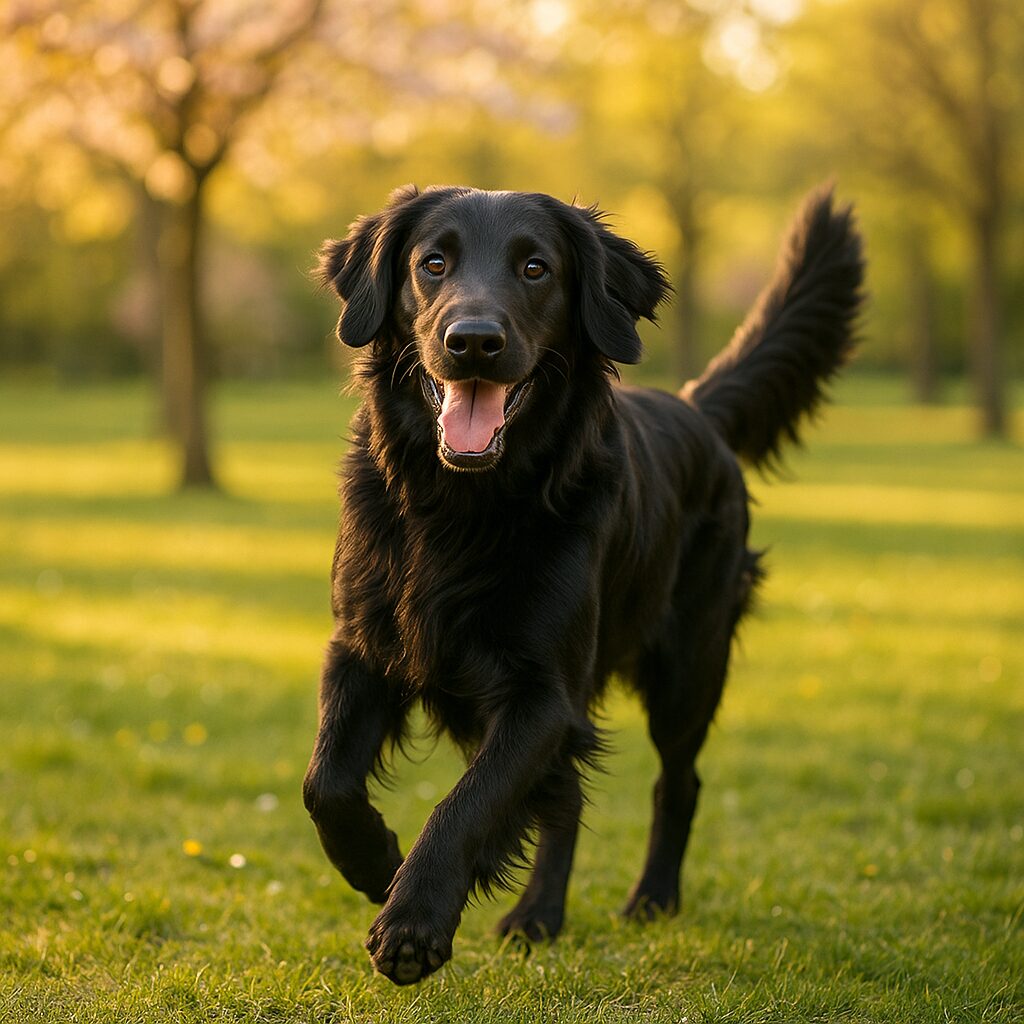
Prompt image 1 (for internal use): realistic photograph of a black Flat-Coated Retriever frolicking in a park in spring, warm light, dynamic posture, joyful facial expression, slightly blurred background, centered composition, natural photographic style. Slug: flatcoated_play_park. Alt: Flat-Coated Retriever running in a park, playing with a stick.
Education and practical methods to channel enthusiasm
Setting clear boundaries does not hinder the cheerfulness of a Flat-Coated; on the contrary, it reassures them. The goal of education is to teach what you expect, when you expect it, and why. With a consistent foundation, the dog can afford to be spontaneous without exceeding human limits. Avoid inconsistency: a vague message generates anxiety and increases exuberance.
Principles of education
- Favor positive reinforcement: rewards, games, and warm voice to strengthen good behaviors.
- Break down learning: short and frequent sessions rather than long and exhausting ones.
- Introduce progressive rules: first recall, then recalls in distracting environments.
- Establish soothing rituals: resting areas, familiar objects, calm exercises after play.
Sometimes there is hesitation between punishing a clumsiness and teaching the desired alternative; the second approach is more effective in the long term. For example, replacing an excited growl with a structured fetch game allows energy to be released without conflict.
Recommended exercises and frequency
| Activity | Duration / frequency | Desired effect |
|---|---|---|
| Dynamic walks | 45–90 min per day | physical exhaustion, olfactory stimulation |
| Fetch games | 10–20 min, 1 to 2 times / day | impulse control, strengthening the bond |
| Mental exercises (puzzles) | 15–30 min / day | cognitive stimulation, reduction of boredom |
| Swimming | seasonal, 1–3 times / week | gentle muscle work, natural pleasure |
Health: special monitoring and prevention
The Flat-Coated Retriever has predispositions that should be known without giving in to alarmism. The most notable medical point remains the relative frequency of certain cancers (notably histiocytic tumors and hemangiosarcomas) compared to other breeds. Added to this are orthopedic risks such as hip dysplasia and hereditary eye conditions.
Recommended examinations
- Annual veterinary check-ups including palpation, blood tests if necessary.
- X-rays to detect dysplasia in young breeding dogs and before breeding.
- Ophthalmological assessment (specialized exam) to detect PRA or other hereditary anomalies.
- Careful monitoring of any skin mass or unusual fatigue: early tumor detection improves therapeutic options.
Nutrition plays a significant role: a quality diet, adapted to age and activity level, limits overweight, an aggravating factor for many pathologies. Providing sufficient rest periods after exercise, and avoiding high-intensity activities before the end of bone growth in puppies, contributes to orthopedic prevention.
Daily life: organization for harmonious coexistence
Living with a Flat-Coated requires an organization that respects its need for activity and contact. This dog likes to belong to a “group”: it seeks human proximity and hates prolonged isolation. It is therefore preferable to avoid long and repeated absences without external stimulation (walker, dog daycare, or canine activities).
Compatibility with families and housing
This retriever enjoys family life, with children capable of respecting canine play rules. Its robustness and patience make it a reliable play partner, but the dog’s size and energy require managing interactions to prevent falls or bumps. In an apartment, the key is to ensure regular and varied outings; city life is possible if exercise and stimulation needs are met.
Coexistence with other animals
Rather sociable, the Flat-Coated often tolerates its peers well if socialized early. With small animals, curiosity can turn into a hunting instinct if training has not included control commands. Learning recall and inhibition commands (leash, “no,” “leave it”) prevents most incidents.
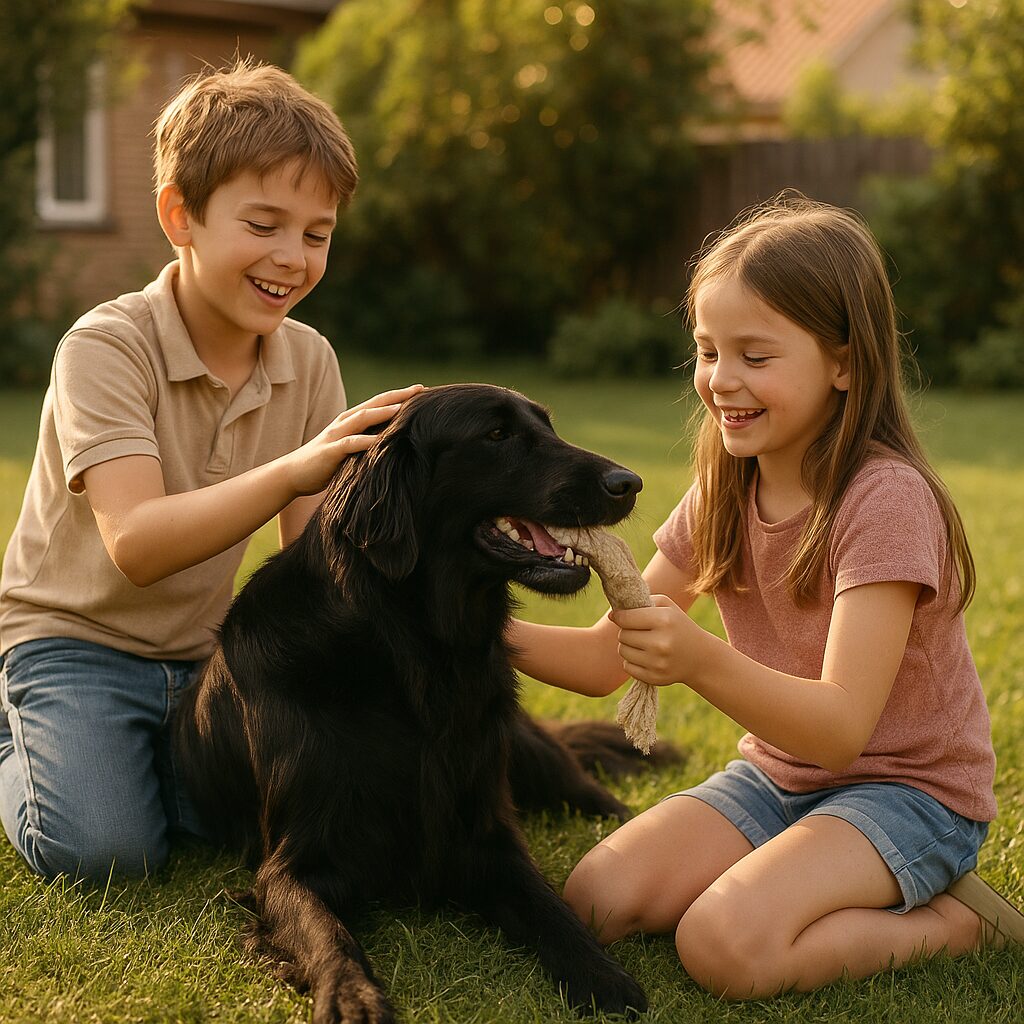
Prompt image 2 (for internal use): realistic family scene showing a black Flat-Coated Retriever playing with children in a garden, soft afternoon light, expressions of complicity, warm composition, domestic and natural atmosphere. Slug: flatcoated_family_home. Alt: Family playing with a Flat-Coated Retriever in the garden, moment of complicity.
Adapted canine activities and sports
The Flat-Coated excels in activities combining retrieving, endurance, and obedience. Agility develops listening and coordination; retrieving exercises satisfy its instinctive need to bring back objects; swimming often represents a natural pleasure and a low-impact exercise.
- Agility: perfect for channeling speed and precision.
- Obedience and tricks: strengthening the bond and gentle authority.
- Object search (nosework): stimulates the sense of smell and problem-solving spirit.
- Canicross and hikes: for sporty owners wishing to share the effort.
- Visits in therapeutic settings: the Flat-Coated’s sociability makes it a good candidate for emotional assistance work.
Adopting a Flat-Coated: practical advice
Before adoption, assess your ability to provide exercise, time, and stimulation. Meet serious breeders who conduct health screenings, or turn to specialized associations if you prefer an adult dog. Inquire about the parents’ temperament, any medical history, and socialization methods used during breeding — these elements strongly influence future temperament.
Budget and commitment
Expect expenses spread across quality food, veterinary care, possibly training sessions, and equipment (leashes, toys, activity gear). Beyond the budget, time commitment is the most demanding resource: a neglected Flat-Coated can develop behavioral problems related to boredom.
FAQ
Does the Flat-Coated remain playful throughout its life?
Yes, the majority retain a playful temperament into old age, although the intensity decreases with age. Their play evolves: less wildness, more structured activities.
Is it a good dog for children?
Often yes: patient and playful, it is suitable for families. Vigilance remains necessary to teach children respect and avoid dangerous games.
Can you keep a Flat-Coated in an apartment?
It is possible if you ensure enough daily exercise and mental stimulation. Without this, the apartment becomes a source of frustration for the dog.
What is its life expectancy?
Around 8 to 10 years on average, varying according to genetics and care; early monitoring of symptoms often allows improving the quality and length of life.
What is the best age to start training?
Very early: the first playful sessions as soon as the puppy arrives (8–10 weeks) lay the foundations for good coexistence.